
The commercial real estate market in the Lower Mainland experienced a significant slowdown in the second quarter (Q2) of 2023. A comprehensive report from the Real Estate Board of Greater Vancouver (REBGV) revealed substantial year-over-year declines in both the volume of sales and their total dollar value, signaling a challenging period for investors and developers alike in this historically vibrant region.
Lower Mainland Commercial Real Estate Sees Sharp Decline in Q2 2023 Amidst Economic Headwinds
The latest market data paints a stark picture for the Lower Mainland’s commercial real estate sector. Q2 2023 concluded with transaction numbers plummeting by more than 50% compared to the previous year, with total dollar values experiencing a similar dramatic fall. This downturn is largely attributed to persistent high borrowing costs and broader economic uncertainties, which have significantly tempered buyer enthusiasm and investment activity.
Sales Plunge by Over 50% as Market Cools
The second quarter of 2023 recorded a mere 280 commercial real estate sales across the Lower Mainland. This figure represents a staggering 56.5% decrease from the 644 sales completed in the identical period of 2022. Such a precipitous drop underscores a pronounced shift in market dynamics, moving away from the robust activity observed in preceding years.
Accompanying the sharp decline in transaction volume was an equally significant reduction in the total dollar value of these sales. The aggregate value of commercial real estate transactions in Q2 2023 was $1.763 billion, a substantial 54% decrease from the $3.831 billion recorded in Q2 2022. This considerable contraction in dollar volume unequivocally highlights the subdued conditions prevailing across all segments of the commercial market. The data suggests that not only are fewer properties changing hands, but the average transaction size or value of properties being sold has also adjusted downwards, reflecting a more cautious and price-sensitive environment.
High Borrowing Costs Continue to Impact Transactions and Investor Sentiment
Andrew Lis, REBGV’s director of economics and data analytics, provided crucial insight into the primary catalyst for this market retraction. He explicitly stated that elevated borrowing costs have emerged as a dominant factor stifling commercial real estate transactions throughout the Lower Mainland. The consistent upward trajectory of interest rates by central banks, aimed at curbing inflation, has made financing acquisitions considerably more expensive for investors and developers.
Lis further elaborated on the prospective trajectory of the market, noting, “With the landscape for monetary policy looking set where it is for at least the near-term, it’s likely we’ll see the commercial real estate market continue along this trajectory for the rest of 2023.” This outlook suggests that unless there’s a significant shift in monetary policy or a notable improvement in economic indicators, the commercial property market is unlikely to experience a rapid rebound in the immediate future. High interest rates translate directly into higher debt service costs, which in turn compresses capitalization rates and reduces the profitability of real estate investments, thereby deterring potential buyers.
Moreover, the uncertainty surrounding future interest rate movements and overall economic stability contributes to a wait-and-see approach among many investors. They are often deferring large capital expenditures, including property acquisitions, until there is greater clarity on market direction and borrowing costs stabilize or begin to decline. This cautious stance invariably impacts transaction volumes and overall market fluidity.
Detailed Q2 2023 Activity Breakdown by Commercial Real Estate Category
The downturn was not isolated to a single segment but was broadly distributed across all major commercial real estate categories, each facing unique pressures alongside the overarching challenge of borrowing costs. Understanding these sector-specific trends provides a more granular view of the market’s current health.
Land Sales Witness Steepest Decline
The land category experienced the most pronounced retraction in Q2 2023, with only 83 commercial land sales recorded. This marks a sharp 62.6% decrease from the 222 land sales in the corresponding period of 2022. The dollar value of land sales also plunged significantly, falling by 57.6% to $789 million in Q2 2023, down from $1.863 billion in Q2 2022. This substantial decline in land transactions often indicates a slowdown in future development projects, as developers become more hesitant to commit to new ventures in a high-cost, uncertain market. The high cost of financing coupled with rising construction costs and potential cooling in demand for new residential or commercial spaces makes land acquisition a riskier proposition.
Office and Retail Sectors Experience Significant Contraction
Q2 2023 saw 112 office and retail property sales, a 51.3% decrease from the 230 sales in Q2 2022. The dollar value of these sales suffered an even more severe blow, declining by a substantial 63.4% from $767 million in Q2 2022 to $281 million in Q2 2023. The office sector continues to grapple with the lingering effects of hybrid work models, leading to questions about long-term space requirements. Meanwhile, the retail sector faces challenges from inflationary pressures affecting consumer spending and the ongoing shift towards e-commerce. Both factors contribute to cautious investment and lower valuations for these asset classes.
Industrial Sector Shows Resilience Amidst Decline
The industrial sector recorded 66 property sales in Q2 2023, representing a 59% decrease from the 161 sales reported in the same period last year. While the sales volume mirrored the general market trend, the dollar value of industrial sales decreased by a comparatively less severe 32.4%, falling from $633 million in Q2 2022 to $428 million in Q2 2023. This relatively smaller percentage drop in dollar value suggests that while fewer industrial properties are trading, those that do are perhaps maintaining stronger price points or attracting more robust investment interest per transaction compared to other categories. The industrial market, driven by logistics, e-commerce fulfillment, and advanced manufacturing, generally exhibits strong fundamentals, but even it is not immune to the broader economic slowdown and increased borrowing costs.
Multi-Family Land Sales Also Decline
Multi-family land sales also experienced a notable decline, with only 19 sales in Q2 2023, down 38.7% from the 31 sales recorded in Q2 2022. The dollar value of multi-family sales dropped by 53.2%, decreasing from $568 million in Q2 2022 to $266 million in Q2 2023. This segment, crucial for addressing housing supply issues in the Lower Mainland, is significantly affected by high construction costs, complex regulatory environments, and the challenge of financing large-scale residential projects at current interest rates. The reluctance to initiate new multi-family developments due to these factors contributes directly to the reduced land sales in this category.
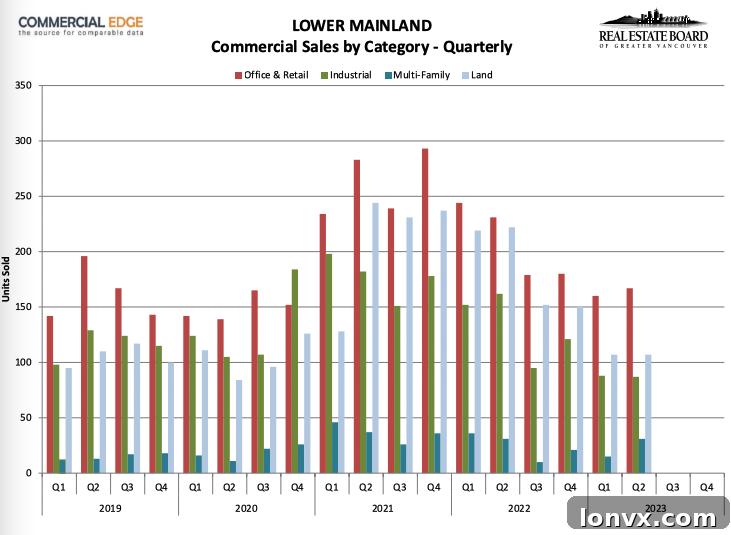
Source: REBGV
Broader Market Context and Contributing Factors to the Downturn
Beyond the direct impact of borrowing costs, several interconnected economic factors are contributing to the current slowdown in the Lower Mainland’s commercial real estate market. Global inflation, although showing signs of moderation, has led central banks to adopt aggressive tightening policies. These policies, while necessary to stabilize prices, have a ripple effect across all investment classes, making risk-free assets more attractive and reducing the appetite for higher-risk ventures like commercial property development and acquisition.
Economic uncertainty, including fears of a potential recession in major economies, further dampens investor confidence. Businesses and individuals become more conservative in their spending and investment decisions, leading to a deceleration in expansion plans that would typically drive commercial real estate demand. Geopolitical tensions and supply chain vulnerabilities also add layers of complexity, making long-term forecasting challenging for investors and developers.
Moreover, local market specifics such as high property taxes, development charges, and regulatory hurdles in the Lower Mainland can exacerbate the effects of a national or global economic slowdown. These factors, combined with increased financing costs, create a formidable barrier to entry and expansion for many commercial real estate players.
Expert Perspectives and the Outlook for the Remainder of 2023
Andrew Lis’s comments highlight the expectation of continued subdued activity for the rest of 2023. This perspective is widely shared among market analysts who monitor the trajectory of interest rates and broader economic health. A significant turnaround in the commercial real estate market typically requires a sustained period of stable or declining interest rates, coupled with robust economic growth and improved investor sentiment. Given the current economic outlook, such conditions are not anticipated to materialize in the short term.
However, it is crucial to note that downturns often present unique opportunities for well-capitalized investors willing to take a long-term view. As prices adjust and competition lessens, strategic acquisitions can be made at more favorable valuations. The question remains when this “bottom” will be reached, and what specific triggers might signal the start of a recovery phase. Potential factors that could influence a shift include a clear indication from central banks that interest rate hikes are definitively over, a significant drop in inflation, or government interventions aimed at stimulating economic activity and housing supply.
Implications for Investors, Businesses, and the Regional Economy
The slowdown in commercial real estate has multifaceted implications. For investors, it means recalibrating expectations, focusing on cash flow and stability, and potentially exploring alternative financing structures. Developers may face increased pressure to halt or delay projects, impacting employment in the construction sector and related industries. Existing property owners might see a softening in valuations and longer vacancy periods, particularly in the office and retail segments.
For businesses looking to lease or expand, the current market might offer more negotiating leverage and potentially more competitive rates in certain sub-sectors. However, the broader economic uncertainty could also lead to a cautious approach to expansion, even with potentially more favorable real estate terms.
The Lower Mainland’s economy, being heavily influenced by real estate and construction, will undoubtedly feel the effects of this downturn. Reduced transaction volumes translate to lower municipal tax revenues from property transfers, and a slowdown in development can impact job creation and overall economic growth. Monitoring these trends closely will be essential for policymakers and stakeholders to navigate the challenges and prepare for future recovery.
Conclusion: Navigating a Challenging Commercial Real Estate Landscape
The second quarter of 2023 marked a significant inflection point for the Lower Mainland commercial real estate market, characterized by sharp declines in both sales activity and dollar volume across all major property categories. High borrowing costs, fueled by aggressive monetary policy, have emerged as the primary dampening force, profoundly influencing investor decisions and market liquidity. As economic headwinds persist, and with interest rates expected to remain elevated in the near term, the market is poised for continued caution throughout the remainder of the year.
While the current landscape presents considerable challenges for buyers, sellers, and developers, it also underscores the cyclical nature of real estate. Adapting to these new market realities, focusing on core fundamentals, and identifying long-term strategic opportunities will be crucial for navigating this period of adjustment. The Lower Mainland’s underlying economic strengths and population growth may eventually underpin a recovery, but the immediate future demands a prudent and patient approach from all participants.
Get the latest news directly in your inbox
Join industry leaders getting the latest news right in your inbox 3x per week!