Metro Vancouver Real Estate: A Pivotal Year Concludes, Setting the Stage for 2025 Growth
The Metro Vancouver housing market wrapped up a transformative year, with December 2024 home sales witnessing a significant surge of over 30 percent compared to the previous year, as reported by Greater Vancouver Realtors (GVR). This impressive end-of-year performance signals a notable shift in market dynamics, reflecting renewed buyer confidence and a response to evolving economic conditions.
Andrew Lis, GVR’s director of economics and data analytics, described 2024 as “a pivot year for the market.” Following several years characterized by dramatic increases in mortgage rates, the real estate landscape has begun to stabilize and, in many segments, rebound. Lis emphasized, “With borrowing costs now firmly on the decline, buyers have started to show up in numbers after somewhat of a hiatus—and this renewed strength is now clearly visible in the more recent monthly data.” This sentiment underscores a broader trend of cautious optimism returning to the housing sector, as prospective homeowners adapt to and benefit from a more favorable lending environment.
2024 Market Overview: Sales, Inventory, and Price Dynamics
The year 2024 saw a total of 26,561 residential sales across the Metro Vancouver region. While this figure represented a modest 1.2 percent increase over the 26,249 sales recorded in 2023, it remained 9.2 percent below the 29,261 sales in 2022 and a more substantial 20.9 percent below the long-term 10-year annual sales average. This indicates that despite the late-year surge, the market, overall, navigated a challenging period marked by higher interest rates and economic uncertainties earlier in the year.
Inventory Levels Reflect Evolving Market Conditions
On the supply side, Metro Vancouver recorded 60,388 properties listed on the Multiple Listing Service (MLS) in 2024. This figure was 5.7 percent above the region’s 10-year annual average, highlighting a more robust supply of homes available for buyers. Compared to recent years, new listings in 2024 were 18.7 percent higher than the 50,894 properties listed in 2023 and 9.7 percent above the 55,047 properties listed in 2022. This increased inventory provides more choices for potential buyers, contributing to a more balanced market, albeit one that still leans towards sellers in desirable segments.
As of the close of 2024, there were 10,948 properties actively listed for sale in Metro Vancouver. This represented a significant 24.4 percent increase compared to December 2023 and was 25.3 percent above the 10-year seasonal average for active listings. Such healthy inventory levels are crucial for sustaining market activity and preventing rapid, unsustainable price escalations.
Understanding Price Movements Across the Region
The MLS Home Price Index (HPI) composite benchmark price for all residential properties in Metro Vancouver stood at $1,171,500 at the end of December 2024. This figure marked a modest 0.5 percent increase compared to December 2023, indicating a period of relative price stability over the past year. However, it also represented a slight dip of 0.1 percent compared to November 2024, suggesting minor month-over-month fluctuations that are typical in a market finding its footing. The overall trend, however, points to a stabilization of prices after a period of volatility, providing a more predictable environment for both buyers and sellers.
Total Sales Shy of Target, But 2025 Poised for Growth
Despite the strong finish, Andrew Lis acknowledged that 2024 sales fell “disappointingly short” of GVR’s forecasted target for the year. However, he quickly highlighted that “the December figures signal an emerging pattern of strength in home sales, building on the momentum seen in previous months.” This indicates that while the annual total may not have met initial expectations, the underlying trends are positive and point towards a healthier market moving forward.
The recent sales figures are now “trending back towards long-term historical averages,” according to Lis. This normalization suggests that the market is regaining its equilibrium after the disruptions caused by high interest rates. “There may still be quite a bit of potential upside for sales as we head into 2025, should the recent strength continue,” he predicted. This optimistic outlook is predicated on the expectation of stable or declining borrowing costs, which are powerful drivers of buyer activity.
Lis further elaborated on the year’s trajectory, noting that while sales activity experienced a slower start, price trends began the year on an upward climb before settling into a flatter trajectory towards the close of 2024. While most market segments recorded year-over-year price increases of a few percentage points, the crucial takeaway is that the Metro Vancouver real estate market appears “considerably more active than we’ve seen in recent years” as it transitions into 2025. This anticipation is fueled by pent-up demand, more stable economic indicators, and a hopeful forecast for interest rate adjustments.
Decoding December’s Performance: A Snapshot of Recovery
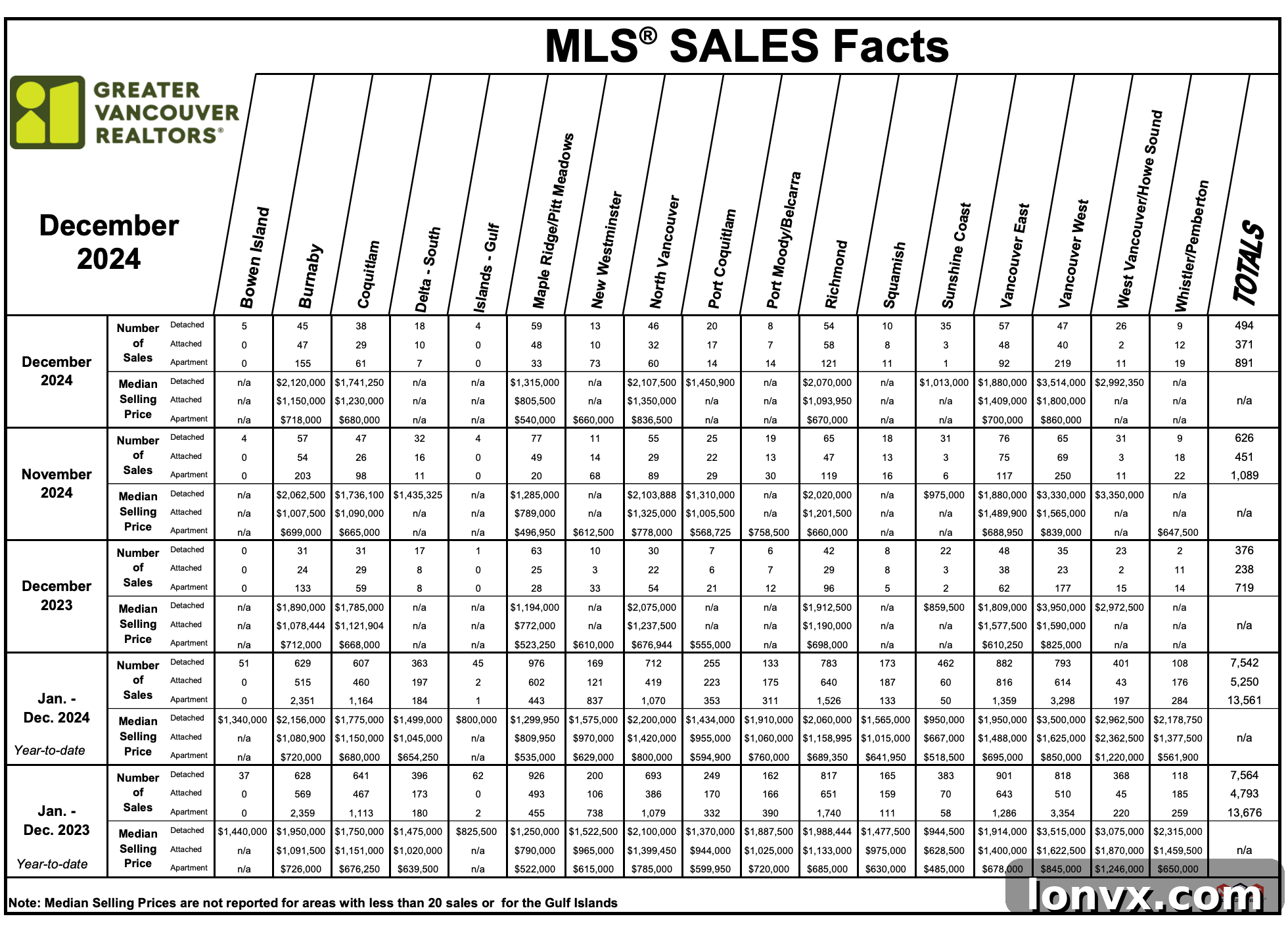
December 2024 proved to be a pivotal month, clearly demonstrating the market’s newfound momentum. The region’s residential sales totaled 1,765, marking a substantial 31.2 percent increase over December 2023. While this monthly total remained 14.9 percent below the 10-year seasonal average for December, the significant year-over-year growth underscores a strong recovery impulse, particularly when considering the challenging conditions of the preceding year.
New Listings and Sales-to-Active Listings Ratio
New listings also saw an increase, with 1,676 detached, attached, and apartment properties newly listed for sale in Metro Vancouver during December. This represented a 26.3 percent rise compared to December 2023, indicating a responsive supply side preparing for increased buyer interest. Interestingly, this figure was just 1.1 percent below the 10-year seasonal average, suggesting a return to more typical listing activity for the month.
A key indicator of market balance is the sales-to-active listings ratio. For December 2024, this ratio for all property types stood at 16.8 percent. This figure provides insight into the pressure on prices and the speed at which homes are selling. Generally, ratios between 12 percent and 20 percent indicate a balanced market, with sustained periods above 20 percent signaling a seller’s market and sustained periods below 12 percent indicating a buyer’s market. Breaking it down by property type:
- Detached homes: 12.1 percent. This suggests a more balanced market for detached properties, nearing buyer-friendly conditions, allowing more negotiation room.
- Attached homes: 23.6 percent. This ratio clearly indicates a seller’s market for attached properties (townhouses), suggesting strong demand and potentially competitive bidding.
- Apartment homes: 18.7 percent. The apartment segment falls comfortably within the balanced market range, leaning slightly towards sellers, reflecting consistent demand.
These varying ratios highlight the diverse performance across different housing segments within Metro Vancouver, with attached homes showing the strongest demand relative to supply.
Detailed Analysis by Property Type: December 2024
The December data provides a granular view of how different housing types performed, revealing distinct trends that shape the broader market narrative.
Detached Home Performance
Sales of detached homes in December 2024 reached 494 units, a robust 31.4 percent increase compared to December 2023. This significant rise indicates renewed confidence in the higher-end segment of the market. The benchmark price for a detached home settled at $1,997,000, representing a 2.0 percent increase from December 2023. Intriguingly, this price remained nearly unchanged from November 2024, signaling price stability after a period of adjustment. The detached segment, often seen as a bellwether for the overall market’s health, appears to be on a steady recovery path.
Apartment Home Dynamics
The apartment market also experienced a notable surge in sales, with 891 units sold in December 2024, marking a 23.9 percent increase over December 2023. This highlights continued demand for more affordable housing options. However, the benchmark price for an apartment home saw a slight decrease to $749,900. This represented a 0.1 percent decrease from December 2023 and a 0.4 percent decline from November 2024. This subtle price softening, despite increased sales, could be attributed to a higher supply of listings in this segment, or perhaps affordability ceilings for buyers, which are impacting upward price momentum.
Attached Home (Townhouse) Segment Leads the Way
The attached home segment, primarily townhouses, showcased the most dramatic growth. Sales in December 2024 totaled 371 units, a remarkable 55.9 percent increase compared to December 2023. This explosive growth underscores the strong appeal of townhouses, which often offer a desirable balance between space, amenities, and relative affordability compared to detached homes. Correspondingly, the benchmark price for a townhouse reached $1,114,600, reflecting a healthy 3.4 percent increase from December 2023. Similar to apartments, there was a slight dip of 0.3 percent from November 2024, indicating minor month-to-month adjustments, but the overall year-over-year trend is distinctly positive for this housing type.
Looking Ahead: Metro Vancouver’s Real Estate Outlook for 2025
The conclusion of 2024 has undeniably set a positive tone for the Metro Vancouver real estate market as it heads into the new year. The emerging pattern of strength, particularly evident in the significant year-over-year sales increases in December, suggests that the market has successfully navigated its “pivot year.” With borrowing costs stabilizing and potentially declining further, buyer confidence is expected to continue its upward trajectory.
The healthy inventory levels provide prospective buyers with more choices, which can lead to sustained activity without the intense pressure of highly competitive bidding wars seen in previous boom cycles. While overall sales in 2024 may have fallen short of initial forecasts, the underlying fundamentals of strong demand, population growth in the region, and the promise of more favorable lending conditions position Metro Vancouver for a considerably more active and potentially upward-trending real estate market in 2025. Stakeholders—from first-time homebuyers to seasoned investors—will be closely watching interest rate decisions and broader economic indicators as they shape the evolving landscape of this dynamic housing market.
For a comprehensive understanding of the market data, you can review the full report here.
Enjoying this article?
Get the latest real estate articles in your inbox 3x week so you stay up to date on the latest in the Canadian real estate industry