
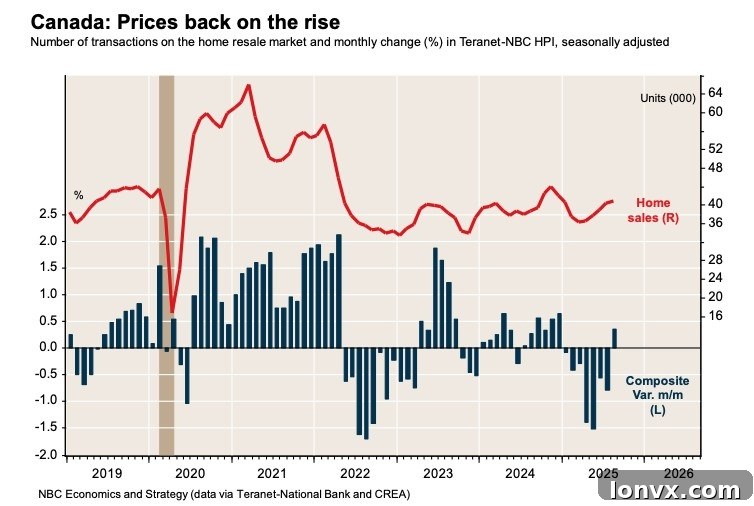
The Canadian housing market, a cornerstone of the nation’s economy, witnessed a pivotal shift in August 2025. After a prolonged period of deceleration, home prices across Canada finally registered an upward movement, marking the first gain of the year. The Teranet-National Bank Composite House Price Index reported a modest yet significant 0.4 percent increase from July, a beacon of cautious optimism for many. This incremental rise coincided with a broader trend of increased activity in the resale market, which saw transactions climb for the fifth consecutive month. This consistent uptick in sales volume, as noted by senior economist Daren King, signaled a potential stabilization in a market that had been grappling with various headwinds. The small but welcome gain suggests that underlying demand might be re-emerging, even as economic uncertainties persist, prompting a closer look at regional nuances and the broader economic landscape influencing real estate decisions across the country.
Regional Dynamics: Ontario’s Tightening Market Amidst Broader Declines
Digging deeper into the August figures reveals a varied picture across Canada’s key urban centers. Ontario, a traditionally dynamic and often overheated market, experienced a notable tightening of its previously “very soft” conditions. This recent surge in activity allowed home prices to tick upwards in several major metropolitan areas within the province. Toronto, the country’s largest housing market, along with Hamilton and Ottawa-Gatineau, all recorded price increases during the month. This resurgence in Ontario can be attributed to a combination of pent-up demand, possibly a slight easing of borrowing costs, and a renewed sense of buyer confidence in specific segments. For buyers in these areas, the increased activity might signal a shift towards a more competitive environment, while sellers may find a more receptive market for their properties after a challenging period. The tightening conditions suggest that the balance between supply and demand is shifting, with demand beginning to outpace available inventory in these specific regions.
Despite the positive momentum observed in August, it is crucial to place these gains in their broader historical context. The Teranet-National Bank composite index, even with its recent boost, remains a considerable 4.6 percent below its December 2024 level. This stark contrast underscores the significant adjustments the market has undergone over the past year. The declines from the peak levels of late 2024 were particularly pronounced in Ontario’s major cities, which are now showing signs of recovery. Toronto, for instance, saw a substantial drop of 7.9 percent from its December 2024 benchmark, followed closely by Hamilton with a 7.4 percent decline. Even Ottawa-Gatineau, while experiencing a more moderate decrease, was still down 1.5 percent over the same period. These figures highlight the steep correction that many markets experienced as interest rates rose and economic uncertainties mounted, making the recent August increase a delicate indicator of potential recovery rather than a full return to previous highs.
The challenges were not confined to Ontario alone. British Columbia, another traditionally robust housing market, also witnessed significant easing of its market conditions. Vancouver, a global real estate hotspot, posted a notable decline of 7.1 percent from its December 2024 levels. Victoria, the provincial capital, experienced a more modest but still negative adjustment of 0.4 percent during the same period. These declines in Western Canada reflect a broader sensitivity to higher borrowing costs and affordability constraints, even in regions typically characterized by strong demand. The varying degrees of decline across different regions underscore the complex interplay of local economic factors, population dynamics, and specific market sensitivities that shape Canada’s diverse housing landscape. Understanding these regional disparities is key to forming a comprehensive outlook on the national housing market.
Affordability and Economic Uncertainty: Key Market Drivers
Senior economist Daren King eloquently articulated the underlying dynamics driving market resilience, stating, “Against the backdrop of the current trade dispute, market resilience has depended on differing levels of affordability. Indeed, the markets with the highest affordability challenges saw the sharpest declines, as the financial risk of such a large real estate transaction was amplified by economic uncertainty.” This statement cuts to the core of the issues plaguing the Canadian housing market. Affordability has long been a critical concern, particularly in high-demand urban centers where rising prices have pushed homeownership out of reach for many. When combined with economic uncertainty, such as the implications of a trade dispute or broader inflationary pressures, the decision to undertake a significant financial commitment like buying a home becomes even more daunting.
The amplified financial risk stems from several factors. Firstly, higher interest rates directly impact mortgage payments, reducing purchasing power and increasing the cost of borrowing. Secondly, job market uncertainties or concerns about future economic growth can make potential homeowners hesitant to take on long-term debt. Markets that were already stretched thin in terms of price-to-income ratios were particularly vulnerable to these pressures, leading to more substantial price corrections. This phenomenon highlights a fundamental principle of real estate economics: when the perceived risk associated with an asset increases, demand tends to cool, and prices adjust accordingly. Understanding how affordability constraints interact with broader economic sentiment is crucial for predicting future housing market movements and developing effective policy responses to support sustainable growth and accessibility.
What’s Next for the Canadian Housing Market?
While the August uptick offers a glimmer of hope, the question of whether this positive trend will endure in the coming months remains a subject of intense debate among economists and market watchers. Daren King cautions that it is “still too early to say,” even with recent pivotal developments such as the Bank of Canada’s decision to lower its key interest rate. On Wednesday, the central bank reduced its benchmark rate by 25 basis points, bringing it down to 2.5 percent. This marks the first rate cut since March, signaling a shift in monetary policy aimed at stimulating the economy and potentially easing borrowing costs for consumers and businesses. Such a move typically has a positive, albeit lagged, impact on the housing market by making mortgages more affordable and encouraging investment. However, the true extent of its influence on buyer confidence and market activity will only become clear over time.
The Bank of Canada’s decision to cut rates comes after a period of aggressive rate hikes designed to combat inflation, which had significantly cooled the housing market. While a rate cut is generally seen as a tailwind for real estate, King points to several persistent headwinds that could continue to weigh on the housing market’s recovery. These factors paint a complex picture for the months ahead, suggesting that a smooth, uninterrupted upward trajectory is far from guaranteed.
One primary concern is “continuing uncertainty.” This encompasses a broad range of factors, from global geopolitical tensions and supply chain disruptions to domestic economic policy shifts and unpredictable consumer sentiment. Such uncertainty makes both buyers and sellers more cautious, potentially dampening transaction volumes and price growth. Another critical factor is “moderating population growth.” While Canada has seen robust immigration in recent years, any moderation could impact housing demand, especially in urban centers that rely on new arrivals to fuel rental and ownership markets. A slower pace of population expansion could ease pressure on housing supply, potentially leading to more balanced market conditions or even further price adjustments in certain areas.
Furthermore, the “risk of persistently high long-term interest rates” poses a significant challenge. Even if the Bank of Canada makes further cuts to its overnight rate, global economic conditions, inflation expectations, and bond market dynamics can influence longer-term fixed mortgage rates. If these rates remain elevated, affordability issues will persist, particularly for first-time homebuyers or those looking to upgrade. This distinction between the Bank of Canada’s policy rate and actual mortgage rates is crucial for understanding the true cost of borrowing for homeowners. Lastly, a “potentially further deterioration in the labour market” could have profound implications. Job losses, wage stagnation, or a rise in unemployment would directly impact consumer confidence, disposable income, and the ability of households to meet mortgage obligations, inevitably casting a shadow over the housing sector.
In conclusion, while the August 2025 data points to a hopeful pivot in Canada’s housing market, offering the first signs of price growth this year, the path forward remains intricate and fraught with challenges. The interplay of regional recoveries, persistent affordability concerns, the delicate balance of monetary policy adjustments, and looming economic uncertainties will define the market’s trajectory. As Daren King rightly suggests, vigilance and a nuanced understanding of these multifaceted influences are essential for anyone navigating the dynamic landscape of Canadian real estate. Investors, homebuyers, and policymakers alike will be closely monitoring these indicators to gauge the true resilience and future direction of the market.