Navigating the Canadian Housing Market Slowdown: A Detailed Economic Outlook
For many holding onto hopes of a swift market rebound, the latest economic indicators suggest a necessary adjustment of expectations. The Canadian housing market appears poised for a more protracted period of slowdown than initially anticipated, challenging both buyers and sellers across the nation. According to the most recent Teranet–National Bank Composite National House Price Index, February saw a modest but significant dip in national home prices, falling 0.1 per cent from January after seasonal adjustments. This seemingly small movement, however, signals a potentially deeper trend, a sentiment echoed and elaborated upon by Darren King, a seasoned economist at the National Bank of Canada.
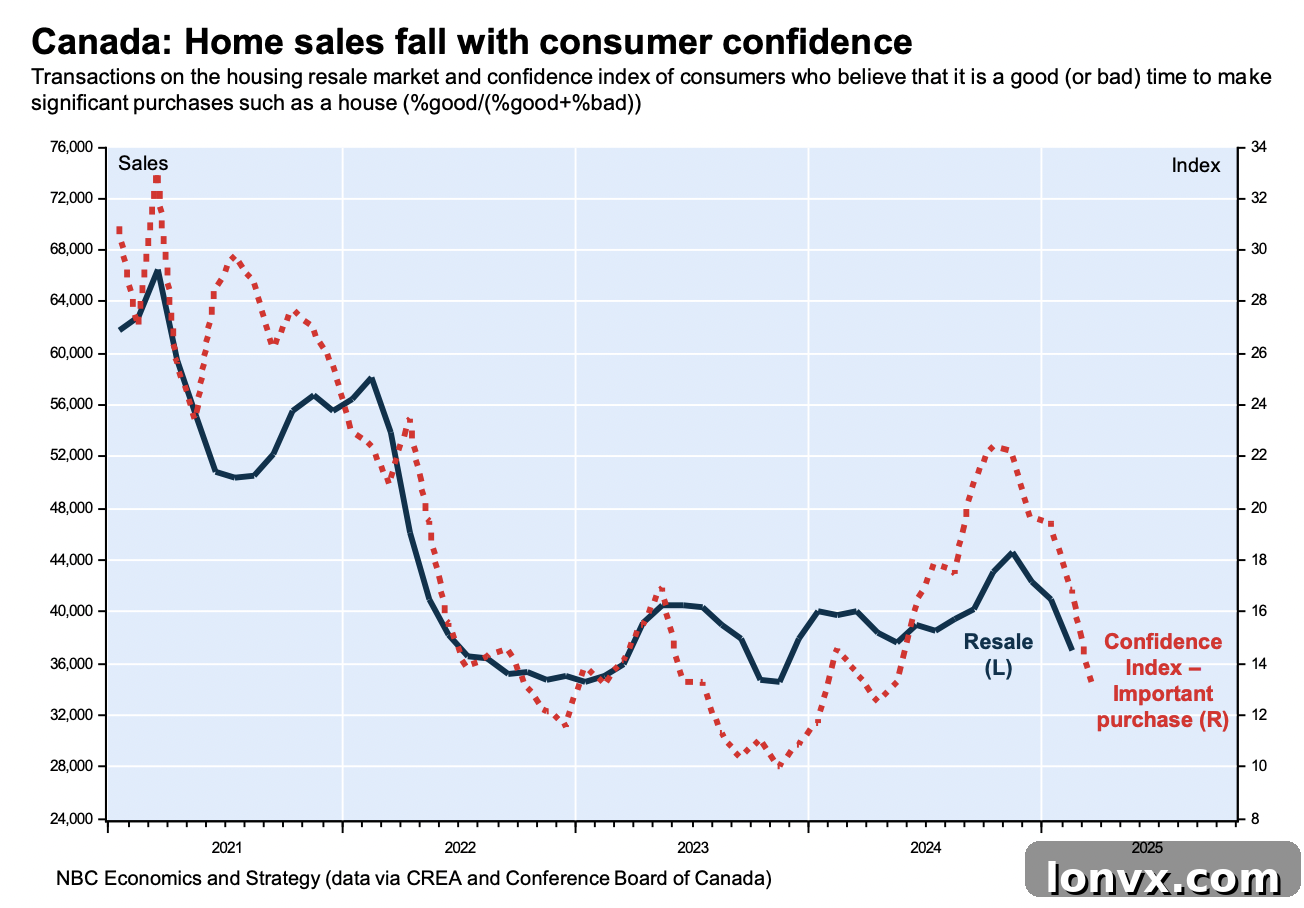
King’s analysis underscores a confluence of factors contributing to this downturn, painting a cautious picture for the months ahead. He highlights that “This decline in prices comes at a time when the resale housing market has slowed sharply in recent months.” This sharp deceleration in resale activity is a critical precursor to price adjustments, indicating a shift from a seller’s market to one where buyers hold more leverage, or simply, where transactions are becoming more infrequent. A primary driver of this market stagnation, King suggests, is the palpable “uncertainty surrounding trade tensions with the United States.” Such geopolitical and economic uncertainties invariably ripple through domestic economies, dampening business investment, impacting employment prospects, and ultimately eroding consumer confidence.
Further exacerbating the situation is a dramatic slump in consumer sentiment. King notes that “Consumer confidence is in free fall,” a psychological barometer reflecting widespread anxiety about economic stability and future prosperity. When consumers feel less secure about their financial future, discretionary spending decreases, and major investment decisions, particularly those as significant as purchasing a property, are often postponed. The most recent data on consumers’ “willingness to make major purchases (such as a property) indicate that the slowdown could continue.” This reluctance to commit to substantial financial outlays directly translates into reduced demand in the housing sector, creating downward pressure on prices and transaction volumes. The intricate interplay of these economic and psychological forces suggests that the current market deceleration is not merely a transient blip but potentially the start of a more sustained period of recalibration.
Regional Divergence: Price Declines in Canada’s Most Expensive Markets
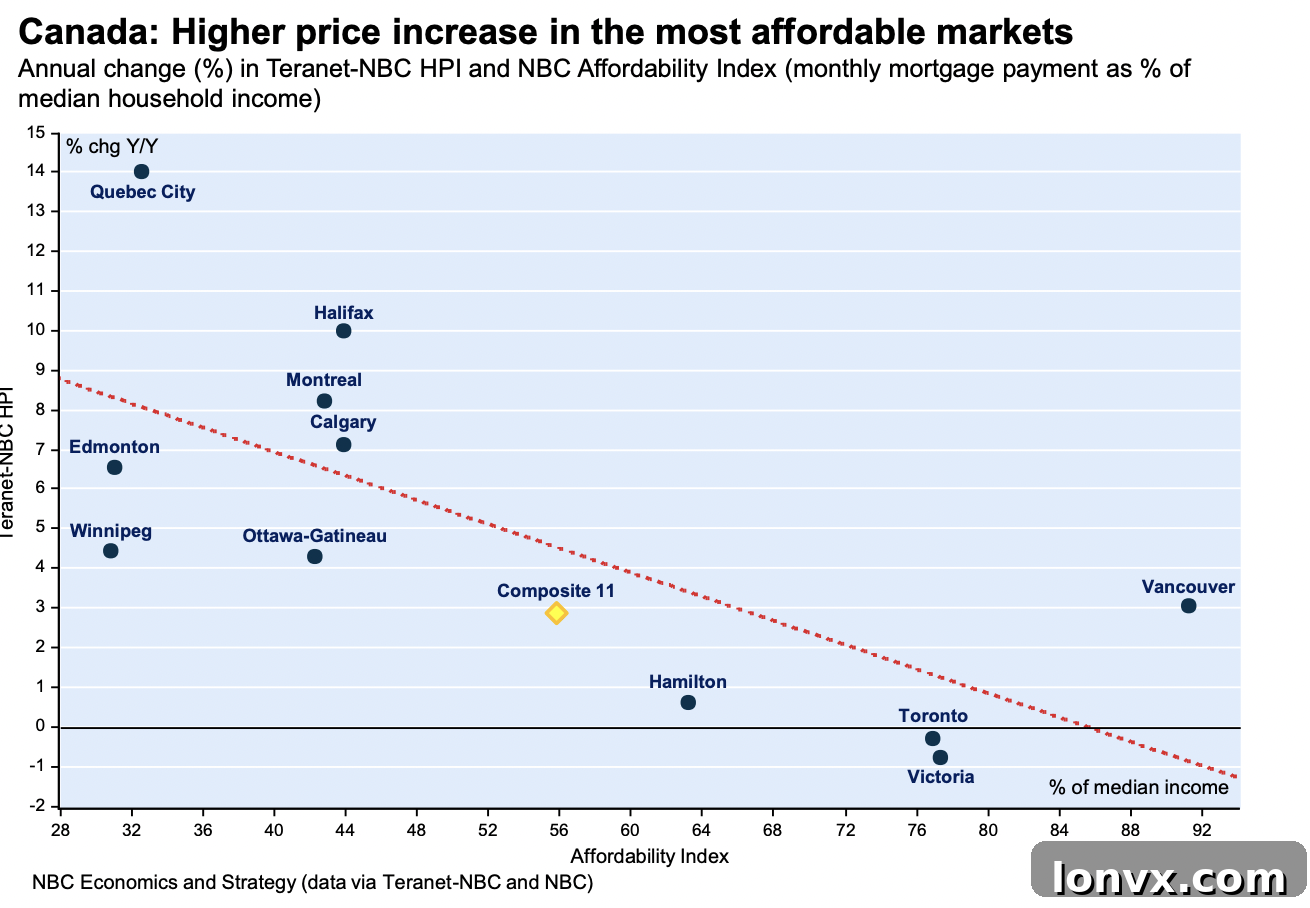
While the national average recorded a year-over-year increase of 2.9 per cent, masking the immediate month-over-month dip, a closer look reveals profound “notable regional differences,” as Darren King points out. This disparity is crucial for understanding the nuanced dynamics of the Canadian real estate landscape. The most significant price declines were concentrated precisely where affordability has been stretched thin for years: Canada’s most expensive and historically overheated markets. Cities like Victoria, Vancouver, and Toronto, long considered bastions of high property values, are now experiencing tangible corrections.
In February, Victoria led this trend with a notable 1.4 per cent month-over-month decline, closely followed by Vancouver, which saw a 0.9 per cent drop, and Toronto, with a 0.5 per cent reduction. More tellingly, Victoria and Toronto were the only two cities across the entire index to post annual price drops, at -0.8 per cent and -0.3 per cent respectively. This year-over-year decline indicates a more entrenched shift, moving beyond mere seasonal fluctuations or momentary market hesitations. For homeowners in these metropolitan areas, this signals a potential erosion of equity, while for prospective buyers, it might hint at a slow and gradual improvement in what has long been an unattainable market. The sensitivity of these high-value markets to economic shifts, interest rate changes, and policy interventions makes them particularly vulnerable during periods of economic uncertainty.
Conversely, a striking counter-narrative emerged from some of Canada’s more affordable urban centres. These markets are currently experiencing robust price growth, attracting attention from both domestic buyers priced out of larger cities and investors seeking better value. Quebec City, for instance, demonstrated exceptional strength with a staggering 14 per cent increase over the past year, closely followed by Halifax with a solid 10 per cent gain. Other cities across the Prairies also posted significant increases, including Calgary at 7.1 per cent, Edmonton at 6.6 per cent, and Winnipeg at 4.4 per cent. This trend highlights a broader rebalancing within the national market, where demand is shifting towards regions offering greater relative affordability and potentially more sustainable growth trajectories.
King succinctly captures this fascinating dichotomy, stating, “It is interesting to note that the highest price increases have been observed in the most affordable markets in the country, while the most expensive markets are at the bottom of the list.” This observation underscores a significant redistribution of real estate activity and investment across Canada. It suggests that while the major urban centres may be undergoing a necessary correction, the underlying demand for housing remains strong nationwide, simply redirecting itself towards areas where the entry barrier is lower. This regional rebalancing could have long-term implications for urban development, inter-provincial migration patterns, and the overall economic landscape of Canada, as populations and capital flows adjust to new market realities.
Market Outlook: What’s Ahead for the Canadian Housing Market?
Looking forward, several intertwined factors are poised to keep the Canadian housing market under sustained pressure, according to Darren King. One of the most critical elements is the Bank of Canada’s monetary policy. While recent interest rate cuts from the central bank have offered a glimmer of hope for some relief, the economist cautions that persistent inflation concerns make the prospect of additional, significant rate reductions uncertain. The Bank of Canada walks a tightrope, balancing the need to stimulate a slowing economy with the imperative to control inflationary pressures. Should inflation remain stubbornly high, the scope for further rate cuts – which would typically make mortgages more affordable and boost buyer confidence – will be severely limited, prolonging the current market sluggishness.
Beyond monetary policy, demographic and labour market trends are also contributing to dampened demand. King points to a moderation in population growth, a crucial factor given Canada’s historical reliance on immigration to fuel housing demand. A slower influx of new residents translates directly into reduced pressure on housing supply, allowing the market more breathing room to adjust. Concurrently, the labour market is showing discernible signs of cooling. A weakening job market, characterized by slower job creation or even job losses, directly impacts consumer confidence and purchasing power. When employment prospects are uncertain, individuals are naturally less inclined to undertake major financial commitments like buying a home, further tempering demand across all market segments.
The economist’s most pressing concern remains the unresolved trade war, particularly its implications for property values. King issues a clear caution: “Unless the current trade war is resolved quickly, home prices are expected to remain under pressure, particularly in the least affordable markets.” This highlights the interconnectedness of global trade dynamics and local housing markets. Prolonged trade tensions can lead to reduced business investment, supply chain disruptions, and decreased economic growth, all of which trickle down to affect consumer spending, job security, and ultimately, housing demand. The impact is likely to be most acutely felt in Canada’s most expensive urban centres – the “least affordable markets” in terms of entry price – where property values are highly sensitive to economic shifts and buyer confidence. These markets, already grappling with high valuations, stand to face the steepest corrections if external economic headwinds persist.
In essence, the Canadian housing market appears to be entering a phase of significant adjustment, driven by a complex interplay of monetary policy constraints, moderating demographic trends, a cooling labour market, and persistent geopolitical uncertainties. While a catastrophic collapse is not necessarily on the horizon, a sustained period of modest price declines and reduced market activity seems increasingly probable. For potential buyers, this period may eventually present opportunities for more reasonable entry points, provided economic stability doesn’t deteriorate further. For sellers, it necessitates a realistic assessment of market conditions and pricing strategies. The coming months will be critical in determining the depth and duration of this slowdown, with many eyes fixed on both the Bank of Canada’s next moves and the broader global economic landscape.