
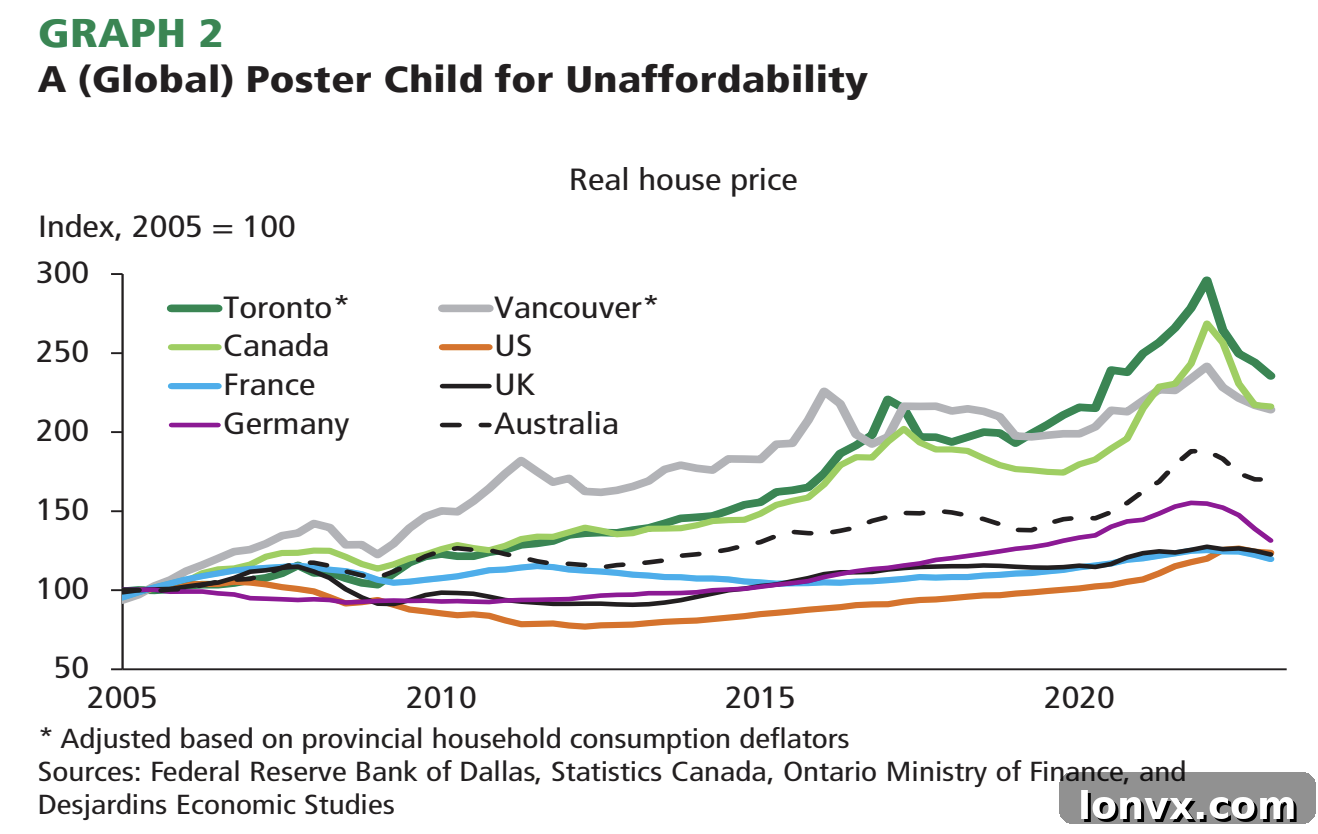
Toronto’s real estate landscape has been nothing short of a rollercoaster, characterized by dizzying highs, precipitous drops, and an ever-present struggle with affordability. In a comprehensive new report, Desjardins economists offer a critical analysis of Canada’s largest city’s housing market, shedding light on its recent tumultuous journey and forecasting where home prices and affordability might head next. This timely report arrives after a period of soaring home prices during the pandemic, followed by a significant market correction. It underscores the exceptional nature of Toronto’s housing market, setting it apart even within the broader context of Canada’s nearly uninterrupted two-decade surge in property values.
The unique pressures on Toronto’s housing market stem from a confluence of factors: robust population growth, a booming job market, and a persistent shortage of housing supply. These elements create an environment where demand consistently outstrips the available inventory, driving prices upwards and making homeownership an increasingly distant aspiration for many. Desjardins’ analysis offers a crucial perspective for anyone invested in, or affected by, the city’s housing dynamics – from prospective first-time buyers navigating an expensive market to current homeowners assessing their equity, and policymakers striving to find sustainable solutions.
At the heart of the report are three distinct scenarios, each painting a different picture of Toronto’s real estate future. These scenarios are designed to illustrate the range of possibilities, from severe downturns to continued growth, based on varying economic and demographic conditions. However, a sobering caveat accompanies all projections: even under the most challenging economic scenarios, Desjardins economists do not foresee a return to widespread housing affordability in Toronto anytime soon. This stark realization highlights the deep-seated structural issues that pervade the market, suggesting that the path to true affordability will be a long and arduous one, demanding more than just short-term market adjustments.
The insights provided by Desjardins are crucial for understanding the potential trajectory of one of the world’s most dynamic and challenging urban housing markets. By examining these diverse scenarios, we can gain a clearer perspective on the forces at play and the potential outcomes for homeowners, buyers, and the broader economy. Let’s delve deeper into each forecast, exploring the nuances and implications of these potential futures for Toronto’s housing landscape.
Scenario 1: The Echoes of the 1990s – A Significant Market Correction
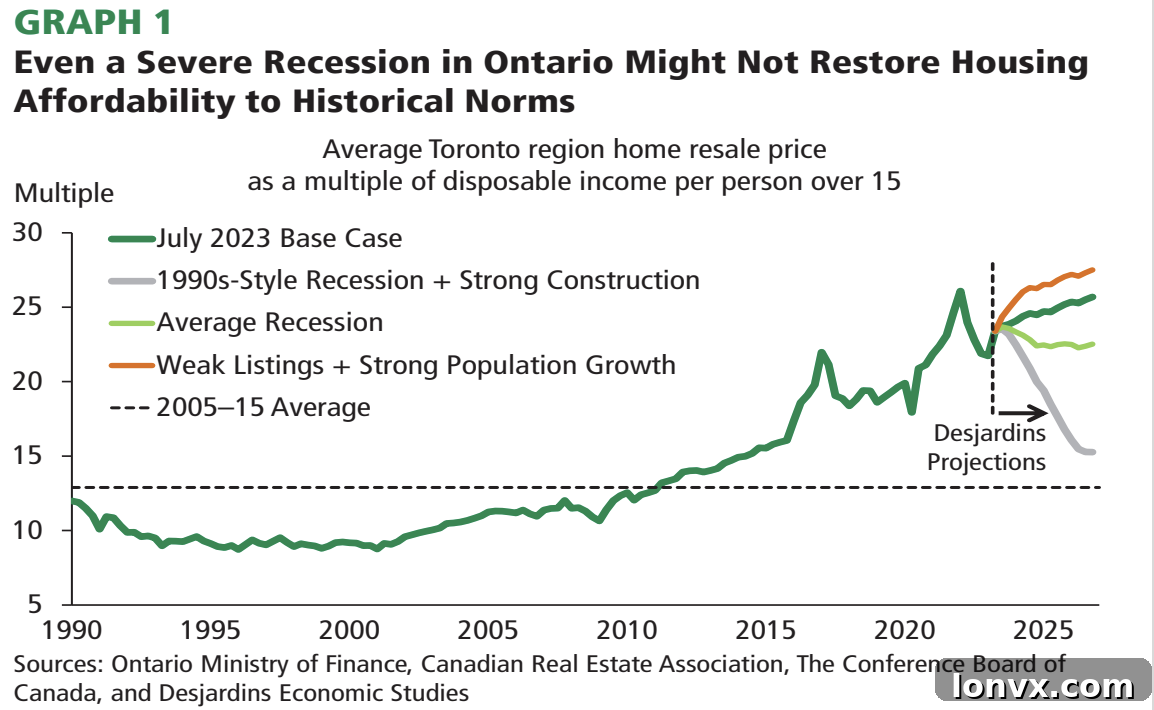
The first scenario outlined by Desjardins presents the most severe outlook, drawing parallels to the profound economic recession and housing market collapse that gripped Toronto in the 1990s. This “throwback to the 1990s” envisions a substantial downturn in Toronto’s housing market, leading to a dramatic and sustained drop in home prices. While economists consider this outcome improbable given current economic fundamentals and the lessons learned from past crises, its implications are significant and would impact virtually every market participant.
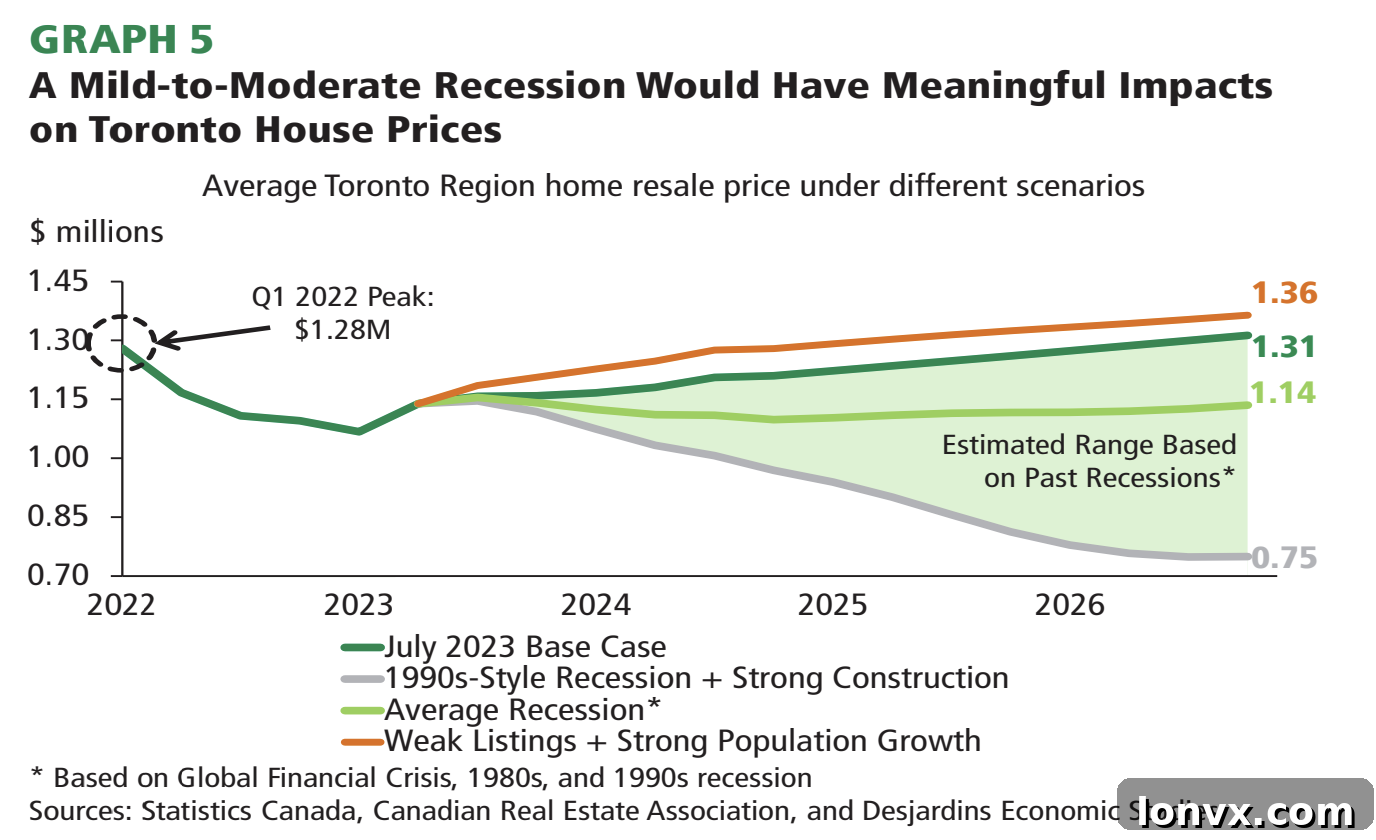
Should this severe recession scenario materialize, Toronto home prices could see a staggering decline of approximately $185,000, representing a 16 percent fall from current levels by the end of the next year. The projections worsen further, with prices potentially plummeting by as much as $340,000, or 30 percent, below the levels observed in July 2023 by the fourth quarter of 2025. Such a precipitous drop would create immense financial distress for many existing homeowners, particularly those who purchased at peak prices, and could trigger widespread equity erosion. Conversely, it would present rare, albeit economically painful, opportunities for cash-rich buyers to enter the market at significantly lower valuations.
Even with such a dramatic plunge, the report critically points out that the home price-to-per capita disposable income ratio would only return to levels last seen in late 2015. This key detail underscores the severity of Toronto’s long-standing affordability crisis, demonstrating that even an extreme market correction would merely turn back the clock by a few years, rather than fundamentally solving the deep structural imbalances that have inflated prices for decades. It suggests that while prices would be lower, they would still remain significantly out of reach for a substantial portion of the population relative to their earnings.
The broader economic and social ramifications of a 1990s-style recession would be profound. As the report emphatically states, “Such a significant price decline could likely only come at a massive economic and social cost.” Compared to Desjardins’ base-case forecast for Ontario, this dire scenario would result in a staggering reduction of more than $35 billion in employment income and nearly half a million total job losses across the province by Q4 2025. Such an economic contraction would ripple across all sectors, impacting consumer confidence, business investment, and overall economic stability, making it a scenario that policymakers would work assiduously to avoid.
Scenario 2: A Moderate Slump – The Path of Gradual Adjustment
Stepping back from the extreme, Desjardins’ second scenario envisions a more moderate economic recession and its corresponding effects on Toronto’s housing market. This outlook is arguably more plausible, examining how ongoing economic headwinds – such as persistent inflation, elevated interest rates, and a general slowdown in global economic growth – could lead to a dip in home prices without triggering a catastrophic market collapse. It provides a nuanced view of a market undergoing adjustment, rather than outright crisis.
Under this “moderate slump” scenario, Toronto house prices are projected to bottom out by the end of the next year, settling approximately 5.0 percent below the levels recorded in July 2023. While this still represents a noticeable correction from peak values, it is considerably less drastic than the 1990s-style downturn. Such a decline would offer some measurable respite for prospective buyers, potentially easing competitive pressures and making entry into the market slightly more attainable. For existing homeowners, while seeing a reduction in their home’s valuation, the impact would be more manageable, avoiding widespread financial distress and preserving a significant portion of their accumulated equity.
Despite this projected decline, the report anticipates only a slight improvement in affordability compared to current challenging levels. Specifically, this scenario would only bring the price-to-disposable income ratio per person over age 15 back to early 2021 levels. While any improvement is a welcome development, returning to early 2021 affordability still implies that housing remains significantly out of reach for a large segment of the population, particularly first-time buyers and those with average incomes. This underlines the persistent nature of the affordability challenge in Toronto, suggesting that even a moderate correction is insufficient to fundamentally alter the structural barriers to homeownership for many. It highlights that the market’s recovery, post-correction, would likely still be characterized by high prices relative to income, necessitating continued strategic financial planning for potential buyers.
This moderate slump scenario also suggests a rebalancing of the market. The intense bidding wars that characterized the pandemic era might subside, allowing for more reasoned transactions and greater buyer agency. Inventory levels could see a modest increase as some sellers adjust their expectations or as economic pressures lead more homeowners to list their properties. However, demand, bolstered by continued population growth and an eventual stabilization of interest rates, is expected to remain robust enough to prevent a prolonged and deep downturn. This scenario, therefore, points to a period of market adjustment rather than outright crisis, where participants will need to adapt to a new equilibrium defined by less frenetic activity and a gradual recalibration of property values.
Scenario 3: The Resilience of Demand – Fueled by Population Growth and Supply Constraints
In stark contrast to the previous two outlooks, Desjardins’ third scenario offers a decidedly more optimistic perspective for current homeowners and a challenging one for prospective buyers, projecting a future where Toronto’s housing market continues its upward trajectory. This scenario is firmly predicated on two powerful and persistent forces: sustained, record-breaking population growth and a critically limited supply of new housing listings. These factors combine to create an environment where demand consistently outstrips supply, leading to continued price appreciation, even in the face of ongoing affordability concerns.
Under this scenario, Toronto home prices could increase by about 6% higher than in the base case forecast. This significant uplift would push prices past the previous peak seen in February 2022 by as early as 2025. For existing property owners, this represents a welcome validation of their investment, reinforcing equity growth and contributing substantially to household wealth. It suggests a market characterized by strong consumer and investor confidence, with persistent upward pressure on values driven by an ever-expanding pool of potential buyers and an insufficient number of homes to meet their needs. This outcome highlights the unique resilience of Toronto’s market, driven by its status as a global magnet for talent and investment.
The primary engine behind this scenario is Canada’s robust immigration policy and Toronto’s undeniable allure as a global city and economic hub. The continuous influx of new residents, both from abroad and from other Canadian provinces, creates an unrelenting demand for housing across all segments of the market. Coupled with this sustained demand is the persistent and complex challenge of housing supply. Toronto faces systemic hurdles in building new homes at a pace that can keep up with population growth, including restrictive zoning laws, lengthy and intricate approval processes, escalating construction costs, persistent labor shortages in the trades, and limited available land for development. This fundamental bottleneck in new listings ensures that competitive dynamics remain fierce, even as prices reach unprecedented new heights.
While this scenario is undoubtedly positive news for those who already own property in Toronto, it presents a far less favorable outlook for prospective buyers. The report explicitly warns that under these conditions, “the sales price-to-disposable income ratio per working-aged person would exceed its pandemic-era peak by mid-decade.” This means that the already extreme challenge of affordability would intensify further, making homeownership even more elusive for a growing segment of the population. The widening gap between housing costs and average incomes would exacerbate wealth inequality and potentially force many to reconsider their dreams of owning a home in the city, leading to increased reliance on rental markets. For new entrants, this scenario implies higher barriers to entry, greater competition, and potentially longer periods of saving before a down payment becomes feasible. It underscores a critical policy dilemma: how to accommodate necessary population growth and economic expansion without further eroding housing affordability and increasing social stratification.
Addressing Toronto’s Deep-Seated Housing Challenges
The comprehensive insights provided by Desjardins’ economists underscore the exceptionally challenging starting position for both prospective first-time home buyers and policymakers striving to improve housing affordability in Toronto. Regardless of which of the three scenarios ultimately unfolds, the underlying structural issues that drive Toronto’s housing market remain deeply entrenched. The report’s findings serve as a powerful and sobering reminder that restoring balance and accessibility to this vital market is not a task for the short term; it is unequivocally a long-run process demanding sustained commitment, innovative solutions, and courageous policy decisions.
As Desjardins’ economists emphasize, “Striking as these results may be, we’ve always known that restoring housing affordability was a long-run process. Our analysis reinforces that view, as well as the need to successfully implement ambitious plans to boost the housing supply.” This statement serves as a clarion call for decisive action, highlighting that while demand-side measures – such as interest rate hikes – can temporarily cool the market, they do not address the fundamental supply-demand imbalance. True and sustainable affordability restoration hinges on significantly increasing the housing supply across all types and price points, catering to the diverse needs of Toronto’s growing population.
Implementing such “ambitious plans” involves a multi-faceted and coordinated approach across all levels of government and key stakeholders. This includes, but is not limited to, comprehensive zoning reforms to allow for greater density and diverse housing forms, streamlined and accelerated permitting processes to cut down on construction delays, strategic investment in critical infrastructure to support new communities, and robust incentives for building diverse housing types, such as purpose-built rentals, affordable ownership units, and missing middle housing. Furthermore, addressing labor shortages in the construction industry and managing the rising costs of building materials are also crucial components of any effective, long-term strategy to bolster housing supply.
The stakes for Toronto are remarkably high. A persistently unaffordable housing market not only impacts individual financial well-being and aspirations but also poses significant risks to the city’s economic competitiveness, its ability to attract and retain talent, and its overall social cohesion. It affects businesses struggling to recruit a diverse workforce, contributes to urban sprawl as residents move further out to find affordable options, and exacerbates existing income and wealth inequalities. Desjardins’ report provides a critical framework for understanding the potential paths ahead, but ultimately, the future of Toronto’s housing market will be shaped by the collective decisions, strategic investments, and political will demonstrated today. The journey to a more affordable, equitable, and sustainable housing landscape will undoubtedly be long and arduous, but it is one that the city of Toronto cannot afford to ignore.