
The Diverging Fortunes: Unpacking Toronto and Vancouver’s Condo Market Dynamics
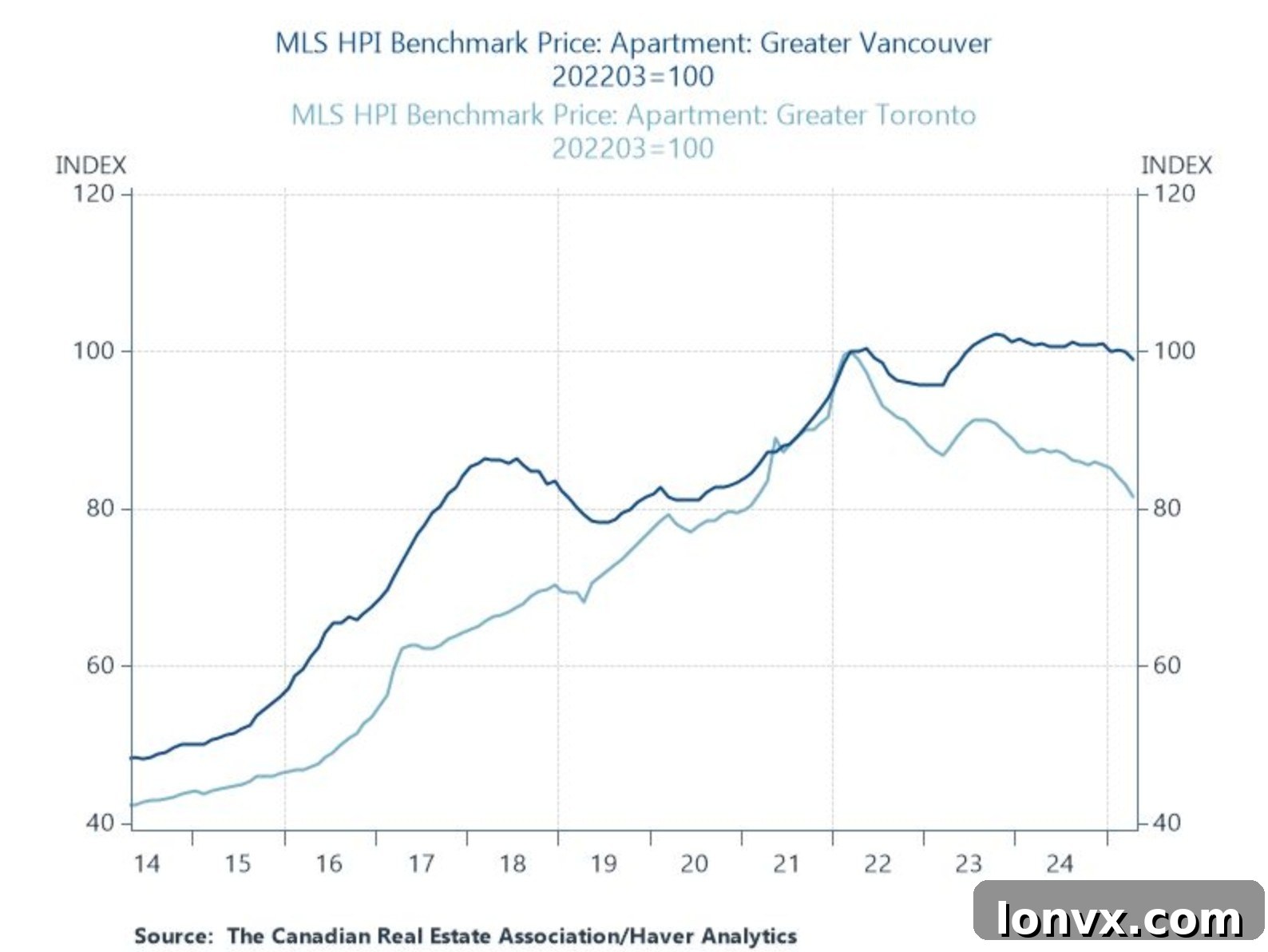
Canada’s real estate landscape continues to tell a fascinating and increasingly divergent story, particularly within the bustling condo markets of its two largest urban centers: Toronto and Vancouver. While both cities have long been synonymous with robust property values and intense demand, recent market shifts reveal a significant chasm opening between their respective trajectories. Toronto’s condo sector, once a beacon of rapid appreciation, is now grappling with substantial price declines, starkly contrasting with Vancouver’s relatively more stable, albeit softening, market.
According to Brendon Ogmundson, chief economist with the BC Real Estate Association, a “wild divergence” has emerged since 2022. CREA data highlights a steep drop of approximately 20 percent in Toronto’s condo prices, while Vancouver’s have merely edged down from their peak. This disparity points to a fundamental imbalance. “There must be a much bigger amount of excess supply in Toronto than Vancouver,” Ogmundson remarked to Real Estate Magazine, concluding emphatically, “It’s much worse in Toronto.” This tale of two markets underscores the complex interplay of economic factors, policy interventions, and urban development strategies shaping Canada’s housing future.
Vancouver’s Measured Resilience: Supply, Demand, and Strategic Development
Despite experiencing significant construction activity over the past five years, Vancouver’s condo market has managed to avoid the sharp downturn witnessed in its Eastern counterpart. Ogmundson attributes this to a nuanced approach to development. Many of the newly constructed units in Vancouver are either still under construction or specifically designated as rentals, preventing an immediate flood of new inventory onto the sales market. This phased release and intentional allocation have acted as a crucial buffer, preventing an overnight imbalance between supply and demand.
However, this relative stability isn’t expected to last indefinitely. Ogmundson anticipates some downward pressure on Vancouver prices in the near future as inventory gradually accumulates and buyer demand naturally softens. Yet, he projects that any decline will likely not parallel the severity seen in Toronto, primarily due to the city’s inherent structural differences and its strategic development planning that has, to date, kept supply in check more effectively.
The geographic constraints of Vancouver, nestled between mountains and ocean, inherently limit the scope for sprawling development. This scarcity of buildable land naturally caps the potential for overwhelming oversupply. Furthermore, a significant portion of new multi-family developments has been geared towards the rental market, addressing a different segment of housing needs and mitigating the influx of for-sale units. This strategic foresight has allowed Vancouver’s market to absorb new supply more gradually, preserving a healthier equilibrium compared to Toronto’s rapid expansion.
Toronto’s Perfect Storm: A Cascade of Policy and Market Forces
The narrative in Toronto presents a stark contrast, described by realtor Jarrod Armstrong of Right At Home Realty as a market that has been “flipped upside down” since hitting its peak in 2022. Armstrong, based in Toronto, points to a “volley of changes” over the last three years that have coalesced into a “perfect storm” for the city’s condo market. These impactful shifts include rapidly escalating interest rates, a federal ban on foreign buyers, significant amendments to Airbnb regulations, and the introduction of vacant home taxes. Collectively, these measures have had a profound effect, prompting a noticeable flight of investors from the market.
A critical factor contributing to Toronto’s predicament is the nature of its recent development boom. Armstrong highlights an oversupply of small condos, typically ranging from 350 to 450 square feet. These units were predominantly built with investors in mind, catering to a demographic seeking rental income or quick appreciation. However, they proved far less appealing to other buyer segments, such as first-time homebuyers or young families, who typically require more space. This misaligned development strategy has led to a significant surplus of inventory that struggles to find buyers, sending prices spiraling downwards. Armstrong grimly states that these small condos “have literally lost a quarter of their value” and are now “really just unsellable.”
The numbers paint a clear picture of this imbalance. Armstrong notes that in a typical month, Toronto might see 3,000 condos listed for sale but only manage around 300 sales. This ten-to-one sales-to-listing ratio underscores the profound lack of demand relative to available supply. The consequences extend beyond existing units, as the city is now witnessing a significant decline in pre-construction sales and an increasing number of abandoned development projects. Adding to the economic headwinds, Armstrong also cited tariffs from the U.S., injecting further uncertainty into the economy and effectively “ruining” the crucial spring condo market.
The confluence of these factors—macroeconomic pressures, restrictive government policies designed to cool an overheated market, and a mismatch in housing product—created a uniquely challenging environment for Toronto’s condo sector. The investor-driven market, once a source of rapid growth, proved vulnerable to these changes, leading to a dramatic re-evaluation of values and a significant cooling period.
Vancouver: Smaller Scale, Shared Market Sentiments
While Vancouver has demonstrated greater resilience, it is by no means immune to the broader market slowdown. Ron Parpara, a realtor with eXp Realty in Vancouver, attributes much of the city’s comparatively better performance to its smaller size. This physical constraint translates into less available land for development, inherently limiting the volume of new stock that can potentially overwhelm demand. However, Parpara is quick to acknowledge that the city is indeed experiencing a market slowdown, with prices registering some dips.
“We’re in a similar situation, just maybe in a little bit of a smaller scale with Toronto,” Parpara observed, emphasizing that “sales are not keeping up with the supply.” This sentiment reflects a critical shift in market dynamics, even in Vancouver. The city is currently grappling with its highest inventory levels in 11 years, with more units slated to come online in the near future. May, a traditionally busy month for real estate, recorded the slowest sales in the last 20 years, signaling a significant shift in buyer behavior and market sentiment.
Furthermore, Vancouver has mirrored Toronto in implementing measures aimed at curbing speculative investment, including a vacant home tax and an Airbnb tax. These policies, similar to those in Toronto, have reshaped the buyer landscape. Parpara estimates that approximately 90 percent of his current transactions involve end-users—individuals buying homes for personal occupancy—rather than investors. This shift from an investor-dominated market to one driven by primary residents suggests a healthier, more sustainable foundation, even if it comes with a period of price adjustments and slower sales.
The move towards a market dominated by end-users can contribute to long-term stability, as these buyers are typically less susceptible to short-term market fluctuations and more focused on the intrinsic value of their homes. However, the immediate impact is often a deceleration of sales velocity and price growth, as the rapid turnover characteristic of investor activity diminishes.
Looking Ahead: Navigating Uncertainty Towards Future Stability
The outlook for the Canadian condo market, particularly in Toronto and Vancouver, remains a topic of intense discussion among experts. Brendon Ogmundson predicts that in the short term, sales will continue to be weak in both cities. This persistent sluggishness is attributed to ongoing economic uncertainty, which dampens consumer confidence, and a growing inventory that offers buyers more choice and less urgency. Despite these immediate challenges, Ogmundson suggests that a rebound is still plausible in the longer term, primarily driven by Canada’s underlying housing shortage and robust population growth.
Ron Parpara offers a more specific forecast for Vancouver, anticipating that prices will continue to fall in the near future. However, he envisages a more balanced market emerging by 2026 or 2027, largely contingent on a gradual decline in interest rates. Lower borrowing costs would undoubtedly inject renewed vitality into the market, making homeownership more accessible and stimulating demand.
Jarrod Armstrong echoes a similar sentiment for Toronto, agreeing that prices are likely to continue their downward trend. He believes that a significant turnaround or “real change” won’t materialize until 2027. By this time, he projects that constraints on inventory will begin to emerge, not due to sudden demand spikes, but rather as a consequence of the current slowdown in new construction. The abandonment of pre-construction projects and reduced new starts today will eventually translate into a scarcity of new supply several years down the line, potentially setting the stage for future price stabilization or even appreciation. “I don’t think we’ve hit bottom,” Armstrong cautions, suggesting that further adjustments are still on the horizon for Toronto.
The path forward for Toronto and Vancouver’s condo markets is clearly bifurcated yet interconnected by overarching economic forces. While Vancouver may experience a more gradual descent, its market is still adapting to a new equilibrium. Toronto, having faced a more abrupt and significant correction, is undergoing a deeper reassessment of its market fundamentals. Both cities are navigating a complex environment characterized by evolving policy landscapes, shifting buyer demographics, and the enduring challenge of affordability. The next few years will undoubtedly be critical in shaping the long-term health and stability of these pivotal Canadian real estate markets, as they move from a period of correction towards a hopefully more balanced and sustainable future.