
Bank of Canada Hikes Rates: What It Means for the Canadian Real Estate Market
The Bank of Canada (BoC) delivered another 25-basis-point interest rate increase on Wednesday, pushing the central bank’s overnight rate to a significant 5.0 percent. This latest adjustment marks a continuation of a historic tightening in monetary policy, elevating interest rates from their unprecedented pandemic-era lows to levels not witnessed since the 2007-08 global financial crisis. For many Canadians, this hike feels like a definitive blow, potentially sealing the fate of an already strained real estate market, with widespread hopes that it will indeed be the final one.
However, Tiff Macklem, the Governor of the Bank of Canada, has expressed a more cautious stance, unequivocally stating that the central bank remains prepared for further increases should economic conditions necessitate them. This leaves the door open for continued uncertainty in an already volatile economic landscape, preventing homeowners and prospective buyers from finding solid ground.
The real estate market sentiment responded almost immediately to the previous, largely unanticipated hike, which only one major bank economist had foreseen. This prior increase, much like the initial 25-basis-point adjustment in February 2022, served as another stern warning shot. Anecdotes of distress among homeowners continue to circulate within the real estate professional community, with many publicly empathizing with those grappling with escalating financial burdens. Real estate agents are reporting a noticeable uptick in calls from property owners contemplating selling their homes, driven by the sustained pressure of mortgage renewals at significantly higher rates or the persistent rise in variable rate payments.
Commercial bank prime rates have now climbed to 7.20 percent. Consequently, variable rate mortgages are now commonly found in the 6.0 percent range, while Home Equity Lines of Credit (HELOCs) have soared to over 7.50 percent for most borrowers. This represents a drastic shift from the approximately 3.0 percent rates that fueled an extreme sense of confidence and affordability in the market during the peak of the pandemic era, profoundly altering the financial calculus for millions of Canadians.
The Bond Market’s Response and Its Impact on Fixed Mortgages
Following the rate hike announcement on July 12, the Canada 5-Year Government Bond yield saw a consistent decline throughout the day, dropping from 3.950 percent at market open to 3.812 percent at close. While yields have generally remained stable within this revised range, this movement is a crucial indicator, as the 5-year bond yield serves as the primary pricing mechanism for fixed-rate mortgages in Canada.
In Canada, fixed-rate mortgages are inextricably linked to government bond yields, particularly those on Government of Canada bonds with comparable maturity periods. The rationale is straightforward: as bond yields rise, lenders must increase their mortgage rates to ensure that mortgage products remain competitive investment vehicles relative to these bonds. If mortgage rates were not adjusted upwards, banks would find it more attractive to invest their capital in government bonds, which are perceived as one of the safest investment options available. Banks typically incorporate a risk premium into their mortgage products, often expressed as “GOC+2” – meaning the bond yield plus an additional 2.0 percent. With current yields, this formula would place fixed mortgage rates in the high 5.0 percent to low 6.0 percent range.
Conversely, a decrease in bond yields typically leads to a corresponding fall in fixed mortgage rates, making them more accessible and affordable for borrowers. Therefore, the fluctuations observed in Canadian bond yields play an indispensable role in dictating the trajectory and affordability of fixed mortgage rates across the country. Understanding this dynamic is key to comprehending the broader impact of the Bank of Canada’s monetary policy decisions on the housing market.
Enjoying this article?
Get the latest REM articles in your inbox 3x week so you stay up to date on the latest in the Canadian real estate industry
This intricate relationship between bond yields and mortgage rates highlights the inherent difficulty for the Bank of Canada in achieving its policy objectives. A significant majority of purchasers today are opting for fixed-rate mortgages, primarily because their pricing has become more attractive compared to variable-rate alternatives. This trend inadvertently limits the central bank’s influence on the demand side of the housing equation. Instead, the rate hikes exert pressure predominantly on the supply side, by intensifying financial stress among existing homeowners and, consequently, incentivizing them to sell their properties.
By all accounts, this appears to be precisely the outcome the BoC has achieved. A growing number of sellers are seemingly “admitting defeat” in the face of persistent financial strain, leading to a notable shift where new housing supply growth is, for the first time in a considerable period, generally outpacing sales. This dynamic underscores a pivotal, if unintended, consequence of the central bank’s aggressive tightening cycle.
Focus Shifts to Housing: A Key Performance Indicator for the BoC
The Bank of Canada’s heightened scrutiny of the housing market has become increasingly apparent, particularly in its recent Quarterly Monetary Policy Report. Furthermore, during the Bank’s subsequent press release, Governor Macklem appeared to be de-emphasizing unemployment as a singular key performance indicator (KPI). Instead, his focus has broadened to include the housing market and immigration trends as crucial metrics for establishing a comprehensive range of potential outcomes for the Canadian economy.
During the press conference, Governor Macklem articulated this shift, stating, “When we raised interest rates, we saw housing slow quite sharply. It is true that they didn’t slow as much as we thought they would…housing has ticked back up.” This comment encapsulates the central bank’s evolving perspective. The initial part of Macklem’s statement references the historic drop in Canadian house prices last year, which began shortly after the inaugural rate hike in February 2022. This period saw a dramatic year-over-year decline in house prices, approaching almost 20 percent—a downturn that remarkably surpassed Canada’s previous record “crash” in house prices in 1989.

Strength or Seasonality? Decoding the Housing Market’s Rebound
The “strength” referred to in Governor Macklem’s recent statements potentially indicates that the Bank of Canada might be overlooking the inherent seasonality in house prices, despite the monetary policy report incorporating seasonally adjusted data. By most objective measures, the Canadian housing market does not appear particularly robust on paper, especially concerning sales volume, which remains significantly lower than typically observed in a quintessential spring market. A substantial portion of the year-to-date growth in Canadian house prices seems to align with conventional seasonal patterns, exhibiting only a slight uptick above the historical norm.
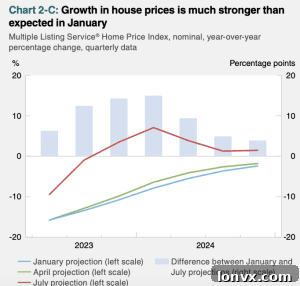
The Bank of Canada has, nonetheless, revised its projections on house prices. Their updated outlook states: “Faster-than-expected pickup in housing resales, combined with a lack of supply, has pushed house prices higher than anticipated in January. The previously unforeseen strength in house prices is likely to persist and boost inflation by as much as 0.3 percentage points by the end of 2023, compared with the January outlook.” This revision signals the BoC’s acknowledgment that housing dynamics are playing a more influential role in the broader inflationary environment than initially projected, adding another layer of complexity to their policy decisions.
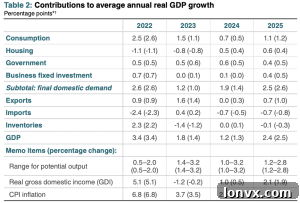
During the press conference, Bank of Canada Deputy Governor Carolyn Rogers further elaborated on the forces underpinning housing growth. She specifically cited supply scarcity and excess demand stemming from robust population growth as critical factors supporting the upward trend in housing. However, this perceived strength in the housing sector is not necessarily mirrored in the Bank’s broader GDP projections, where they anticipate housing to contribute negatively to overall GDP growth throughout 2023. This discrepancy highlights the nuanced and often contradictory signals within the Canadian economy, making policy calibration exceptionally challenging.
No End in Sight? The Quest for a Terminal Rate
The pressing questions on everyone’s mind remain: is this cycle of rate hikes finally over? When will it end, and when can we expect the economic situation to improve? Governor Macklem had previously hinted that 5.0 percent might represent his “terminal rate”—the benchmark at which the central bank would cease its tightening efforts. With the recent hike, the overnight rate has now meaningfully surpassed the rate of inflation, signifying that, when adjusted for inflation, the real interest rate is now positive. This is a critical milestone in monetary policy.
The real interest rate, calculated as the nominal interest rate minus the inflation rate, typically needs to become positive before a sustained reversal in policy, such as rate cuts, can begin. Historically, central bank interest rates tend to remain at their peak for an average of nine months before any rate reductions are initiated. This historical precedent offers a glimmer of hope for a future reprieve, yet the Bank of Canada’s explicit readiness for further hikes underscores the ongoing vigilance required to bring inflation back to its target range sustainably. The path ahead remains uncertain, heavily dependent on evolving economic data and global factors.
Feature image source: Twitter, @bankofcanada