
Ottawa Real Estate Market Wraps Up 2024 with Growth Amidst Shifting Conditions
The Ottawa real estate market concluded 2024 on a cautiously optimistic note, showcasing resilience and hinting at evolving dynamics for the year ahead. According to the Ottawa Real Estate Board (OREB), a total of 613 homes were sold in December 2024, marking a 7.9 percent increase compared to December 2023. While this year-over-year growth signals a positive shift, sales figures remained slightly below historical averages, with December’s performance 6.8 percent below the five-year average and 2.7 percent below the ten-year average for the month.
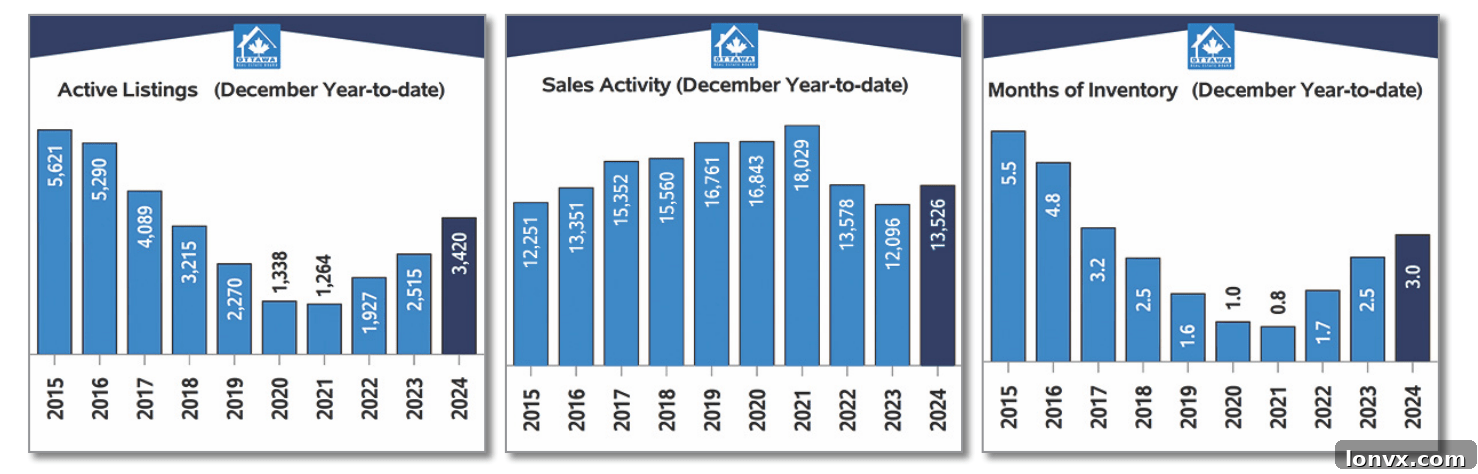
Looking at the broader picture, the year-to-date sales for 2024 reached 13,526 units by December, representing an encouraging 11.8 percent rise from the same period in 2023. This upward trajectory suggests a gradual recovery and increased activity after a period characterized by market hesitation.
Paul Czan, president of OREB, reflected on the year’s performance, stating, “A year of wait-and-see came to a close with the expected slowdown over the holiday season.” He further emphasized the positive indicators observed in the latter half of the year: “The latter half of the year brought signs of more favourable market conditions with consecutive interest rate drops, higher insured mortgage limits and extended amortizations. It’s early to assess the impact of these measures. And it’s an uphill battle against affordability and supply issues that persist.” Czan’s commentary highlights a nuanced market, balancing emerging opportunities with deeply entrenched challenges.
Optimism Tempered by Economic and Political Uncertainty
Despite the prevailing caution, there’s a palpable sense of optimism among market participants. Czan noted that increased listing activity suggests sellers are anticipating improved conditions, expecting to attract buyers who have been observing the market but holding back on significant moves. This indicates a growing confidence in the market’s potential for increased dynamism.
“While the improving market conditions are encouraging, the supply needs to be there,” Czan elaborated. He also pointed to external factors, adding, “Coming political shifts are adding a layer of uncertainty but there is a trending optimism for more increased market activity in the months ahead.” This blend of hope and apprehension underscores the complex environment in which Ottawa’s real estate market is currently operating. The interplay between local market fundamentals, broader economic policies, and political landscapes will undeniably shape its trajectory in early 2025.
Source: OREB
Comprehensive Analysis of Ottawa Home Prices in December 2024
Price movements in December 2024 offered a mixed but generally upward trend across Ottawa’s housing segments. The overall home price index (HPI) composite benchmark price reached $645,800, marking a solid 3.8 percent increase from December 2023. This benchmark provides a standardized measure of home price inflation, offering a more accurate representation than average or median prices by accounting for property characteristics.
A deeper dive into specific housing types reveals diverse performance:
- Single-Family Homes: This segment saw its benchmark price climb to $729,300, up 3.7 percent year-over-year. The consistent demand for detached properties, often seen as a long-term investment, continues to underpin this growth, albeit at a moderate pace.
- Townhouse/Row Homes: These properties experienced the most significant price surge, with their benchmark reaching $533,200 – an impressive 11.3 percent increase from the previous year. This substantial jump highlights the growing appeal of townhouses, likely driven by their relative affordability compared to single-family homes and their appeal to first-time buyers and young families seeking more space than condominiums.
- Apartment Homes: Conversely, apartment homes (condominiums) saw a slight dip, with their benchmark price at $404,400, down 2.5 percent from 2023. This segment’s performance could be attributed to a variety of factors, including increased inventory of new developments, changing buyer preferences post-pandemic favoring more space, or specific investor behaviors. Despite the slight decline, condominiums remain a vital entry point into homeownership for many and play a crucial role in maintaining housing diversity.
In terms of transaction volume, the total value of home sales in December 2024 amounted to $406.9 million, an increase of 12.7 percent from December 2023. This substantial increase in monetary value, outpacing the growth in unit sales, suggests a shift towards higher-priced transactions or a general upward movement in property values across the board.
Inventory and New Listings: A Shifting Balance of Supply and Demand
The supply side of the Ottawa real estate market experienced notable changes in December 2024, signaling a potential rebalancing between buyer and seller dynamics.
- New Listings: December saw 603 new listings enter the market, representing a 13.6 percent increase from the previous year. This rise in new inventory is a welcome development, offering more choices for prospective buyers. Interestingly, this figure also marked a 3.5 percent increase from the five-year average for December but remained 2.7 percent below the ten-year average, suggesting that while new supply is growing, it’s still playing catch-up to longer-term historical trends.
- Active Listings: Perhaps the most significant indicator of market shift was the total number of active listings at the end of December, which stood at 3,216 units. This figure is a remarkable 58.7 percent higher than in December 2023. Furthermore, it’s 90 percent above the five-year average and 51.4 percent above the ten-year average for the month. Such a substantial increase in active listings suggests that properties are staying on the market longer, or that the influx of new listings is outpacing the rate of sales. For buyers, this translates to more options and potentially less intense bidding wars, fostering a more balanced market environment. For sellers, it means increased competition and a greater need for strategic pricing and presentation.
The surge in active listings provides a crucial buffer against the chronic supply issues that have plagued the market in recent years. While a larger inventory offers more choice, it also puts downward pressure on rapid price appreciation, potentially aligning with the Bank of Canada’s goals of cooling inflation and stabilizing the housing market.
Factors Influencing Ottawa’s Real Estate Trajectory
Beyond the raw numbers, several underlying factors are shaping Ottawa’s real estate narrative. The mentioned “consecutive interest rate drops” (or the anticipation thereof) play a pivotal role. Lower interest rates directly enhance affordability by reducing monthly mortgage payments, thereby expanding the pool of eligible buyers and stimulating demand. Paired with “higher insured mortgage limits and extended amortizations,” these policy adjustments aim to ease the financial burden on buyers, especially first-time purchasers, allowing them to enter a market that has become increasingly expensive.
However, the “uphill battle against affordability and supply issues that persist” remains a central theme. Ottawa, like many major Canadian cities, faces a structural deficit in housing supply relative to its population growth. This imbalance drives up prices, making homeownership a distant dream for many. Municipal planning, zoning regulations, construction costs, and labor shortages all contribute to the slow pace of new housing development. Addressing these systemic issues will require concerted efforts from all levels of government and industry stakeholders.
What December’s Data Means for Buyers and Sellers in Ottawa
For potential buyers, December’s data brings a glimmer of hope. The significant increase in active listings means more choices and potentially less pressure to make quick, high-offer decisions. While affordability remains a concern, stabilizing or decreasing interest rates could incrementally improve purchasing power. Buyers now have a stronger position to negotiate and carefully evaluate properties rather than being caught in frenzied bidding wars.
Sellers, on the other hand, might need to adjust their expectations. The increased inventory implies more competition among properties. While prices are generally stable or rising modestly, sellers must ensure their homes are competitively priced and well-presented to stand out. The days of guaranteed multiple offers might be receding, necessitating a more strategic approach to listing and marketing.
Anticipating the Future: Ottawa Real Estate in Early 2025
As Ottawa transitions into 2025, the market appears poised for continued evolution. The “trending optimism for more increased market activity” suggests that the first quarter could see a more robust start than previous years, especially if interest rate stability or further reductions materialize. However, the influence of “coming political shifts” introduces an element of unpredictability. Potential changes in housing policies, economic stimuli, or even global events could sway market sentiment and activity.
The sustained efforts to address affordability and supply will be critical. Should new policies or initiatives be introduced to expedite construction, streamline regulations, or support diverse housing options, Ottawa’s market could achieve a healthier balance. Conversely, if these fundamental issues remain unaddressed, the market may continue to experience cycles of growth and stagnation, perpetually battling affordability challenges.
Overall, December 2024 provided a fitting conclusion to a transformative year for Ottawa’s real estate market. It showcased a market that, while still navigating significant challenges, is beginning to find its footing, displaying signs of growth and adaptability. The interplay of market forces, economic policies, and evolving buyer-seller dynamics will define its path forward.
Review the full report for more detailed statistics.
Enjoying this article?
Get the latest REM articles in your inbox 3x week so you stay up to date on the latest in the Canadian real estate industry