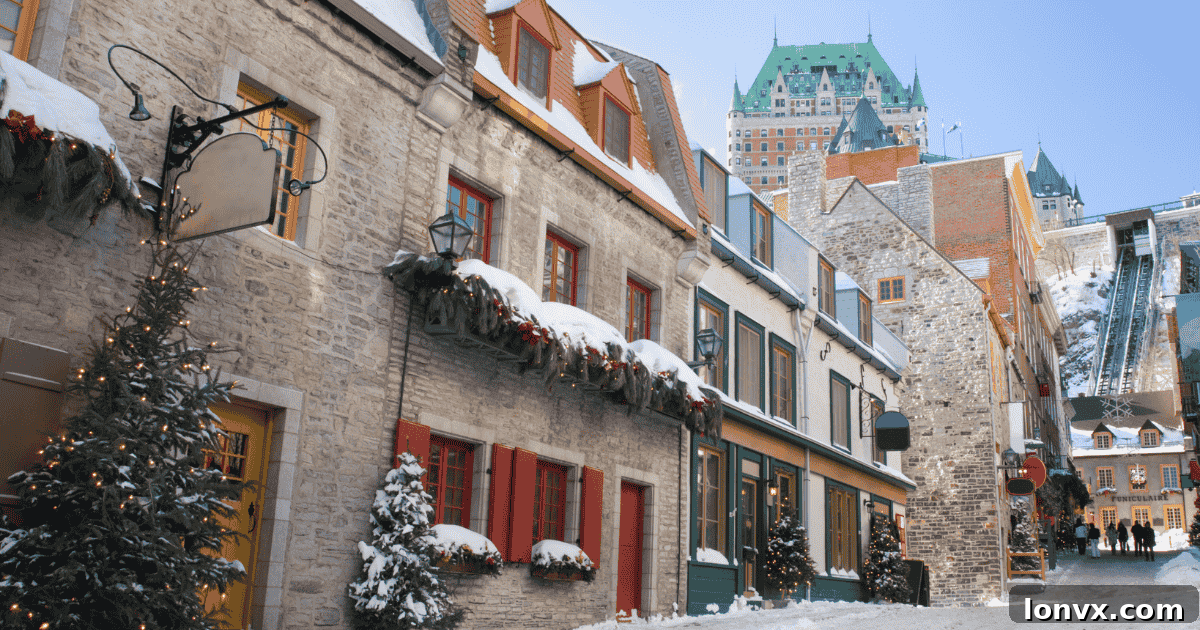
Quebec City in winter (Canva)
Quebec’s Real Estate Market: A Unique Trajectory Amidst National Trends
The real estate market in Quebec continues to carve its own path, consistently defying national trends that have characterized much of Canada. While other provinces have experienced volatility and slowdowns, La Belle Province’s residential sector demonstrated surprisingly robust activity throughout 2025, with many regions experiencing what can only be described as a significant boom. Despite prevailing economic uncertainties and a sharply reduced supply of available properties, sales figures saw an increase across all segments, highlighting Quebec’s exceptional resilience and unique market dynamics.
Remarkably, 2025 was recorded as the third-best year ever for Quebec’s real estate, according to a comprehensive report from the Quebec Professional Association of Real Estate Brokers (QPAREB). This impressive performance included an average increase of eight percent in sales compared to the previous year, accompanied by a notable climb of approximately nine percent in property prices. This growth trajectory underscores a market driven by distinct provincial factors, positioning Quebec as a vibrant outlier in the Canadian housing landscape.
Several key elements contributed to this surge. Favorable financing conditions played a crucial role, with declines in interest and mortgage rates making homeownership more accessible. The extension of the maximum mortgage amortization period further eased the financial burden on prospective buyers. Additionally, the province has witnessed a significant rise in rental costs, prompting a growing number of Quebec renters to transition into homeownership. This confluence of factors created a potent environment for sustained market activity.
Furthermore, homes in Quebec, which are currently outperforming those in Ontario and British Columbia, remain significantly more affordable. This price advantage makes Quebec highly attractive to buyers who have been priced out of the softening markets in these more expensive provinces. It’s important to note that the Quebec market is primarily dominated by domestic buyers, largely due to Canada’s foreign buyer ban, which reinforces its unique, regionally-driven dynamics. Quebec, a province celebrated for its beauty, vast forests, and rich heritage—Canada’s largest by area and the only one with a francophone majority—has once again proven its mettle as a resilient nonconformist during a period of national economic slowdown.
Mounting Affordability Pressures: The Price of Prosperity
While Quebec’s real estate momentum has delivered significant economic benefits, it has not come without a cost, particularly in terms of affordability. Charles Brant, QPAREB’s director of market analysis, points out that this sustained upward trajectory has put considerable pressure on prices, thereby “exacerbating the issue of affordability.” This concern has become increasingly pronounced as the market continues its strong performance.
Brant noted, referencing the final months of the previous year, that “A growing number of households reached the limits of their debt capacity, which slowed the pace of sales.” This trend suggests a potential moderation and gradual deceleration in the market’s rapid growth as we move further into 2026. Buyers, stretched to their financial limits, may become more cautious, impacting transaction volumes.
A critical indicator of this pressure is the province’s listing-to-sales ratio, which is currently nearing historically low levels. This metric clearly underscores a pronounced and persistent shortage of property listings across Quebec. In such an environment, the market heavily favors sellers, who often receive multiple offers and can command higher prices due to fierce competition among buyers. This imbalance between supply and demand is a fundamental driver of the current affordability challenge.
Brant predicts that alongside the deteriorating affordability, especially prominent in the southern regions of the province, “The persistent low inventory of properties throughout Quebec will also contribute to a plateau in transaction activity in many Quebec markets.” He further asserts that “These market conditions—which remain very favorable for sellers—will continue to support prices.” This outlook suggests that while transaction volumes may stabilize, property values are unlikely to decline significantly in the near future. Like many other real estate experts, Brant anticipates that price growth this year will be more moderate compared to the preceding period of rapid escalation.
This sentiment is echoed by the Canadian Real Estate Association (CREA) in their recent forecast. CREA predicts that home prices in Quebec will continue to rise at a healthy, albeit more tempered, pace this year. Their report emphasizes that the gains recorded in 2026, while positive, will be “markedly lower than the gains recorded in 2025,” signaling a shift towards a more balanced, yet still robust, market environment.
Quebec City Leads the Charge: Regional Hotbeds of Activity
Data compiled by QPAREB from the past year and the early months of 2026 paints a clear picture of sustained growth across most metropolitan areas within Quebec. This growth in sales has frequently been accompanied by a sharp decline in available inventory, highlighting the intense demand prevalent throughout the province. Among these dynamic markets, Quebec City stands out as a true leader, having experienced its strongest residential price growth on record, cementing its status as one of Canada’s most vibrant housing markets.
In Quebec City, the median price of single-family homes experienced an astounding jump of 17 percent, reaching an eye-popping $450,000. This dramatic increase is a testament to the city’s burgeoning appeal and the acute housing shortage it faces. Camille Laberge, the association’s senior economist, explained this phenomenon simply: “Exceptional scarcity translated into particularly sharp price increases.” The limited availability of properties, coupled with strong buyer demand, created a perfect storm for rapid value appreciation.
While Quebec City may be the star, other regions are also experiencing significant activity. In Montreal, the provincial economic hub, the median price for homes has climbed to approximately $635,000. Although this increase is not as dramatic as the record-setting growth observed in Quebec City or the notable surges in areas like Saguenay, it remains a significant and noteworthy rise, reflecting the continued strength of Canada’s second-largest city’s real estate market. The sheer volume of transactions and a consistently large pool of buyers ensure Montreal remains a powerhouse within the province.
Beyond the major urban centers, popular resort regions such as Mont-Tremblant and the picturesque Eastern Townships are also witnessing intense market activity. These areas are attracting affluent buyers who are not only seeking vacation homes or properties for an outdoor-oriented lifestyle but also keen investment opportunities. The appeal of Quebec’s natural beauty and recreational offerings is a powerful draw. Furthermore, a recent release from Engel & Völkers highlighted increased activity specifically within Montreal’s luxury housing segment, indicating a strong appetite at the high end of the market.
While the province’s slower-paced condominium market has seen a slight improvement in supply, the inventory pressure remains particularly intense for single-family homes and “plex” properties. These multi-unit dwellings, such as duplexes and triplexes, are an iconic and characteristic feature of Quebec’s housing landscape, reflecting the province’s architectural and urban development history. The provincial real estate association continues to advocate vigorously for increased housing supply across all segments, hoping to alleviate the significant market imbalance and improve overall affordability for Quebecers.
Agents Adapt to a New Reality: Navigating Market Shifts
It wasn’t long ago that Quebec was largely perceived as a province immune to major housing market fluctuations, often characterized by its relative stability compared to the more volatile markets in other parts of Canada. However, that perception has dramatically shifted. Local real estate agents and brokers are now actively adjusting to a vastly different and increasingly dynamic reality, one marked by rapid changes and intense competition.
Josiane Pepin, vice-president of operations at Remax Bardagi in Montreal, emphasizes the enduring strength of buyer motivation. “There is still a real willingness to buy, especially for turnkey, well-located homes and solid income properties,” she observes. This indicates that while the market is competitive, well-maintained and strategically positioned properties continue to attract strong interest, particularly from buyers looking for immediate occupancy or investment returns.
Pepin further elaborated on regional nuances within Quebec. She noted that “Quebec City is currently the most active, with a very tight balance between supply and demand.” This tight market in the provincial capital corroborates the record price growth seen there. “Greater Montreal is also strong because of its sheer volume and constant buyer pool, but it is more price-sensitive and the higher end takes more time. Gatineau remains robust,” she added, highlighting the diverse conditions experienced even within a single province.
Beyond sales activity, the provincial real estate association and its regulatory bodies have also been exceptionally busy, striving to ensure transparency and stability in a rapidly evolving environment. Nicolas Geoffroy-Brûlé, a Remax broker who oversees offices in Quebec City and Trois-Rivières, pointed out a unique challenge. “We are well regulated, but all the information is not known by the public,” he stated. “It’s a local challenge to explain the rules to our clients,” underscoring the importance of clear communication in navigating complex transactions.
Geoffroy-Brûlé expressed a wish—one he acknowledges is “unlikely to be fulfilled”—for a period of stability for organized real estate. He explained his desire for “No changes for now, so all the agents have time to assimilate all the changes the government imposed in the past few years.” These recent government-mandated changes are substantial and aim to enhance the integrity and fairness of the market. They include improved transparency in transactions, stronger consumer protection measures, tighter regulations governing rentals, and comprehensive condo reform. Such reforms are crucial for protecting both buyers and sellers in an active market.
Adding another layer of complexity, the provincial association is currently grappling with widespread concerns surrounding the province’s upcoming new regulatory framework, particularly regarding updated flood zone maps. This initiative has understandably caused anxiety among some homeowners, who worry that their property values could plunge if their homes are re-designated into higher-risk flood zones, impacting insurance costs and resale potential. This demonstrates the multifaceted challenges faced by real estate professionals and regulators in Quebec today.
Looking Ahead: Factors Shaping Quebec’s Real Estate Future
As Quebec’s real estate market continues its distinctive journey, several overarching factors are poised to influence its trajectory in the coming years. While the recent past has been characterized by robust growth, the future presents a delicate balance of potential dampeners and significant catalysts that could reshape demand and supply dynamics.
One potential dampener on future housing demand is slowing population growth, particularly noticeable in urban centers like Montreal. A deceleration in new residents, whether through immigration or inter-provincial migration, could eventually ease the intense pressure on housing supply. However, Quebec’s attractive quality of life and economic opportunities could still draw new residents, offsetting some of this effect. The interplay between demographic shifts and housing needs will be crucial to monitor.
On the other hand, the province stands to benefit from major government-backed investment projects, which could rekindle interest and spur economic activity. A prime example is the proposed high-speed rail link connecting Toronto, Montreal, and Quebec City. Such infrastructure developments not only create jobs but also enhance connectivity and desirability of the regions involved, potentially attracting new businesses and residents, thereby stimulating demand for housing in key corridors.
Furthermore, the broader economic outlook and the prevailing interest rate environment will continue to play a pivotal role. Any significant shifts in interest rates could directly impact mortgage affordability and buyer sentiment. Quebec’s economy, with its diverse sectors from aerospace to natural resources, generally demonstrates stability, but global economic headwinds could still exert influence. The continued trend of inter-provincial migration, with buyers seeking affordability and lifestyle benefits, will also be a key driver, especially from high-cost provinces.
Quebec’s unique cultural and linguistic landscape further contributes to its distinct market. The strong local identity and preference for francophone communities mean that market trends often evolve independently of anglophone-dominated regions elsewhere in Canada. This cultural factor, combined with provincial policies and a different economic structure, ensures that Quebec’s real estate will likely remain a market with its own set of rules and influences.
Ultimately, Quebec’s real estate market remains a fascinating study in resilience and adaptation. It balances the challenges of affordability and limited supply with strong buyer demand, favorable financing conditions, and robust regional economies. The intricate dance between these forces will define its path forward. As the saying goes, “Qui vivra verra”—time will tell how these factors converge to shape the future of real estate in La Belle Province.