
Quebec’s Real Estate Market: A Deep Dive into Montreal and Quebec City Trends in November
In a dynamic and often unpredictable real estate landscape, understanding regional nuances is key to grasping the broader market narrative. The Quebec Professional Association of Real Estate Brokers (QPAREB) has released its latest report, shedding light on the performance of the Montreal and Quebec City Census Metropolitan Areas (CMAs) for November. While the fall season experienced a tentative start, Montreal’s market displayed surprising stability, maintaining sales levels close to historical averages and leaning towards a seller’s advantage with year-over-year price increases. In contrast, Quebec City saw a dip in sales following a period of growth, even as active listings began a gradual ascent.
This report offers a critical look at how different factors—from interest rates and affordability to buyer sentiment and inventory levels—are shaping the residential real estate markets in two of Quebec’s most significant urban centers. It provides valuable insights for potential buyers, sellers, and investors navigating the current economic climate.
Montreal CMA: Stability Amidst Shifting Sands
Source: QPAREB
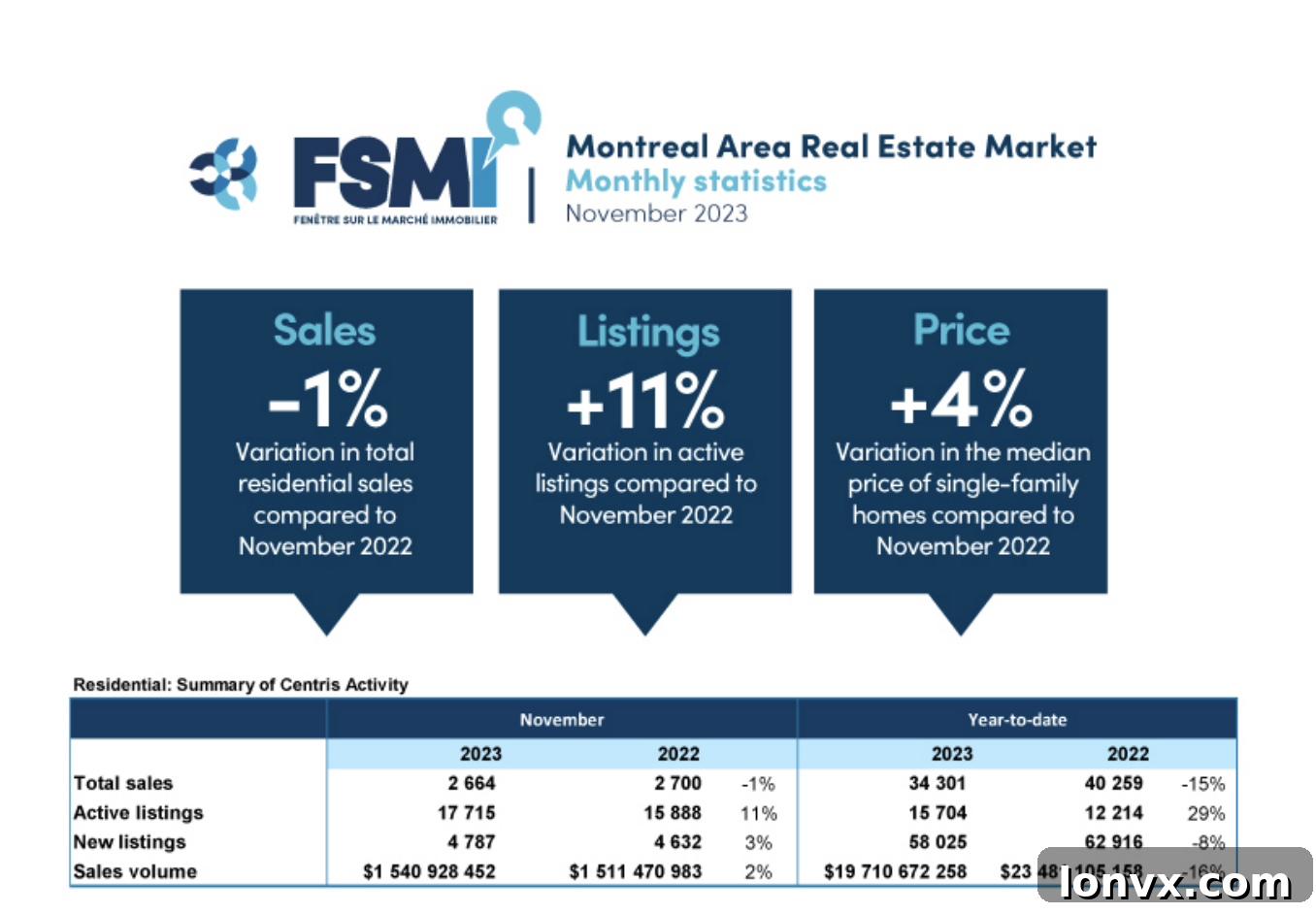
November proved to be a month of resilient stability for the Montreal CMA, despite a slight year-over-year decline. A total of 2,664 residential units were sold, representing a modest 1 percent decrease (equivalent to 36 fewer transactions) compared to November of the previous year. While this figure marks the second-lowest transaction level for this specific time of year since market data compilation began in 2000, it also suggests a degree of market equilibrium and a return to more sustainable activity levels after the frenetic pace of recent years.
One of the more encouraging developments was the increase in active listings across all property types, which surged by 11 percent in November compared to a year ago, reaching 17,715 units. This increase in available inventory is a welcome sign for buyers, as it brings the total closer to levels last observed in summer 2019. However, it’s crucial to note that despite this upward trend, the current inventory remains well below the long-term historical average, indicating that the market still favors sellers to some extent, particularly for highly sought-after properties.
Key Market Differentiators and Expert Commentary
Charles Brant, QPAREB’s Market Analysis Director, provided crucial context on Montreal’s unique position compared to other major Canadian metropolitan areas. “Unlike other large Canadian metropolitan areas such as Toronto and Vancouver, the residential market in the Montreal region is not experiencing a rapid increase in the number of properties returning to the market,” Brant noted. He attributed this divergence to Montreal’s comparatively lower property prices, which translate into lower debt levels for households and more manageable monthly mortgage payments. This affordability advantage acts as a buffer, preventing the kind of sharp inventory surges seen in more expensive markets where homeowners might be more compelled to sell due to financial pressures.
Brant further highlighted a significant challenge contributing to the subdued sales figures: “It should also be noted that the inability of some buyers to qualify for a mortgage is keeping sales at low levels, contributing to pressure on the rental market.” This illustrates the ripple effect of higher interest rates and stricter lending criteria. When prospective homebuyers are sidelined, demand for rental properties intensifies, potentially driving up rents and exacerbating affordability issues in the rental sector. However, this scenario presents an opportunity for investors. Brant added, “In this context, the market for small income properties seems to be finding renewed appeal among investors, as rates stabilize, while offering other advantages to those wishing to become owner-occupants.” This suggests that investors are looking for stable returns in a less volatile environment, while the potential for owner-occupants to gain rental income from a multi-unit property makes homeownership more accessible.
Price Trends in Montreal
Despite the slight dip in sales volume, median prices across all property types in the Montreal CMA showed healthy growth compared to November of last year. Condominiums saw a 4 percent increase, reaching a median price of $395,275. Single-family homes also experienced a 4 percent rise, with a median price of $539,700. Plexes, which include duplexes and triplexes, saw a 2 percent increase, bringing their median price to $731,250. These consistent price increases across property types underscore the underlying demand and the market’s continued strength, albeit at a more moderate pace than the rapid appreciation observed during the pandemic boom.
Quebec City CMA: A Market Seeking New Momentum
Source: QPAREB
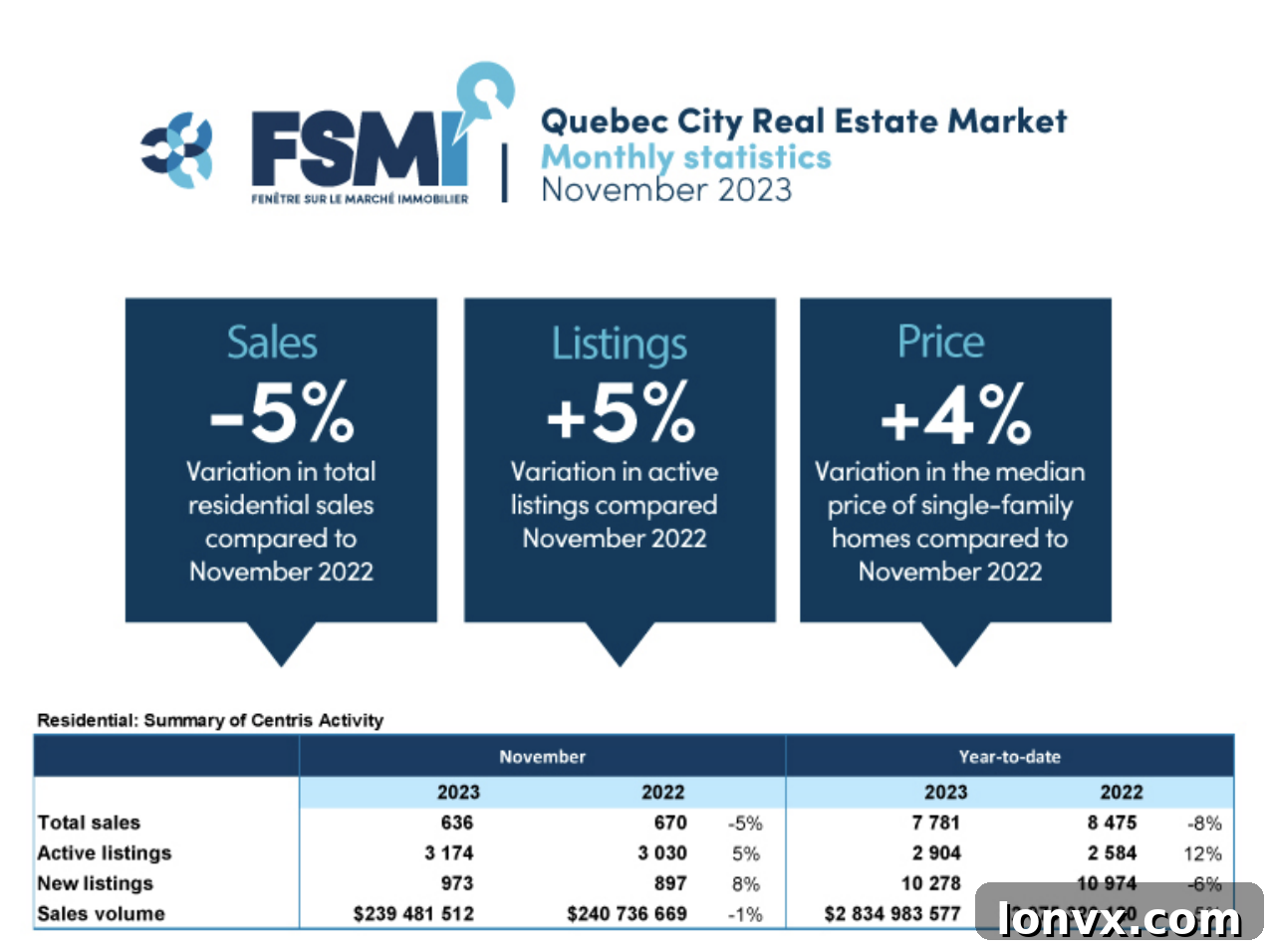
The Quebec City CMA presented a somewhat different picture in November. After four consecutive months of increases, the market experienced a slowdown, with 636 sales recorded. This represents a 5 percent decrease, or 34 fewer transactions, compared to November 2022, bringing the sales volume closer to the historical average for the region. This deceleration suggests that the market may be grappling with factors that temper buyer enthusiasm, such as the cumulative effect of higher interest rates and evolving affordability concerns.
Active listings in Quebec City saw a modest increase of 5 percent from last year, reaching 3,174 units. However, the distribution of this increase varied by property type. While single-family homes and plexes saw increases of 8 percent and 5 percent respectively, condominiums experienced a 3 percent decrease in available listings. This mixed trend indicates shifting preferences or supply dynamics within different segments of the housing market in the provincial capital.
Affordability Thresholds and Condo Market Dynamics
Charles Brant’s analysis for Quebec City highlighted an emerging challenge for single-family homes. “Activity in the Quebec City market is showing signs of running out of steam,” Brant observed. He explained that “while single-family homes are still relatively affordable, their price has reached a threshold which makes it more difficult for households to qualify for a mortgage. In the Quebec City region, half of the single-family homes sold above $360,500 in November.” This indicates that even in a market generally considered more affordable than Montreal, rising prices combined with higher interest rates are pushing some buyers out of the single-family home segment.
This challenge for single-family homes appears to be benefiting the condominium market. “The dynamic is therefore favourable to the condominium market, which holds the top spot in terms of transactional activity in November,” Brant noted. He elaborated on the appeal of condos, stating, “This property category is popular both with young homebuyers as well as with repeat buyers, usually around retirement age, in more upscale segments.” Condominiums offer a more accessible entry point for first-time buyers and a convenient, lower-maintenance option for those looking to downsize or seeking a different lifestyle in their later years, particularly in premium locations.
Price Movements in Quebec City
Median prices in the Quebec City CMA displayed a varied performance. Single-family homes, despite the sales slowdown, saw a 4 percent boost from the previous year, reaching $360,500. This reinforces Brant’s point about prices reaching an affordability threshold. Condominiums experienced a significant 16 percent increase, bringing their median price to $259,000, underscoring their growing popularity and demand. In contrast, plexes saw a slight decrease of 1 percent, settling at a median price of $389,000. These diverse price movements reflect the specific supply-demand imbalances and buyer preferences within each property category.
Broader Market Outlook and Key Takeaways
The QPAREB report for November paints a picture of a Quebec real estate market characterized by resilience in some areas and evolving dynamics in others. Montreal’s market demonstrates a stable, albeit subdued, environment where lower property prices relative to other major Canadian cities provide a cushion against rapid inventory surges and extreme financial pressures. The increasing interest in income properties reflects an adaptive investment strategy in response to current economic conditions and rental market pressures. Meanwhile, Quebec City is navigating a period of adjustment, where affordability thresholds for single-family homes are redirecting buyer attention towards the more accessible and increasingly popular condominium sector.
For potential homebuyers, understanding these regional specificities is crucial. While Montreal offers relative stability and lower debt burdens, the challenge of mortgage qualification remains pertinent. In Quebec City, the robust condominium market presents opportunities, especially for those seeking affordability or lifestyle changes. Investors, on the other hand, might find strategic advantages in multi-unit properties in Montreal or the growing condo segment in Quebec City, particularly as interest rates show signs of stabilization.
Looking ahead, the Quebec real estate market will continue to be influenced by prevailing economic factors, including the trajectory of interest rates, inflation control, and overall consumer confidence. The insights provided by QPAREB are invaluable for stakeholders to make informed decisions in a market that, despite its challenges, continues to demonstrate unique strengths and adaptive capabilities within the broader Canadian context.
Enjoying this article?
Get the latest real estate articles and insights delivered directly to your inbox 3x a week to stay informed on the Canadian real estate industry.