
The Canadian housing market commenced the year with a significant widening of the supply-demand gap across most large urban centers in January. According to a new report from RBC Economics, cautious buyers largely remained on the sidelines, even as inventories continued their upward climb. This period of heightened caution and increasing availability is placing renewed pressure on home prices, resulting in some of the most substantial year-over-year declines observed in many regions over recent years.
Rachel Battaglia, a seasoned economist at RBC, highlighted the persistent hesitancy among potential buyers, despite the elevated inventory levels typically affording them increased bargaining power. This indicates a broader market sentiment where factors beyond mere availability—such as economic uncertainty, the enduring impact of high interest rates, and a general “wait-and-see” approach—are profoundly influencing purchasing decisions and deterring immediate action.
Several external elements also contributed to January’s subdued market performance. Severe winter weather, characterized by heavy snowfall and widespread storms across various parts of the country, undoubtedly played a role in suppressing buyer activity and limiting property viewings. Furthermore, an unusual calendar configuration, with a higher number of working days compared to January of the previous year, might have statistically exaggerated some of the monthly trends. However, even when accounting for these transient influences, the underlying trend of significantly declining demand remained stark in numerous markets, particularly in historically active areas like Vancouver and the Fraser Valley, which experienced sharp contractions in sales activity.
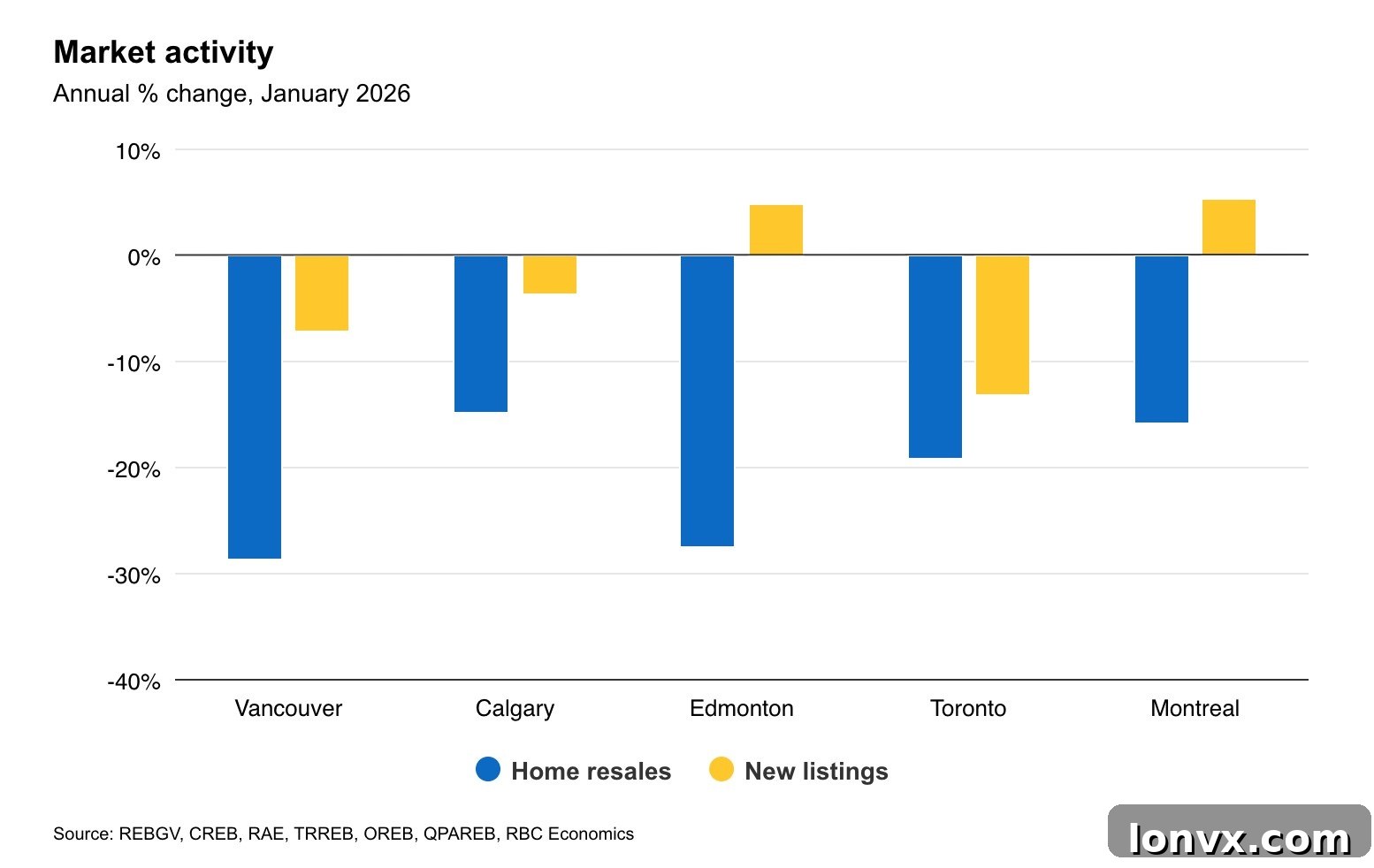
Beyond the West Coast, other major markets such as Edmonton, Winnipeg, and Saskatoon also posted notably weak results for the month, reflecting broader challenges. Even traditionally robust housing markets like Toronto and Montreal continued to show distinct signs of softening, grappling with recalibrating buyer expectations and an evolving supply landscape. In contrast to these trends, Calgary and Regina stood out as rare exceptions, recording increased buying activity amidst the prevailing national slowdown. This divergence underscores the highly regional nature of Canada’s housing market, where local economic conditions, relative affordability, and migration patterns can significantly influence individual market dynamics.
The consistent rise in housing inventories across the majority of regions throughout January is a pivotal development. This accumulation of available homes is directly contributing to renewed downward pressure on prices, leading to significant year-over-year price adjustments in numerous markets. For many homeowners and prospective buyers, these shifts represent a notable departure from the intense, seller-favored conditions of recent years, underscoring a transition towards a more balanced—and in some cases, buyer-favored—market environment.
Toronto’s Housing Market Under Sustained Pressure
The Greater Toronto Area (GTA), often considered a bellwether for the national housing market, continued its softening trend deep into January. Home resales in the region experienced a substantial decline of 9.9 percent on a seasonally adjusted basis compared to December. This marked the fourth consecutive monthly drop in sales, representing the steepest pullback in nearly a year and extending the challenging conditions that characterized much of the previous year. The sustained deceleration in sales activity indicates a more entrenched shift from the frenzied pace witnessed in earlier periods of the pandemic-era boom.
Ontario’s particularly harsh winter weather, including some of the largest snowfalls experienced in years, likely exacerbated this slowdown. Buyers, facing little urgency in a market that increasingly favors them due to higher inventory and reduced competition, were content to delay their purchasing decisions. This lack of immediate pressure is a stark contrast to previous years when buyers often felt compelled to act quickly or risk being outbid or missing out entirely on a property.
New listings, while not surging dramatically, rose modestly enough to keep the overall inventory of homes for sale higher than historical norms for this time of year. This persistently elevated inventory, combined with the subdued demand, created an environment where price pressures continued to mount significantly. The MLS Composite Home Price Index for the Toronto area vividly reflected this reality, falling by a notable eight percent year-over-year in January. This marked the 22nd consecutive annual decline and the sharpest drop recorded in three years, signaling a prolonged period of adjustment for one of Canada’s most expensive and dynamic housing markets. The persistent erosion of benchmark prices has substantial implications for both homeowners’ equity and the broader health of the regional economy.
Montreal Market Cools, Finds New Balance
In the Montreal metropolitan area, housing sales experienced a modest but noticeable slip of 1.4 percent from December, extending a gradual slowdown observed in late 2023. This tempering of demand has been significantly accompanied by a surge in new listings, primarily driven by an influx of condominium units entering the market. This increased supply has been instrumental in recalibrating the market dynamics, successfully bringing it closer to a state of equilibrium.
The sales-to-new listings ratio, a critical indicator of market balance, has settled into a more normalized range, suggesting that neither sellers nor buyers currently hold an overwhelming advantage. This shift is a welcome development for those seeking more predictable and less frantic market conditions. As a direct consequence of this rebalancing, price growth has already shown significant moderation. Annual gains in median single-family home prices have slowed considerably, moving away from the double-digit increases of the recent past. Similarly, condominium prices, which often lead market shifts, saw only a modest two percent rise compared to a year earlier, indicating a significant deceleration in appreciation and a push towards stability.
Despite the increase in new listings observed in January, the overall active listings in Montreal remain somewhat limited when viewed in a broader historical context. This suggests that while the market is more balanced now, a sustained improvement in buyer confidence, potentially fueled by anticipated interest rate cuts or a more stable economic outlook, could still lead to a resurgence in price growth later in the year. The relative scarcity of total available properties could quickly tip the scales back towards sellers if demand picks up significant momentum, highlighting the delicate balance currently at play.
Vancouver’s Housing Momentum Stalls Dramatically
January proved to be a month of sharp reversal for Vancouver’s housing market, effectively erasing the modest gains that had been tentatively posted in late 2023. Sales activity in the region plunged by nearly 30 percent from December, a significant contraction that vividly highlights the inherent fragility of buyer confidence in one of Canada’s priciest real estate landscapes. This dramatic downturn underscores the profound sensitivity of the Vancouver market to broader economic headwinds, particularly interest rate fluctuations and affordability constraints.
Resales in Greater Vancouver now sit significantly below the 10-year seasonal average, indicating a prolonged period of suppressed activity compared to historical norms. Concurrently, listings have swelled to levels well above their historical averages, creating a pronounced imbalance that continues to strongly favor buyers. This dynamic provides purchasers with a greater abundance of options, more time to make informed decisions, and increased leverage in negotiations, representing a stark departure from the intense bidding wars that once characterized this highly competitive market.
The Greater Vancouver benchmark price continued its downward trajectory, declining by 5.7 percent year-over-year in January. This marks nearly a full year of continuous annual declines, reflecting the sustained pressure on property values. The combination of significantly reduced sales volumes and persistent price erosion suggests that Vancouver’s market is undergoing a substantial correction, driven by severe affordability challenges and a cautious buyer pool patiently waiting for clearer signals on future market direction and potential interest rate adjustments.
Calgary: Navigating Higher Sales Amidst Rising Supply
Defying the broader national trend of cooling demand, Calgary’s housing market recorded a healthy 7.3 percent increase in sales in January. This uptick in purchasing activity suggests a degree of resilience in the local economy and continued attractiveness for buyers, possibly driven by factors such as interprovincial migration and relatively better affordability compared to more expensive markets like Vancouver or Toronto. However, this positive sales momentum was somewhat overshadowed by an even larger jump in new listings entering the market during the same period.
The significant influx of new properties for sale means that despite increased buyer interest, elevated inventory levels continue to exert downward pressure on prices. The composite benchmark price in Calgary declined by 4.7 percent from a year earlier, illustrating the persistent challenge of absorbing new supply even with robust demand. Notably, detached homes in Calgary have shown greater resilience and have held up better in terms of price stability compared to higher-density units like condominiums or townhouses, indicating a distinct preference for more traditional housing types among current buyers in the region.
With significant residential construction still actively underway across the city, RBC Economics anticipates that housing supply will remain elevated in Calgary for the foreseeable future. This sustained high level of inventory is likely to limit any significant shift back toward seller-friendly conditions, at least without a considerably stronger and more sustained rebound in buyer demand. Calgary’s market therefore presents a unique scenario of active sales growth concurrently battling substantial supply increases, making it a critical market to observe for broader Canadian housing trends.
A Broader Look at Other Canadian Markets
Beyond these major urban centers, the RBC report also highlighted notable weaknesses in several other key Canadian housing markets. The Fraser Valley, contiguous with Vancouver, mirrored the general slowdown of the West Coast, experiencing similar pressures of declining demand and increasing inventory. Edmonton, Winnipeg, and Saskatoon, representing significant urban hubs in the Prairies, also reported soft results for January. These markets, while perhaps not facing the extreme affordability challenges of Toronto or Vancouver, are still influenced by analogous factors such as higher borrowing costs and general economic uncertainty, leading to more cautious buyer behavior across the board.
In contrast, Regina, much like Calgary, demonstrated an increase in buying activity for the month. This resilience in certain prairie cities often stems from comparatively lower entry prices, making homeownership more attainable for a wider segment of the population, and potentially from more stable local economies that are less susceptible to volatile national market fluctuations. The varying performance across these diverse markets critically underscores the highly regional nature of Canada’s housing landscape, where national averages can sometimes mask distinct and important local realities that drive investment and purchasing decisions.
The Road Ahead: What to Expect for the Canadian Housing Market
As the Canadian housing market navigates the early months of the year, the trends observed in January set a distinctly cautious tone for what lies ahead. The widening gap between supply and demand, coupled with persistent buyer hesitancy, strongly suggests that the market will likely remain balanced, if not slightly buyer-favored, in many regions throughout the first half of the year. The primary catalyst for a significant shift in dynamics is widely expected to be the trajectory of interest rates. Anticipation of potential rate cuts by the Bank of Canada later in the year is a major factor influencing current buyer caution, as many are opting to wait for the prospect of lower borrowing costs before fully re-entering the market.
Should interest rates begin to fall, it could unlock significant pent-up demand, particularly in markets where affordability remains a substantial hurdle. However, the extent and speed of any such rebound will also depend crucially on broader economic stability, robust employment rates, and renewed consumer confidence. The continued influx of new housing supply, especially in growth areas like Calgary, will also play a pivotal role in preventing a rapid return to overheated conditions, even if demand strengthens considerably. Government policies related to housing supply and immigration will also continue to shape these evolving dynamics.
Ultimately, the Canadian housing market is undergoing a profound period of recalibration. After several years of unprecedented growth and intense competition, it is actively adjusting to higher interest rate environments and evolving buyer expectations. While challenges persist in terms of affordability and market uncertainty, the increased inventory offers a tangible window of opportunity for buyers who are well-positioned and patient. The coming months will be critical in determining whether January’s cautious start evolves into a sustained period of market rebalancing or if external factors, such as economic stimulus or significant policy changes, trigger a new and transformative phase of activity.