
In the competitive world of real estate, standing out from the crowd is often key to success. However, two London, Ontario realtors, Johnny Hewerdine and Tristan Squire-Smith, recently found themselves in the spotlight not just for their innovative marketing, but for the controversial nature of their approach. Their story highlights a growing tension between traditional industry norms and a desire for authentic, disruptive advertising that resonates with modern consumers.
Hewerdine and Squire-Smith made headlines when they were reportedly terminated from their previous brokerage, a decision attributed to “professional differences” stemming from their use of what some considered polarizing content in their billboard and social media campaigns. While their former brokerage and the specific reasons for their departure remain undisclosed by the agents themselves, the incident quickly sparked conversation across the real estate community and beyond.
The duo’s distinctive marketing style, centered around their now-infamous slogan, “You could do worse,” had graced local billboards for several months before the situation escalated late last year. According to the realtors, many consumers embraced the slogan, finding its candidness refreshing and unlike the typical real estate advertisements that flood the market. Yet, this positive public reception was not universally shared within the industry, leading to significant pushback from competitors and other professionals who deemed the slogan unprofessional and, some felt, belittling to their peers.
The Slogan at the Heart of the Matter: “You Could Do Worse”
The phrase “You could do worse” is deceptively simple, yet it ignited a firestorm of debate. On one hand, it’s a bold, understated confidence booster; on the other, it can be interpreted as a subtle jab at the competition. Hewerdine and Squire-Smith, who are not an official team but lifelong friends who met on the varsity swim team at Western University, insist their intent was never to offend. Their collaboration, built on two decades of friendship and mutual support on deals, is rooted in a desire to inject authenticity and levity into an often-stuffy industry.
Hewerdine, with five years in the business, and Squire-Smith, with approximately two, explain that their approach is a genuine reflection of who they are. “We’re two blue-collar guys. To be successful, we need to be as authentic as possible,” Hewerdine states. “We inject a sense of levity. A lot of people appreciate that approach.” Squire-Smith reinforces this, adding, “All our ads are objectively compliant. There’s nothing underhanded.”
The core of the misunderstanding, it appears, lay in the interpretation. Many in the industry perceived “You could do worse” as an implicit declaration of superiority, a subtle insinuation that other agents simply weren’t as good. However, for Hewerdine and Squire-Smith, it was merely their way of “doing their thing”—a lighthearted, self-aware expression of their value proposition without overt boasting. This divergence in perception underscores the fine line between confident marketing and perceived arrogance, especially in a professional field often governed by specific codes of conduct and decorum.
“We’re two blue-collar guys. To be successful, we need to be as authentic as possible…We inject a sense of levity. A lot of people appreciate that approach.”
– Johnny Hewerdine, real estate agent
A Bold Stance: Embracing Authenticity and Disruptive Marketing
The realtors characterize their marketing philosophy as “disruptive marketing.” This isn’t just a catchy phrase; it’s a strategic choice to humanize the real estate industry through humor, irony, and a refusal to conform to conventional imagery. They consciously avoid the ubiquitous real estate agent stereotype: the impeccably dressed professional, arms crossed, proudly displaying a wall of awards on a billboard. “In an industry that presents itself through awards, we go and do the opposite,” Hewerdine asserts.
This commitment to disruption extends far beyond their slogan. Their marketing materials, particularly their single, regularly updated billboard in London, are a testament to their creativity and willingness to poke fun at themselves and the industry’s pretensions. Past campaigns have featured them comically touting their “zero awards won” (a fact they humorously confirm as accurate), hoisting underwear up flagpoles, or presenting awkward teenage photos complete with pimples, braces, and even a graduation robe. These visuals are designed to grab attention, evoke a laugh, and ultimately make them more relatable to potential clients seeking a less formal, more genuine experience.
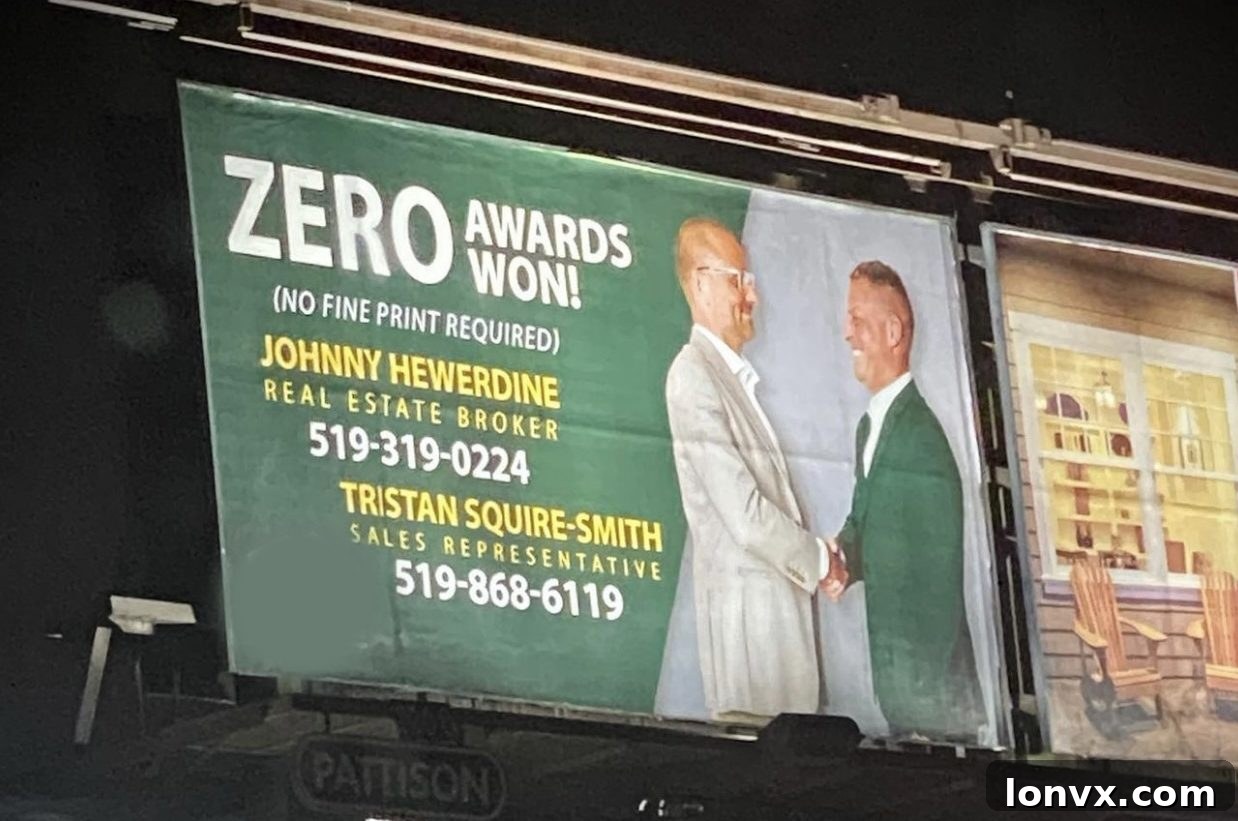
Source: Johnny Hewerdine and Tristan Squire-Smith
Beyond the Slogan: A Visual Feast of Unconventionality
Their marketing arsenal also includes a penchant for dramatic, often explosive, visual effects in their “signature listing videos.” While they enthusiastically declare their love for “explosions!” with roaring laughter, they are quick to clarify that these effects are achieved safely and professionally using green screen technology and expert video editing. This theatrical flair adds another layer to their brand, transforming property listings from mundane tours into engaging, memorable cinematic experiences. The goal is to make the entire process of buying or selling a home, which can be inherently stressful, more enjoyable and less intimidating.
Barb Potempa, a satisfied client who recently sold her London-area home with their assistance, is a vocal proponent of their unique style. She describes their “thing for flames” and their constant “burning or blowing things up” as part of their “out-of-the-box approaches.” Potempa enthusiastically embraced their “you could do worse” slogan, believing that those who take offense are “taking this way too seriously.” For her, Hewerdine and Squire-Smith excel at bringing “laughter to a stuffy industry” and making the stressful journey of real estate more palatable through humor and genuine engagement.

Tristan Squire-Smith (left) and Johnny Hewerdine
The Power of Niche Marketing: Attracting the Right Clients
Despite the controversy and their bold approach, Hewerdine and Squire-Smith are acutely aware that their brand of humor and directness isn’t for everyone. They openly acknowledge that they “water it down” for more cautious clients, recognizing that consumer preferences vary widely. This self-awareness is central to their successful business model. “Consumers either love it or hate it,” Hewerdine explains. “If they hate it, we’ve saved everybody time, and they can find someone more conventional.”
This pragmatic view underpins their strategy of niche marketing. “You can’t please everybody,” he continues. “We target like-minded consumers, which makes our business efficient. People call it a niche approach as if that’s a negative. But every business needs a niche.” In an oversaturated market, carving out a distinct identity and appealing to a specific demographic can be far more effective than trying to be everything to everyone. By attracting clients who appreciate their authenticity and humor, they foster stronger, more productive working relationships built on mutual understanding and shared values. This focused approach allows them to operate more efficiently, investing their energy and resources into clients who genuinely resonate with their brand.
Their collaborative dynamic is also a key component of their success. “Together, all our skills are complementary. We couldn’t do it on our own,” Hewerdine states, highlighting the synergy between their individual talents. “We’re a bottomless pit of ideas.” This continuous wellspring of creativity ensures their marketing remains fresh, engaging, and always one step ahead, continually pushing the boundaries of what’s expected in real estate advertising.
Navigating Industry Pushback and Maintaining Professionalism
The termination from their previous brokerage could have been a significant setback, but Hewerdine and Squire-Smith transitioned seamlessly to a new one, continuing their distinctive marketing efforts without missing a beat. Their decision not to name either their former or current brokerage, as Squire-Smith explains, stems from “a desire to maintain professionalism and strong working relationships with our peers while mitigating any outside chance of litigation.” This demonstrates a commitment to professional conduct despite the unconventional nature of their brand, illustrating that their disruptive approach to marketing does not equate to a disregard for industry ethics or camaraderie.
Their journey highlights a broader challenge within many established industries: how to embrace innovation and authenticity without alienating traditionalists or infringing on professional standards. Hewerdine and Squire-Smith are not merely selling homes; they are selling an experience, a perspective that champions genuineness and humor in a field often characterized by formality. Their story serves as a compelling case study in brand differentiation and the courage to remain true to one’s vision, even in the face of controversy.
The Future of Hewerdine and Squire-Smith: Breaking the Glass Ceiling
With a new billboard slated for release in the coming months, London’s real estate landscape can anticipate more surprises and, likely, more raised eyebrows. Hewerdine and Squire-Smith are not content to merely exist within the industry; they aim to redefine it, one unconventional campaign at a time. “We’re breaking that glass ceiling, baby,” Hewerdine playfully declares, a sentiment that encapsulates their audacious spirit and their unwavering commitment to pushing boundaries.
Their ongoing story is a testament to the evolving nature of marketing and the increasing demand for authenticity in business. In an era where consumers are bombarded with advertisements, those that truly stand out, that spark conversation, and that dare to be different are often the ones that leave a lasting impression. Johnny Hewerdine and Tristan Squire-Smith are doing just that, proving that sometimes, in real estate, “you could do worse” than to simply be yourself.
Editor’s note: The contributed photos have been edited by the subjects to remove the name of their brokerage.