
Navigating Canada’s Evolving Real Estate Landscape: Trends, Affordability, and Future Outlook
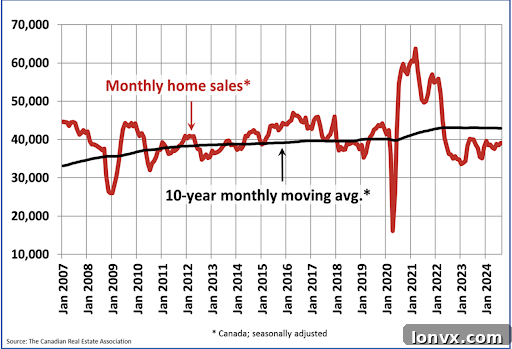
The Canadian real estate market is currently navigating a period of significant transformation, marked by a delicate interplay of fluctuating interest rates, evolving buyer sentiment, and shifting supply-demand dynamics. Following the Bank of Canada’s initial interest rate adjustments, an intriguing pattern has emerged: home sales have shown an uptick as potential buyers experience improved affordability. However, this recovery remains cautious, with overall sales volumes still considerably below their long-term historical averages, indicating a market that is far from fully rebounding to pre-pandemic vigour.
While the market celebrates a modest increase in sales activity, a comprehensive price recovery remains elusive. Nevertheless, momentum is building. National home sales volume demonstrated a notable 1.3 per cent month-over-month increase in August, achieving its highest level since January 2020. This upward trajectory in sales, coupled with other indicators, paints a picture of a market gradually finding its footing after a turbulent period.
The Rise of New Listings and a Shifting Market Balance
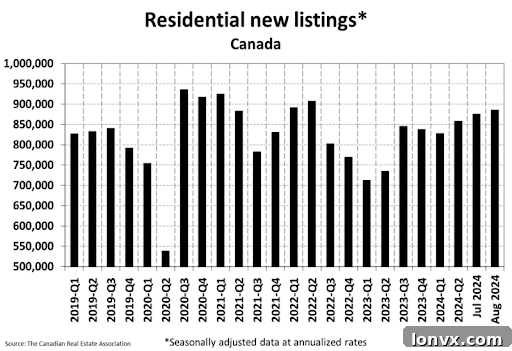
Concurrently with the rise in sales, the volume of new listings continues to expand, marking the fourth consecutive month of increased inventory. This sustained accumulation of new properties entering the market is a critical factor influencing the future trajectory of Canadian real estate. If the current trend persists, where supply continues to outpace demand, the market is poised to transition further into a buyer-friendly environment. This shift would grant buyers greater negotiation power, more choice, and potentially more stable or even declining prices, moving away from the seller-dominated conditions seen in recent years.
The growing inventory of homes for sale is a welcome development for many prospective purchasers who have been sidelined by intense competition and rapidly escalating prices. For the market to achieve true equilibrium, a healthy balance between supply and demand is crucial. The current trend suggests a movement towards this balance, but the full implications for pricing and market velocity are still unfolding.
Looking ahead, the market is rife with cautious optimism. Expectations of further interest rate reductions into 2025 are fueling hopes among potential buyers and investors. Such cuts would likely enhance borrowing capacity and further improve affordability, potentially unlocking pent-up demand and stimulating greater market activity. However, this optimism is tempered by the understanding that a full-scale market resurgence depends on a confluence of sustained economic stability, continued affordability improvements, and a balanced approach from policymakers.
Regional Dynamics: Edmonton, Calgary Surge While GTA Adjusts
Despite the national uptick in sales, the Canadian real estate market exhibits distinct regional variations. Many buyers across the country remain in a holding pattern, strategically awaiting more favourable affordability conditions before committing to major purchases. This sentiment contributes to a somewhat stalled national market, even as certain regions show stronger activity.
Nationally, the number of newly listed properties saw a 1.1 per cent month-over-month increase in August, bringing the total available properties to approximately 177,450. This represents a significant 18.8 per cent increase from the previous year, yet it still falls short of historical averages, indicating that while supply is growing, it hasn’t reached levels typically associated with a fully robust, balanced market.
A striking development for the second consecutive month has been the substantial boost in new supply originating from Calgary, with Edmonton also registering a noticeable rise in listings. This surge in newly listed properties in Alberta’s major urban centres has played a crucial role in offsetting a decline observed in the Greater Toronto Area (GTA). This divergence highlights the varying economic and demographic pressures influencing different markets across Canada. Alberta’s relative affordability and strong economic performance, particularly in the energy sector, may be attracting inter-provincial migration and stimulating local market activity, contrasting with the more expensive and potentially oversupplied segments of the GTA market.
Understanding the Sales-to-New-Listings Ratio: A Measure of Market Balance
The sales-to-new-listings ratio is a vital indicator of market balance, offering insight into the intensity of competition and price pressures. A higher ratio typically signals a seller’s market, where demand outstrips supply, leading to quicker sales and upward price pressure. Conversely, a lower ratio often indicates a buyer’s market, characterized by ample inventory and more negotiation room for purchasers.
In the most recent period, the national sales-to-new-listings ratio experienced a slight increase, reaching 53 per cent. This figure matches the level recorded in April, suggesting a degree of stability in market conditions. However, it’s important to contextualize this against past market highs. The current ratio remains a considerable distance from the peak of 81 per cent achieved in December 2023, which represented an exceptionally strong seller’s market.
Since January’s 46 per cent and February’s 52 per cent, the ratio has demonstrated relative and consistent stability. This consistency, despite month-over-month fluctuations, suggests that the market is neither rapidly overheating nor dramatically cooling down on a national level. Matching the April 2024 average provides some reassurance, indicating that the market is maintaining a steady, albeit moderate, pace in terms of demand absorbing new supply. This stability is crucial for fostering confidence among both buyers and sellers, allowing for more predictable market behaviour.
Price Dynamics: The Post-2022 Recoil and Current Stagnation
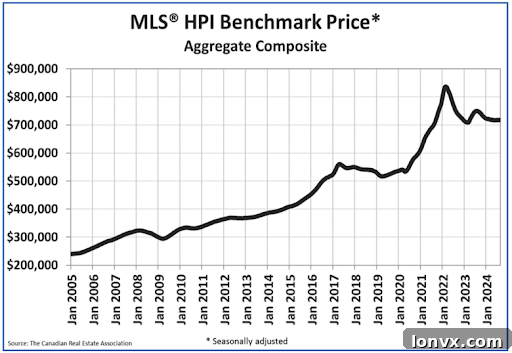
The trajectory of Canadian home prices has been marked by dramatic swings in recent years. After reaching unprecedented record highs in 2022, the market experienced a swift and significant recoil, with prices dropping almost as rapidly as they had ascended. This sharp correction was largely in response to aggressive interest rate hikes by the Bank of Canada, aimed at cooling an overheated market and combating inflation.
Since hitting the bottom of this recoil, the national housing market has largely settled into a period of stagnation. There has been very little decisive upward or downward momentum in prices, creating a challenging environment for both buyers seeking clear indicators of future value and sellers hoping for renewed appreciation. This lack of clear direction reflects the ongoing tug-of-war between improved affordability from rate cuts and the persistent high cost of living, combined with increased inventory levels in some areas.
This period of price stability, while perhaps frustrating for those hoping for rapid gains, can also be seen as a necessary consolidation phase for the market. It allows for a re-evaluation of values and a recalibration of expectations among participants, potentially laying the groundwork for more sustainable growth in the long term, once economic conditions and interest rate policies provide clearer signals.
Significant Fluctuations in GTA Condominium Market
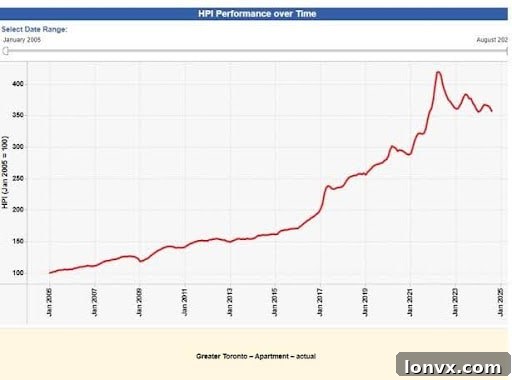
While the national price trends show overall stability, specific market segments and regions are experiencing more pronounced volatility. The condominium apartment market in the Toronto area, particularly, has been subject to significant fluctuations. After experiencing an all-time high price, mirroring the broader market’s peak, GTA condos underwent a substantial recoil. This “blow-off top” was followed by a series of bounces, indicating periods of price adjustments and renewed, albeit often short-lived, market interest.
The GTA condo market is a unique beast, heavily influenced by investor activity, population growth, and housing affordability constraints that push buyers towards more compact living options. However, increased supply, particularly of new construction, combined with higher interest rates impacting mortgage qualification and investor returns, has contributed to this pronounced volatility. The market’s sensitivity to these factors means that condo prices can react more sharply to economic shifts than other property types.
Source: x.com/Tablesalt13/
The outlook for GTA condominiums for 2025 appears challenging. Projections suggest that prices could approach the 350 margin, which would represent a significant drop from the January 2022 high of approximately 450, potentially nearing a record low. This bearish forecast underscores the significant headwinds facing this segment of the market, including continued high inventory, affordability pressures, and possibly less investor enthusiasm in a higher-interest-rate environment. Buyers in this market are likely to find more leverage, while sellers may need to adjust their expectations.
The Road Ahead: Affordability, Interest Rates, and Market Evolution
The Canadian real estate market is undeniably at a crossroads. The cautious optimism stemming from potential future rate cuts is a significant driver of current sentiment. Lower interest rates directly translate to reduced borrowing costs, making homeownership more accessible and potentially stimulating demand. However, the Bank of Canada’s decisions will continue to be data-dependent, balancing inflation targets with economic growth. Any further cuts would need to be carefully calibrated to avoid re-igniting unsustainable price growth, particularly in historically hot markets.
Affordability remains a central theme. While rate cuts help, the fundamental challenge of high home prices relative to income persists in many major urban centres. Policies aimed at increasing housing supply, streamlining development, and assisting first-time buyers will be critical in addressing this long-standing issue. The disparity between regions, with provinces like Alberta offering more attainable housing, highlights the need for tailored solutions rather than a one-size-fits-all approach.
The shift towards a buyer’s market in some segments, characterized by increasing inventory and stable sales-to-new-listings ratios, suggests a move towards a healthier, more balanced market. This evolution is beneficial for long-term sustainability, reducing the risk of speculative bubbles and fostering a more equitable environment for all participants. However, it also means that rapid price appreciation, characteristic of the recent past, is unlikely to return soon.
Looking to 2025 and beyond, the Canadian real estate market will likely be defined by continued adaptation. External economic factors, global events, and domestic policy decisions will all play a role in shaping its trajectory. Buyers will need to remain discerning, focusing on fundamentals and long-term value, while sellers will need to adjust to a more competitive landscape. The resilience and adaptability of the market will be tested, but the current trends suggest a gradual, albeit complex, path towards rebalancing.