
Canada’s Housing Market: A Deep Dive into Royal LePage’s 2023 Forecast and Regional Insights
The Canadian housing market has experienced unprecedented volatility in recent years, making reliable forecasts more critical than ever for buyers, sellers, and investors. As 2023 approaches, industry experts are weighing in on the trajectory of home prices and market activity. Royal LePage, a prominent real estate services provider, has released its comprehensive Market Survey Forecast, offering a detailed outlook for Canada’s national aggregate home price, alongside specific projections for major metropolitan areas. This insightful report suggests a period of adjustment followed by a modest recovery, shaping a nuanced landscape across the country.
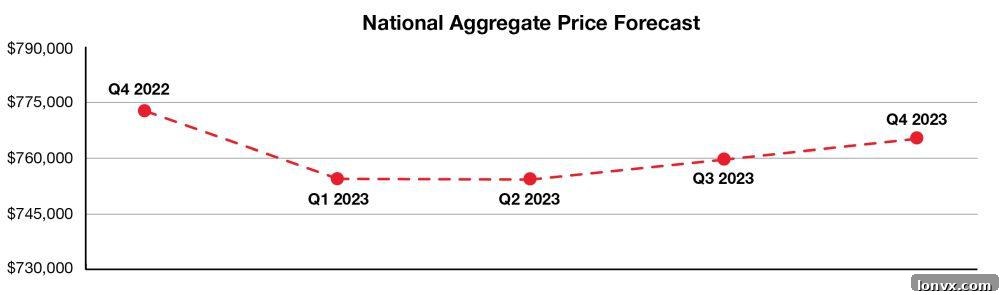
According to Royal LePage’s analysis, Canada’s national aggregate home price is anticipated to conclude 2023 approximately one percent below the levels observed in the fourth quarter (Q4) of 2022. This projection reflects an ongoing market correction, largely influenced by rising borrowing costs and a shift in buyer sentiment following the intense activity of the pandemic era. The forecast outlines a distinct two-phase trajectory for the year: an initial period of more pronounced declines in the first quarter, followed by a gradual stabilization and modest price growth in the latter half of the year.
Specifically, the first quarter of 2023 is expected to witness double-digit year-over-year declines. This is attributed to comparing the current, quieter market conditions with the historically high prices recorded during the final weeks of 2022’s pandemic-driven housing frenzy. However, the outlook brightens as the year progresses. Royal LePage anticipates prices to flatten on a quarter-over-quarter basis in the second quarter, leading to a modest improvement in the second half of 2023. This upward trajectory is expected to continue, allowing the market to conclude the year on a more positive note, essentially aligning Canadian home values with where they stand today.
Key Dynamics Shaping the 2023 Canadian Housing Market
The Canadian housing market’s performance in 2023 will be influenced by several intertwined factors. Understanding these underlying dynamics is crucial for interpreting the regional forecasts and making informed decisions.
Interest Rates and Affordability Challenges
Rapidly rising borrowing rates have been a primary catalyst for the current market correction. As the Bank of Canada aggressively increased its overnight rate, mortgage costs soared, significantly impacting buyer affordability and dampening demand. Phil Soper, President and CEO of Royal LePage, emphasized that “the frenzied housing market overshot, and the inevitable downward slide or market correction began, intensified by rapidly rising borrowing rates.” While this led to a steep drop in sales volume, home prices have shown resilience, experiencing relatively modest declines compared to the peak.
The stabilization of interest rates is widely considered a pivotal factor for market recovery. Royal LePage predicts that restored consumer confidence, once interest rates stabilize, will encourage many buyers who have adopted a ‘wait-and-see’ approach to re-enter the market. This renewed demand, coupled with persistent supply issues, could contribute to the projected modest price growth in the latter half of 2023. However, higher borrowing costs will continue to limit purchasing power, particularly for first-time buyers, influencing the types of properties in demand.
Persistent Housing Supply Shortage and Pent-Up Demand
Despite the recent downturn in market activity, Canada continues to grapple with a long-term housing supply shortage. This structural issue acts as a critical buffer, preventing more severe price corrections. Even with reduced transaction volumes, the scarcity of available homes on the market helps maintain a floor under prices. Complementing this, a significant pool of pent-up demand exists from qualified buyers who possess the financial capacity to transact but have opted to delay their purchases during these turbulent times. As market confidence returns and interest rates stabilize, this dormant demand is expected to reactivate, further supporting prices and potentially leading to tighter competition in popular segments.
Condominiums Poised for Outperformance in Most Major Markets
A notable trend identified in the Royal LePage forecast is the expected outperformance of condominium prices compared to single-family homes in the majority of major Canadian markets. This shift is largely a direct consequence of affordability challenges driven by higher interest rates. As purchasing power diminishes, buyers, especially first-time entrants, are increasingly gravitating towards more budget-friendly housing options. Condominiums typically offer a lower entry point into the housing market, making them an attractive alternative in an environment of elevated borrowing costs. This dynamic is anticipated to drive modest price appreciation in the condo segment, even as single-family home prices experience more significant adjustments in some regions. Edmonton and Winnipeg are the only exceptions where single-family homes are still expected to see stronger performance than condos.
Price Evolution: From Peak Declines to Gradual Recovery
The year 2023 will see a progression in price dynamics. As Phil Soper explained, “Comparing prices to the previous year, the first quarter of 2023 should show the deepest decline in home values.” This is due to the comparison with the extreme market conditions of early 2022. However, as the year advances, year-over-year comparisons are projected to show progressively less price decline. Small week-to-week improvements are anticipated in the third and fourth quarters, allowing Canadian home values to essentially end 2023 flat relative to current levels. It is important to note that despite the recent corrections, home prices remain considerably above pre-pandemic levels, underscoring the significant gains made in previous years. Royal LePage projects the aggregate price of a home in Canada in Q4 2023 to be 15 percent higher than Q4 2020 and 18.4 percent above Q4 2019 levels.
Source: Royal LePage
Regional Market Spotlights: A City-by-City Outlook for 2023
While national trends provide a broad overview, the Canadian housing market is inherently regional. Each major city faces unique local conditions that will shape its specific performance in 2023. Royal LePage’s forecast provides granular insights into these distinct markets.
Greater Toronto Area (GTA)
The Greater Toronto Area, historically one of Canada’s hottest markets, is expected to see a moderate correction. Royal LePage forecasts the aggregate price of a home in the GTA to decrease by two percent year-over-year, reaching approximately $1,056,734 in Q4 2023. This regional aggregate reflects a divergence in property types: the median price of a single-family detached property is anticipated to decline by 2.5 percent to $1,329,413, while condominiums are forecast to show modest growth, increasing by one percent to $701,243. This trend highlights the increasing role of affordability in driving demand towards the condo segment. Market activity levels in the GTA are predicted to pick up by mid-2023, contingent on the stabilization of interest rates and a resurgence of consumer confidence, signaling a potential return to more balanced conditions.
Greater Montreal Area
In the Greater Montreal Area, the aggregate price of a home is projected to decrease by two percent year-over-year, settling at around $532,238 in Q4 2023. Mirroring trends in other major cities, single-family detached properties are expected to see a 2.5 percent decrease to $588,315. Notably, unlike Toronto and Vancouver, Montreal’s condominium segment is also forecast to experience a slight dip, with a 1.5 percent decrease to $421,383. Royal LePage anticipates a continued slight decrease in prices during the first half of the year, followed by a modest rebound in the subsequent six months, once interest rates stabilize. This stabilization is expected to draw many ‘wait-and-see’ buyers back into the market. Furthermore, Montreal’s relative affordability compared to other major Canadian cities is likely to attract interprovincial buyers, although the market has begun to feel the effects of the two-year ban on foreign buyers, which officially commenced on January 1st.
Greater Vancouver
Greater Vancouver’s housing market is expected to experience a one percent year-over-year decrease in its aggregate home price, bringing it to an estimated $1,216,611 in Q4 2023. Within this, the median price of a single-family detached property is forecast to decline by two percent to $1,644,538, while condominiums are projected to show resilience with a one percent increase to $747,299. Despite a noticeable decrease in demand during the latter half of 2022, a persistent lack of available inventory has played a crucial role in preventing more significant price declines. Should activity pick up in the new year as anticipated, Royal LePage warns that tight competition among buyers, particularly in segments where inventory remains constrained, could become a significant challenge, perpetuating upward pressure on prices.
Ottawa
The nation’s capital, Ottawa, presents a somewhat more optimistic outlook than its larger counterparts. Royal LePage predicts that the aggregate price of a home in Ottawa will increase by two percent year-over-year in Q4 2023, reaching $739,602. This growth is expected to be led by condominiums, which are forecast to appreciate by two percent to $378,114, surpassing the one percent rise predicted for single-family detached properties ($850,117). The higher borrowing costs are a key driver here, limiting buyers’ purchasing power and funneling demand into the more affordable condo market. However, interest rates will remain a significant factor, with a potential resurgence in buyer demand if rates stabilize or decline. Sales are also expected to gradually increase, partly due to depleted inventory levels, indicating a shift towards a sellers’ market in specific segments.
Calgary
Calgary’s housing market is projected to demonstrate healthy growth, with the aggregate home price expected to increase by 1.5 percent year-over-year to $612,451 in Q4 2023. The median price of a single-family detached property is predicted to rise by one percent to $701,142, while condominiums are forecast to see stronger appreciation, increasing by 2.5 percent to $239,543. The entry-level market, especially the condominium segment, has already recorded double-digit sales growth, signaling its appeal. Calgary is also expected to benefit significantly from demand from out-of-province buyers, particularly first-time homebuyers relocating from Ontario and investors seeking more affordable opportunities. The prevailing lack of available inventory will continue to exert upward pressure on prices, especially in the lower end of the market, indicating strong competition for available properties.
Edmonton
Edmonton’s housing market is anticipated to see a modest increase in the aggregate price of a home, rising one percent year-over-year to $442,683 in Q4 2023. Unlike many other major cities, single-family detached properties are expected to lead this growth with a two percent increase to $491,436, while condominiums are forecast to decrease by 1.5 percent to $198,281. Similar to Calgary, strong interprovincial demand, particularly from buyers relocating from Ontario and British Columbia, is expected to maintain a healthy and balanced market. This robust demand is predicted to continue into the beginning of the new year, with the market gradually returning to more typical seasonal trends as 2023 progresses, reflecting the city’s relative affordability and economic appeal.
Halifax
Halifax is forecast to experience a slight increase in its aggregate home price, rising 0.5 percent year-over-year to $479,285 in Q4 2023. Both single-family detached properties and condominiums are expected to see modest gains; the median price of a single-family home is projected to increase by 0.5 percent to $544,610, and condos by 1.5 percent to $407,015. After sales volumes reached a two-decade low in 2022, Royal LePage anticipates a resurgence in housing demand by spring. The region continues to face low inventory levels, and without a significant increase in supply, the projected rise in demand will inevitably exert upward pressure on prices. The Halifax housing market is expected to revert to more normal seasonal trends in 2023, supported by continued population growth and its attraction for both domestic and international buyers.
Winnipeg
In Winnipeg, the aggregate price of a home is expected to decrease by one percent year-over-year to $368,181 in Q4 2023. Single-family detached properties are projected to show resilience with a one percent increase to $410,565, while the median price of a condominium is forecast to decrease by three percent to $243,082. Housing supply levels in the region are expected to remain low but may see improvements in the new year as ongoing supply chain challenges ease and housing starts pick up pace. Demand for single-family homes is anticipated to drive the most activity in the market. Despite lower condo prices, inventory levels remaining below the five-year average suggest that significant declines are unlikely. Overall, the Winnipeg market is expected to transition towards a more balanced state, provided interest rates stabilize, offering more predictable conditions for participants.
Regina
Regina’s housing market is forecast to experience a 1.5 percent year-over-year decrease in the aggregate price of a home, reaching $361,495 in Q4 2023. The median price of a single-family detached property is expected to decline by two percent to $389,648, while condominiums are projected to see a one percent increase to $221,796. Any price appreciation in the region is anticipated to be concentrated in the condominium segment and the lower end of the market, as higher mortgage rates have priced some buyers out of single-family homes. A concerning trend highlighted in the forecast is an increase in foreclosures in Regina this year, a pattern expected to continue into 2023 as overleveraged homeowners face the renewal of their previously low fixed-rate mortgages, potentially adding more inventory to the market under distressed conditions.
Conclusion: A Year of Adjustment and Gradual Stabilization
The Royal LePage Market Survey Forecast for 2023 paints a picture of a Canadian housing market undergoing a necessary period of adjustment. While the initial months of the year are expected to see continued price declines, particularly when compared to the peak of 2022, the latter half of the year offers a more optimistic outlook with stabilization and modest growth. Key factors such as interest rate trajectories, the persistent supply shortage, and evolving buyer preferences towards more affordable housing options like condominiums will dictate market performance. Regional variations will be significant, with some cities experiencing minor corrections and others witnessing continued appreciation, driven by local economic conditions and interprovincial migration. For both buyers and sellers, understanding these nuanced forecasts and remaining adaptable to changing market dynamics will be crucial for navigating the evolving Canadian real estate landscape in 2023.