Royal LePage has once again updated its 2023 price forecast, reflecting the surprising and sustained strength of Canada’s real estate market and the significant price appreciation observed throughout the first half of the year. This revised outlook paints a picture of resilience and continued demand in a dynamic economic landscape.
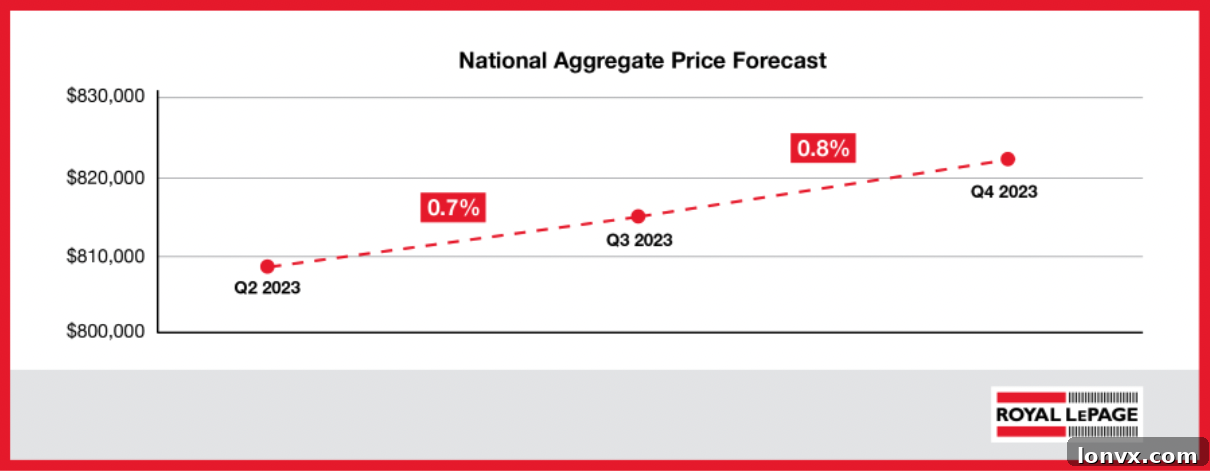
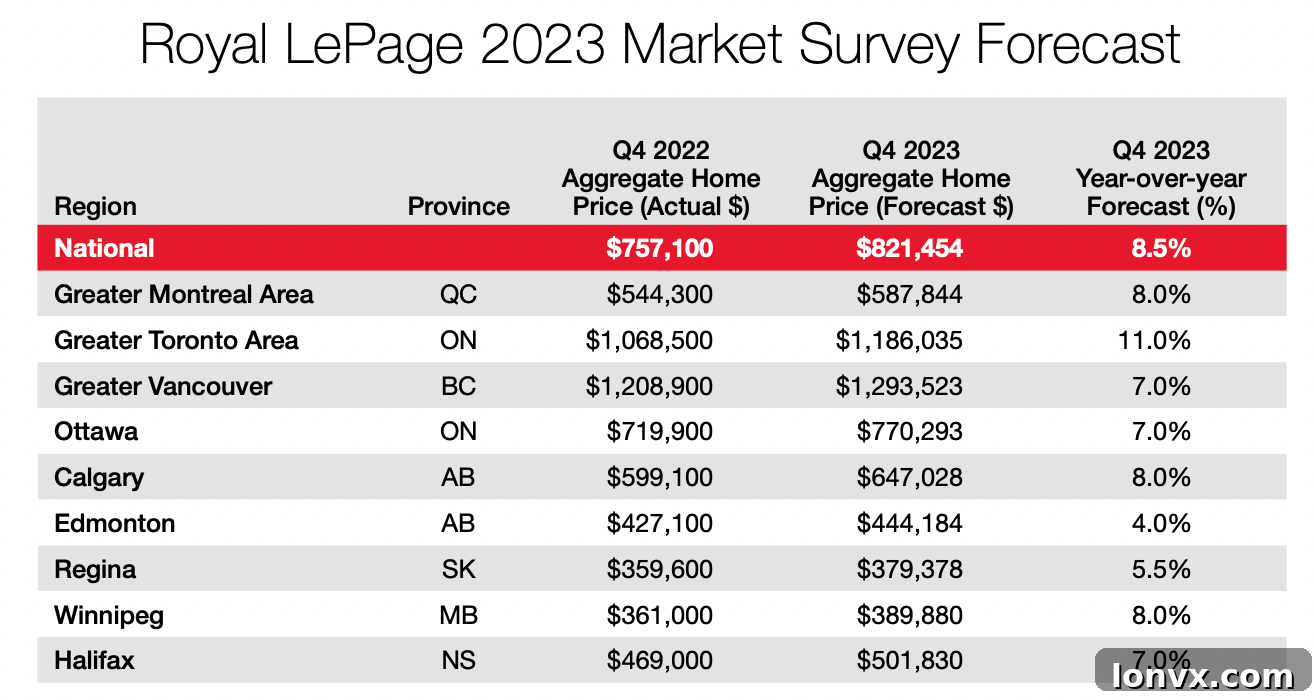
In a report released recently, the prominent real estate company projected an 8.5 percent increase in the aggregate price of homes during the fourth quarter of 2023, when compared to the same period last year. This new prediction is a substantial revision, nearly doubling the more conservative 4.5 percent increase that Royal LePage had initially predicted in the spring. The upward adjustment underscores the unexpected momentum that has characterized the Canadian housing sector.
The report highlights a critical divergence in market sentiment: homebuyers remain notably determined, eager to secure properties despite economic headwinds, while potential sellers exhibit a degree of hesitancy, largely in response to additional interest rate hikes implemented by the Bank of Canada. This imbalance between resolute buyers and cautious sellers is a key factor shaping current market dynamics.
Phil Soper, President and CEO of Royal LePage, articulated the central bank’s challenge: “The Bank of Canada remains determined to bring inflation down to its target of less than three percent. This has proven to be especially challenging at a time when the job market is so strong, and Canadians continue to spend, partly due to a build-up of savings during the pandemic.” Soper’s comments point to the complex interplay of high employment, consumer spending, and persistent inflation pressures that influence the Bank of Canada’s monetary policy decisions.
Despite these challenges, Soper notes the underlying health of the housing market: “The Canadian real estate market has been in a steady state of recovery since the start of the year. While these additional interest rate hikes, and those potentially to come, will likely put a damper on activity and sales volumes, demand for housing remains very strong.” This suggests that while transaction volumes might see a temporary dip, the fundamental demand for housing continues to exert upward pressure on prices.
While a slight moderation in activity is anticipated, Royal LePage expects the pace of price appreciation to temper in the latter half of 2023. This is projected to lead to a stabilization or a marginal increase in home prices on a quarter-over-quarter basis. However, a perennial issue continues to fuel price growth: the chronic shortage of housing supply across the country, which consistently keeps upward pressure on market values.
“We are close to that pivotal point where people who purchased at the peak would break even if they sold today.”
– Phil Soper, CEO & President, Royal LePage
The second quarter of 2023 offered encouraging signals for the Canadian real estate market. Nationally, the aggregate home price remained relatively stable year-over-year, recording a modest decrease of 0.7 percent to $809,200. More importantly, there was a significant quarter-over-quarter increase of 4.0 percent. This positive momentum marks the second consecutive quarter of growth, following a period of price declines triggered by the central bank’s aggressive interest rate hike campaign, which commenced in March 2022. The current aggregate price of a home in Canada now sits just 5.6 percent below the all-time peak recorded in the first quarter of the previous year.
Soper emphasizes the significance of this recovery for many homeowners: “We are close to that pivotal point where people who purchased at the peak would break even if they sold today.” This sentiment reflects a regained confidence among those who bought properties at the height of the market frenzy.
Buyer Determination and Strategic Adjustments in a High-Rate Environment
Following the Bank of Canada’s recent quarter-point increase, the overnight lending rate now stands at 5.0 percent. This elevated rate might deter some, but many prospective buyers are displaying remarkable fortitude.
“Despite the central bank’s decision to start raising interest rates again, many buyers are still in the game. Demand remains strong, particularly among those who have secured a rate hold,” Soper commented. He added, “Buyers who are determined to make a purchase this year have accepted the reality of higher initial carrying costs, rationally surmising that rates are at or near peak and will become more affordable before long.” This forward-looking perspective suggests that many buyers are banking on future rate reductions, making current higher costs a temporary hurdle rather than a permanent barrier.
However, this determination often comes with a need for adaptation. Buyers are increasingly adjusting their expectations, which may involve exploring alternative housing types, considering different neighbourhoods, or opting for smaller and more affordable properties. This flexibility allows them to navigate the current market conditions and achieve their homeownership goals, even if it means compromising on some initial preferences.
The Persistent Challenge of Seller Hesitancy and Limited Inventory
On the flip side of the market, Soper notes that potential sellers who are not under immediate pressure to move have largely put their plans on hold. This hesitancy further exacerbates the ongoing, acute shortage of housing supply, which is a structural issue within the Canadian real estate market. One primary concern for these potential sellers is the fear of not being able to find a suitable move-up home in an already tight market, leading to a “chicken or the egg” dilemma.
Additionally, many homeowners who secured fixed-rate mortgages at historically low rates during the pandemic boom are understandably reluctant to re-enter the market as buyers, facing substantially higher borrowing costs for a new property. The financial disincentive of trading a low-rate mortgage for a high-rate one is a significant barrier to increasing inventory. This combination of fewer sellers willing to list and sustained buyer demand continues to contribute to the chronic inventory shortage, which is a fundamental driver of rising home prices across the country.
The broader implications of the housing supply crisis extend beyond just seller reluctance. Factors such as restrictive zoning laws, escalating construction costs, and labour shortages in the construction industry all play a role in limiting the creation of new housing units. Addressing this multi-faceted supply challenge is crucial for long-term affordability and market balance in Canada.
Navigating Regional Variances in Canada’s Housing Recovery
The recovery of the Canadian real estate market has not been a uniform phenomenon; rather, it has unfolded with distinct differences across various regions. Approximately one-third of the regions analyzed in the Royal LePage report posted year-over-year aggregate price gains in the second quarter, indicating robust localized growth. Conversely, only four regions reported quarterly declines, underscoring the widespread nature of the recovery, even if its pace varies.
Canada’s largest and most expensive real estate markets, the Greater Toronto Area (GTA) and Greater Vancouver (GVA), are still below their previous price peaks. However, the aggregate price of homes in these highly competitive regions has shown consistent slight increases, signaling a gradual yet definite path to recovery. These markets, often bellwethers for national trends, demonstrate that even after significant corrections, demand remains strong enough to drive prices back up.
In contrast, the Greater Montreal Area (GMA) experienced a shorter correction period, and home prices there currently sit just 2.4 percent below their peak. This quicker rebound in Montreal highlights how local economic conditions, population growth, and specific market dynamics can lead to diverse recovery timelines. Understanding these regional variations is essential for grasping the inherent complexity of the Canadian real estate market, as a single national narrative often masks important local realities.
The Ripple Effect: Increased Pressure on Canada’s Rental Markets
The escalating cost of borrowing and the challenges in accessing homeownership have had a profound and significant impact on rental markets nationwide. As detailed in the Royal LePage report, landlords, facing higher carrying costs on their properties (due to increased mortgage payments or property taxes), have increasingly passed these expenses on to tenants through rent increases. This economic reality creates a direct link between the cost of owning and the cost of renting.
Furthermore, a growing segment of the population that finds themselves unable to qualify for home lending due to stringent mortgage rules or who are simply priced out of the resale market are turning to rentals. This influx of demand into the rental sector adds immense pressure to the already limited supply of available rental units. The phenomenon of “renovictions” and bidding wars for rental properties is becoming more common in major urban centers, reflecting this acute shortage.
Statistical data corroborates this trend. According to Statistics Canada’s latest Consumer Price Index, rent prices in May were up a substantial 5.7 percent over the same period last year. This figure represents an average, with many cities experiencing even steeper increases. The rising cost of rent significantly strains household budgets, particularly for lower-income individuals and families, exacerbating Canada’s broader affordability crisis. The tight rental market, therefore, acts as a critical indicator of the broader challenges within the Canadian housing ecosystem, impacting a vast segment of the population who rely on rental housing.
For a more comprehensive understanding, including detailed regional summaries, you can read the full report from Royal LePage.
Looking Ahead: A Balanced Outlook for Canadian Real Estate
The updated Royal LePage forecast for 2023 clearly signals a robust and resilient Canadian real estate market, one that has defied earlier predictions of a more significant slowdown. The projected 8.5% aggregate price increase by Q4 2023 underscores the persistent strength of demand, especially when juxtaposed against a backdrop of rising interest rates and a stubborn inflation battle by the Bank of Canada.
While the latter half of the year may see a moderation in the pace of appreciation, the underlying factors driving the market—strong employment, pent-up savings, and critically, a severe housing supply shortage—are expected to maintain upward pressure on prices. The determination of buyers, who are increasingly adapting their strategies to navigate the current environment, continues to be a dominant force. Conversely, seller hesitancy, influenced by both financial considerations and the challenge of finding suitable replacement homes, compounds the inventory crunch.
Regional variations will undoubtedly continue to shape local market experiences, with some areas recovering faster and others still working their way back to peak values. Furthermore, the ripple effect on the rental market, characterized by surging rents and increased competition, highlights the interconnectedness of Canada’s housing challenges. As the year progresses, all eyes will remain on the Bank of Canada’s next moves, inflation figures, and the persistent efforts to address the fundamental imbalance between housing supply and demand, which remains the long-term determinant of market health and affordability.
Enjoying this article?
Get the latest real estate articles in your inbox 3x week so you stay up to date on the latest in the Canadian real estate industry