
Navigating Canada’s Condo Investment Landscape: Opportunities and Challenges for Long-Term Renters
The allure of investment properties, particularly condominiums, has long captivated Canadian investors seeking to build wealth and generate passive income. However, the dynamics of this market are in constant flux, posing critical questions about long-term viability and profitability. With significant changes sweeping across North America, notably the tightening of short-term rental regulations, the traditional playbook for real estate investment is being rewritten.
A recent analysis by Zoocasa delves into this evolving landscape, examining whether investment condos remain a sound choice amidst these regulatory shifts. The move away from lucrative short-term rental platforms like Airbnb is not just a Canadian phenomenon; New York City, for instance, recently enacted a law prohibiting rentals for less than 30 days, mirroring proactive steps taken by several Canadian municipalities. These policy changes are primarily driven by a pressing need to address housing shortages and affordability crises, with policymakers aiming to channel more properties back into the conventional long-term rental market.
The Evolving Landscape of Short-Term Rental Regulations
The era of unrestricted short-term rentals is rapidly drawing to a close across Canada, marking a significant pivot for property investors. Many Canadian cities have already implemented stringent limitations, and the trend shows no sign of abating. These regulations are designed not only to alleviate housing supply pressures but also to preserve the character of residential neighborhoods, addressing concerns from local residents about noise, transient populations, and the commercialization of residential zones.
For example, as of September 1, Halifax introduced new rules restricting how units can be rented in residential areas. Specifically, basement apartments and backyard suites are now mandated to be rented for more than 28 days, pushing these units squarely into the long-term rental category. Toronto, another major urban center, imposes a maximum limit of 180 days per calendar year for short-term rentals, effectively preventing year-round short-term operations. Not to be outdone, the British Columbia government is actively drafting its own comprehensive set of laws to govern the burgeoning short-term rental sector province-wide. These regulations often include licensing requirements, principal residence clauses, and strict zoning limitations, forcing investors to adapt their strategies or face substantial penalties.
For investors who previously relied on the higher income potential of short-term rentals, these changes necessitate a strategic re-evaluation. The shift compels a greater focus on the long-term rental market, demanding a deeper understanding of traditional landlord responsibilities, tenant relationships, and sustainable cash flow generation.
Assessing Profitability: Rent vs. Mortgage Dynamics
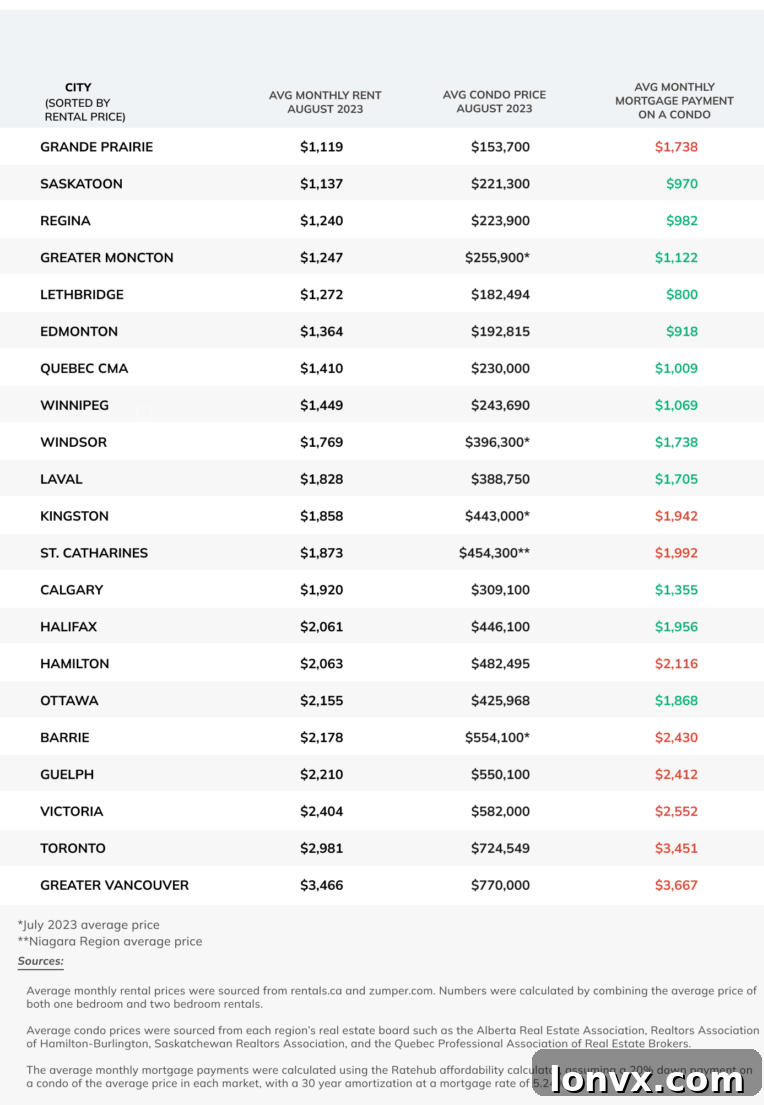
Understanding the financial viability of a condo investment hinges on a crucial comparison: how monthly rental income stacks up against monthly mortgage payments. Zoocasa’s insightful analysis provides a snapshot of this dynamic across various Canadian cities, offering valuable guidance for prospective investors. The study specifically compared the average monthly rental price with the average monthly mortgage payment for a typical condo in each city, shedding light on potential cash flow scenarios. It’s important to note, however, that this analysis focused solely on these two core figures and did not factor in additional costs such such as utilities, property taxes, insurance, maintenance fees, or potential vacancies – all of which are critical considerations for a holistic investment assessment.
Canada’s Rental Market at a Glance
The backdrop for this analysis is a robust and growing rental market nationwide. In August, Rentals.ca reported a significant 8.9 percent annual increase in rent prices, pushing the average rent across Canada to a record-high of $2,078. This surge in rental costs, often outpacing the rise in condo prices in many cities, creates an interesting dynamic where rental income can potentially outstrip ownership costs in specific markets.
Where Investors Find Favorable Returns
Among the 12 cities where average condo mortgage payments were found to be lower than the average rent, several regions stand out as potential havens for investors. Calgary, in particular, demonstrated the most substantial difference, presenting a compelling case for investment. With an average monthly rent of $1,920 and an average monthly mortgage payment for a condo at $1,355, investors in Calgary could potentially see a monthly surplus of $565. This positive cash flow is attractive, driven by factors like a recovering energy sector, robust population growth, and relatively more affordable housing compared to other major Canadian cities.
Beyond Calgary, other Alberta cities like Edmonton and Lethbridge also showed promising conditions, with average mortgage payments falling below average rental prices. These markets often benefit from lower property acquisition costs and steady demand for rental housing. Moving eastward, Quebec and the Maritimes also offer attractive conditions for investors. In Halifax, where the average rent stands at $2,061, the monthly mortgage payment for an average condo totals $1,956, indicating a close but potentially positive cash flow. Quebec City presents an even more favorable scenario, with average monthly condo mortgage payments around $1,009 – a significant $401 less than the city’s average rent, highlighting its strong investment appeal.
Source: Zoocasa
The Anomaly of Grande Prairie
While most cities in the Prairies showcased favorable conditions, Grande Prairie bucked the trend. In this particular market, average monthly condo mortgage payments surpassed the average rent by a substantial $619. This anomaly suggests unique local market dynamics, possibly including a recent surge in condo prices not yet matched by rental demand, or perhaps specific economic factors affecting local affordability for renters versus buyers.
Navigating Ontario’s Unique Investment Climate
Zoocasa’s analysis clearly indicates that Ontario, Canada’s most populous province and a major economic hub, presents a distinct set of challenges for condo investors. The region is characterized by high property values and intense competition, which often translates into less favorable cash flow opportunities for landlords. With the notable exceptions of Windsor and Ottawa, where monthly mortgage payments for an average condo were found to be lower than rent, the vast majority of other Ontario cities analyzed in the study reported monthly mortgage payments significantly higher than the average rental income.
Toronto, for instance, boasts the second-highest average monthly rent on the list at $2,981. However, the average monthly mortgage payment for a condo in the city reaches $3,451, resulting in a negative cash flow difference of $470 per month for the average investor, even before considering other costs. This gap highlights the significant capital required to enter the Toronto market and the difficulty in covering carrying costs purely through rental income. Similarly, other prominent Ontario cities such as Guelph, Barrie, Hamilton, and St. Catharines also recorded relatively higher mortgage payments compared to rent costs, underscoring a broader regional trend.
Lauren Haw, Zoocasa’s broker of record and industry relations officer, emphasized the profound impact of rising interest rates on condo investors in these challenging markets. She noted, “Condo investors continue to have a hard time covering carrying costs, and they’re not making a profit, which is leading many to sell their investment properties.” This sentiment reflects a market where the traditional metrics of profitability are being severely tested, prompting many to re-evaluate their investment portfolios or exit the market altogether.
Beyond the Numbers: Factors Influencing Investment Decisions
While the rent-vs.-mortgage comparison offers a crucial starting point, a comprehensive investment decision must account for several other critical factors. Property taxes, for example, vary significantly by municipality and can add hundreds of dollars to monthly carrying costs. Similarly, condo fees cover maintenance and shared amenities but represent a fixed expense that directly impacts profitability. Insurance, potential vacancies, and unexpected repair costs are also essential considerations that can quickly erode a seemingly positive cash flow.
The current economic climate, marked by persistent inflation and high-interest rates, further complicates the picture. Rising interest rates directly increase mortgage payments, making it harder for investors to achieve positive cash flow, especially in high-cost markets like much of Ontario. These macro-economic factors influence not only the cost of ownership but also the affordability for renters, thereby impacting demand and rental rates.
Resilience in the Face of Change: Investor Outlook
Despite the tightening regulations and financial challenges, particularly from rising interest rates, investor interest in real estate remains remarkably persistent. The Bank of Canada reports that investors accounted for a significant 30 percent of home purchases in the first quarter of 2023. This enduring interest underscores the belief among many that real estate continues to be a valuable long-term asset, offering a hedge against inflation and a pathway to wealth accumulation.
The central bank’s recent decision to pause interest rate hikes and maintain the overnight lending rate at 5.0 percent could further fuel this demand. A period of interest rate stability might provide a clearer outlook for borrowing costs, potentially encouraging more investors to enter or re-engage with the market. However, the focus is increasingly shifting from short-term speculative gains to more stable, long-term rental income and property appreciation. Investors are becoming more strategic, prioritizing markets with strong fundamentals, consistent demand, and a favorable rent-to-mortgage ratio, even if the initial cash flow is modest. Diligent market research, comprehensive financial planning, and a clear understanding of local regulations are more vital than ever for success in this evolving Canadian real estate landscape.
To delve deeper into the specific market dynamics and detailed city-by-city breakdowns, you can read Zoocasa’s full analysis here.