
The views expressed in this column are solely those of the author.
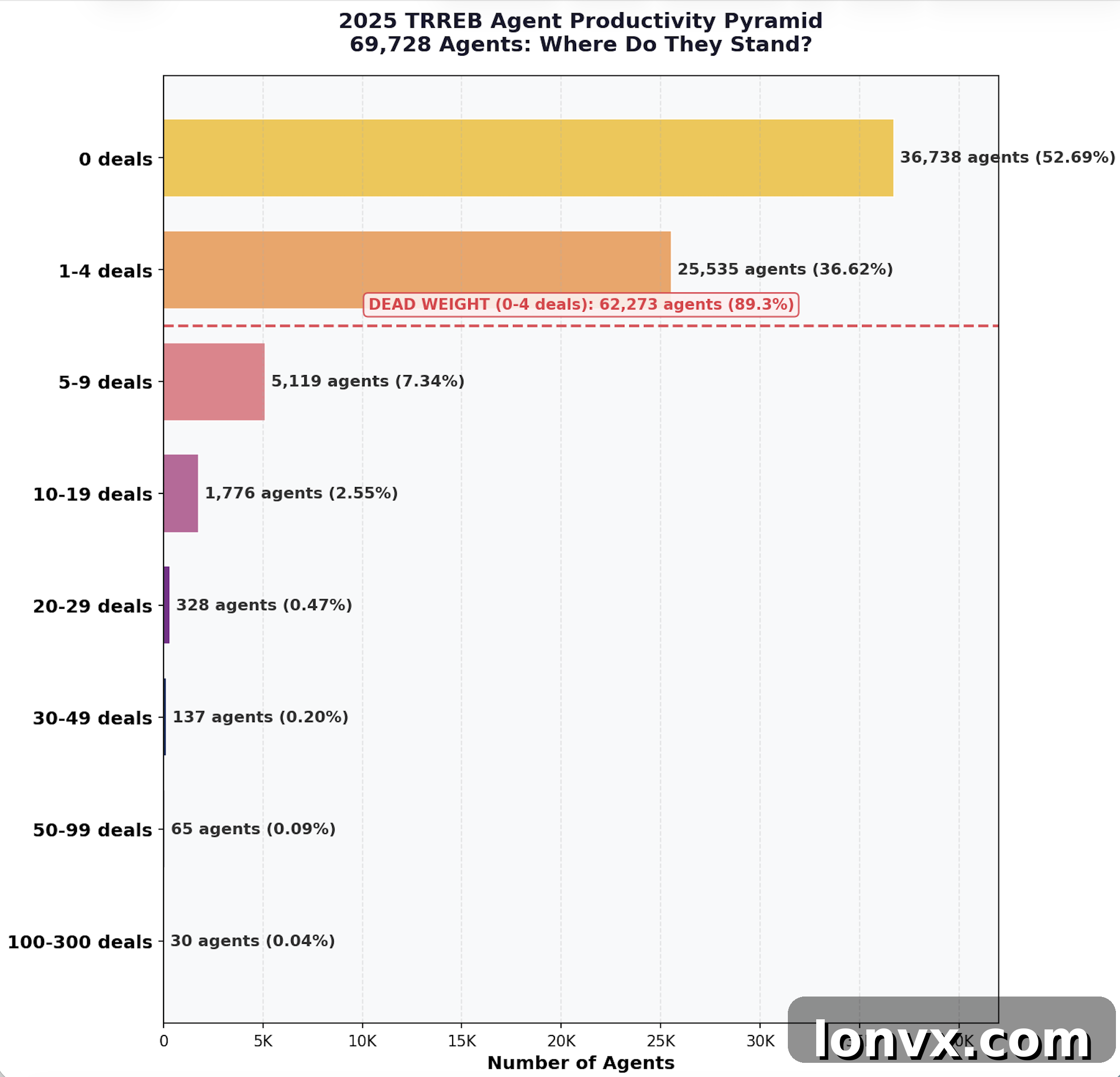
The Toronto real estate market, often seen as a bellwether for the broader Canadian economy, harbors a silent, profound crisis beneath its volatile surface. While public discourse frequently zeroes in on fluctuating market corrections and the impact of interest rate hikes, a more fundamental issue has been unfolding: the systematic decline in agent productivity and the alarming rise of an unqualified workforce. As of December 31, 2025, data compiled by Redatum from the Toronto Regional Real Estate Board (TRREB) painted a stark picture: out of 69,728 licensed real estate agents, a mere 560 managed to close 20 or more transactions throughout the year. This elite group represents a minuscule 0.8 percent of the entire industry. This figure alone signals a critical health check for the profession.
The severity of this decline is underscored when compared to just five years prior, when the ranks of these top-tier agents numbered 1,975. The industry, instead of addressing this growing imbalance, appears to have been caught off guard, allowing an existential crisis to fester. An in-depth analysis of over 800,000 TRREB transaction sides between 2021 and 2025 reveals a disturbing pattern. This isn’t just another cyclical market downturn; it’s a deeply entrenched systemic skills mismatch. It’s a narrative born from a convergence of outdated association business models, the pervasive illusion fostered by social media performance, and the complacent habits cultivated during a quarter-century bull market. The industry, once built on expertise and dedication, now risks being founded on illusion rather than tangible skill.
The Undeniable Truth: A Crumbling Foundation of Productivity
The current state of productivity within the Toronto real estate sector is not merely concerning; it’s staggering. A deeper dive into the numbers for 2025 reveals a foundation that is actively eroding. A shocking 36,738 TRREB agents, accounting for 52.7 percent of the total licensed pool, completed zero transactions throughout the entire year. Even more concerning, another 25,535 agents, representing 36.6 percent, closed between one and four transactions—a volume barely sufficient for subsistence, let alone a sustainable career. Collectively, an astounding 89.3 percent of all licensed agents closed four or fewer deals in a full year. These are not viable real estate careers; they are, effectively, expensive hobbies that do little more than subsidize the industry’s overheads and dilute the value of professional service.
The shift in agent productivity has been rapid and dramatic. In 2021, a relatively healthy and competitive market still saw nearly 7,000 agents successfully closing 10 or more transactions annually, indicating a robust pool of genuine talent. However, the period between 2021 and 2022 marked a critical turning point. The industry’s “enrollment machine,” designed to continuously onboard new agents, continued its relentless pace even as market conditions shifted dramatically, essentially running into a wall. In just a single year, the system added 9,415 agents who subsequently closed zero transactions, while simultaneously, 5,460 previously active and productive agents exited the higher-performing ranks. This simultaneous influx of non-producers and exodus of experienced professionals accelerated the crisis.
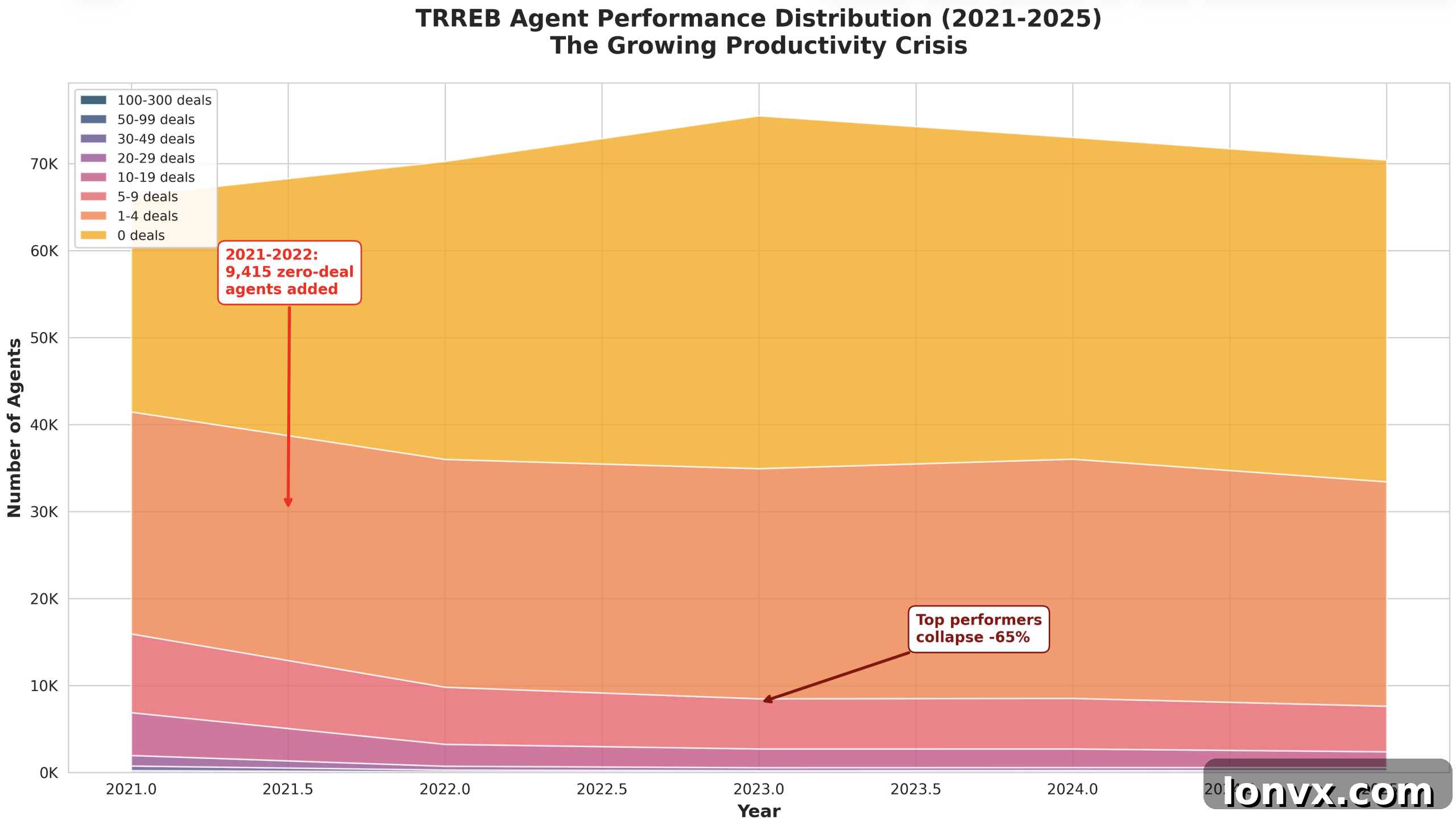
Over the last five years, the backbone of the industry—the productive core of agents consistently closing 10 or more deals—has collapsed by a staggering 65 percent. The elite tier, those top performers handling 20 or more transactions, has been decimated by an even more alarming 70 percent, according to TRREB data via Redatum. Crucially, the real estate industry itself didn’t shrink; instead, it underwent a profound transformation, effectively replacing its “all-star” players with “benchwarmers.” What should ideally be a stable pyramid, with a broad base of moderate producers supporting a smaller, highly skilled elite tier, has completely inverted. This alarming structural change undermines the very integrity and efficiency of the real estate profession, impacting service quality for consumers and the long-term viability for brokerages.
Unpacking the Collapse: Three Systemic Forces at Play
To truly grasp the magnitude and origin of this crisis, one must look beyond superficial market fluctuations and delve into three interwoven systemic forces that have created this perilous vulnerability within the real estate profession.
1. The Flawed Association Incentive Structure
A primary driver of the oversupply problem lies within the fundamental business model of professional real estate associations. These organizations primarily generate revenue through course enrollments and the continuous expansion of their membership base. Consequently, their definition of “success” is intrinsically tied to how many individuals enter the profession, rather than how many actually achieve sustained success within it. This creates a relentless cycle of oversupply. Each year, thousands of aspiring agents are ushered into the profession, each paying substantial fees—often exceeding $15,000—for education, first-year licensing, brokerage affiliations, and initial marketing efforts. The structural disconnect here is glaring: the entities that profit from training and licensing are completely insulated from the detrimental costs of this massive oversupply. Brokerages and real estate teams are left to absorb the operational burdens and liabilities associated with managing an inflated talent pool, while the associations continue to benefit from continuous growth, regardless of agent performance or market saturation.
2. Social Media and the Rise of the Illusion Economy
The second powerful force contributing to the industry’s woes is the profound transformation of real estate marketing, shifting from a focus on property and expertise to an emphasis on lifestyle and superficial imagery. Amplified by the pervasive influence of social media algorithms, the industry largely adopted a “fake it till you make it” mantra. Instead of showcasing competence, market knowledge, or negotiation prowess, agents increasingly began marketing a curated lifestyle. Images of leased luxury vehicles, designer clothing, and opulent settings became more prevalent than genuine demonstrations of skill. In a historically rising market, this superficial approach appeared to work; buyers and sellers, eager for success, were drawn to agents who projected an image of prosperity. However, this environment inadvertently rewarded the wrong type of content, transforming the noble profession into a caricature of itself. For an agent closing only one or two deals a year, the exorbitant cost of maintaining this facade—from luxury car leases to designer wardrobes and professional content production—routinely consumes the vast majority, if not all, of their meager net income. Flaunting wealth and success in a market where homeowners are grappling with declining property values and financial uncertainty is not aspirational; it is profoundly out of touch and further erodes public trust in the profession.
3. The Abrupt End of 25 Years of ‘Easy Mode’
For a remarkable quarter-century, spanning from 1997 to 2022, the Toronto real estate market operated in what can only be generously described as “easy mode.” This isn’t to diminish the hard work of dedicated agents, but rather to acknowledge that the prevailing market conditions rewarded sheer presence over precise skill. With few exceptions, property prices consistently trended upwards, inventory shortages automatically generated bidding wars, and effective marketing often meant little more than listing a property on the Multiple Listing Service (MLS) and waiting for offers to pour in. In 2015, the definition of competence might have simply involved answering your phone promptly and showing up on time. However, the demands of 2025 are fundamentally different. True competence now requires sophisticated data-driven market analysis, the implementation of nuanced and creative pricing strategies, genuine and effective negotiation skills, and the critical ability to counsel and reassure clients navigating complex market anxieties. When the market dynamics unequivocally shifted in 2022, the “easy mode” abruptly ceased to exist. The passive skills that had sufficed for two decades became instantly obsolete. Many elite agents, facing new challenges, either scaled back their operations or chose to retire. Mid-tier and lower-tier agents, severely lacking the essential skills required to navigate a difficult and unpredictable market, largely froze. They are now passively waiting for a “normal” market to return—a return that, all evidence suggests, is not going to happen. The industry has entered a new era, demanding a radical recalibration of skills and strategy.
The Compliance Nightmare and the Urgent Path Forward
Brokerages often optimistically view the “middle tier” of agents as a vital development pipeline, a source for future top performers. However, this critical demographic has also suffered a severe blow, collapsing by approximately 40 percent since 2021. Meanwhile, the staggering 25,535 agents who manage to close only one to four deals per year represent more than just low productivity; they are effectively natural attrition waiting to happen, existing on the periphery of the profession. The uncomfortable and often overlooked reality that brokerages must urgently confront is the immense compliance risk generated by this top-heavy and unproductive structure. Financial Intelligence Unit (FINTRAC) regulations and other regulatory bodies impose stringent requirements on brokerages, obliging them to meticulously monitor every single licensed agent under their umbrella. In 2025, this translates to 36,738 “zero-transaction” or “zombie” agents who carry significant potential liability exposure, consume valuable administrative bandwidth, and generate absolutely no revenue. A single compliance violation stemming from one of these unproductive agents can easily cost a brokerage more in fines and reputational damage than a highly productive agent generates in an entire year. The industry has demonstrably reached a new, highly unstable equilibrium. To not only survive but thrive during this critical transition over the next three to five years, the entire industry playbook must be fundamentally rewritten and adopted.
What Needs to Change: A Blueprint for Resilience
The time for incremental adjustments is over; radical shifts are required across all facets of the real estate industry to foster genuine resilience and productivity.
Brokerages Must Implement Rigorous Performance Standards: It is no longer sustainable or responsible to maintain expansive rosters simply for marginal desk fees. The legal, operational, and reputational liability associated with housing thousands of zero-deal agents far outweighs the negligible income they might provide. Quality must definitively take precedence over quantity. Brokerages need to establish clear, measurable performance benchmarks, provide targeted support for those demonstrating potential, and, where necessary, prune their rosters to foster a more accountable and productive environment. This isn’t about arbitrary cuts, but about strategic resource allocation and risk management.
Agents Must Invest in Skills, Not Superficial Appearances: The era where lifestyle marketing could successfully replace genuine competence is definitively over. Agents must abandon the performance art that has come to define social media in real estate and instead invest heavily in acquiring and refining critical skills. This includes mastering sophisticated pricing strategies grounded in robust data analysis, developing creative and effective marketing techniques that deliver real value, and becoming proficient in data forecasting to counsel clients through complex market cycles. Continuous professional development, mentorship, and a commitment to lifelong learning are no longer optional but essential for survival and success.
Associations Must Align Incentives with Actual Success: The real estate industry cannot endure a business model that, by its very design, profits from failure. Professional associations have a moral and ethical imperative to reform their incentive structures. This means shifting focus from merely increasing membership numbers to genuinely supporting agent success and fostering a culture of high performance. Potential reforms could include more rigorous entry requirements, ongoing performance reviews, or support programs designed to elevate the skill level of existing members. Their long-term viability, and indeed the reputation of the entire profession, depends on this critical realignment.
The market itself is still robustly transacting, albeit under new conditions; it is the agent population and its foundational structure that is profoundly broken. The brokerages and individual Realtors who possess the foresight and courage to recognize this as a permanent skills obsolescence crisis—a fundamental shift in required competencies—rather than a temporary market condition, are the only ones who will not just survive, but truly thrive in this new, demanding equilibrium. The future of real estate demands adaptability, genuine skill, and an unwavering commitment to professional excellence.