The Unseen Value: How Parking Spaces Skyrocket Toronto Condo Prices
In Toronto’s dynamic and fiercely competitive real estate market, a parking space is far more than just a convenience; it’s a significant asset that can dramatically enhance a property’s value. For condominium owners and prospective buyers, the presence of a dedicated parking spot can elevate a unit’s appeal, desirability, and ultimately, its market price—sometimes by an astonishing six figures. A recent, in-depth analysis conducted by Wahi, a prominent real estate platform, meticulously explored this phenomenon, shedding crucial light on the premium homeowners pay for this coveted amenity across various districts within the expansive city of Toronto.
The comprehensive study undertaken by Wahi delved into the median price variations observed between one-bedroom condominiums, specifically comparing units that included parking with those that did not. This research spanned across Toronto’s six former pre-amalgamation municipalities: East York, Etobicoke, North York, Scarborough, Old Toronto, and York. By segmenting the city in this manner, the analysis aimed to provide a granular understanding of how geographical location and local market dynamics influence the value proposition of a parking space, offering valuable insights into the city’s complex urban real estate landscape.
The findings from Wahi’s analysis were unequivocally clear and underscored the profound impact of parking on the Toronto condo market. Condominium units that boasted a parking space not only commanded significantly higher sale prices but also demonstrated a faster turnover rate on the market. While the exact financial premium varied considerably from one location to another, the study revealed that a parking spot could add an impressive $100,000 or even more to a property’s sale price, highlighting its status as a critical determinant of value in the urban housing sector.
“It isn’t a secret that parking in Toronto isn’t cheap; the city’s dense urban environment and ongoing development make space a premium,” explains Benjy Katchen, CEO of Wahi. “However, Wahi’s latest analysis provides condominium buyers with a much clearer, data-driven understanding of precisely how much more they might need to budget—or conversely, how much they stand to save—depending on whether a parking space is a necessity for their lifestyle or an amenity they can forgo.” Katchen further elaborates, emphasizing that these insights are vital for making informed decisions in such a high-stakes market.
Parking’s Premium: Units with Parking Fetch Over $122K More and Sell Faster
The Wahi study meticulously examined condominium sales data from the first half of the current year, providing a timely snapshot of the market. The research specifically focused on one-bedroom units, comparing their median sale prices and the average days they spent on the market, distinctly categorizing them by the presence or absence of a parking spot. This focused approach allowed for a direct and accurate comparison, isolating the impact of parking from other variables that might influence property value.
A striking revelation from the study was the difference in selling times. Condominiums listed without a parking space generally took a longer duration to find a buyer. This trend was particularly pronounced in Toronto’s outer boroughs and areas beyond the immediate downtown core, where robust public transit networks and extensive cycling infrastructure are less developed or accessible. In contrast, units equipped with parking in more centrally located and well-serviced areas, such as East York and Old Toronto, demonstrated remarkable efficiency, selling an average of three days quicker than their counterparts without parking. This illustrates the acute demand for convenience, even in areas with good transit, for those who value personal vehicle access.
Scarborough emerged as the region exhibiting the most significant disparity in selling times, highlighting the critical role of car ownership and thus parking in this part of the city. One-bedroom condominiums in Scarborough that included a parking spot sold, on average, within 25 days. Conversely, similar units in Scarborough that lacked parking remained on the market for a considerably longer period, averaging 41 days. This substantial difference of 16 days underscores the heightened demand for private vehicle accommodation in areas where driving is often a necessity rather than a luxury, making a parking space a compelling and indispensable feature for potential buyers.
When analyzing the financial impact, East York stood out with the most substantial price disparity attributable to parking. The median sale price for a one-bedroom condominium in East York featuring a parking space was an impressive $532,000. In stark contrast, a comparable one-bedroom unit in the same area without a parking spot sold for a median price of $410,000. This staggering difference of $122,000 unequivocally demonstrates the immense value and premium attached to owning a parking space in this desirable Toronto neighbourhood. Such a substantial price gap makes a parking spot a critical factor in a property’s overall valuation and investment potential.
Toronto’s Parking Hotspots: Where Parking Adds the Most Value
Unsurprisingly, the Wahi analysis identified affluent and strategically central neighbourhoods as the areas where a parking space contributes the most significant uplift to a condominium’s price. Yorkville, a district renowned for its luxurious properties, high-end boutiques, and vibrant cultural scene, consistently topped the list. In these coveted locations, condominiums that came with a dedicated parking spot commanded at least $98,000 more than identical units that lacked this valuable amenity. This premium reflects not only the scarcity of parking in these dense urban cores but also the desire for unparalleled convenience among the discerning buyers who frequent these areas.
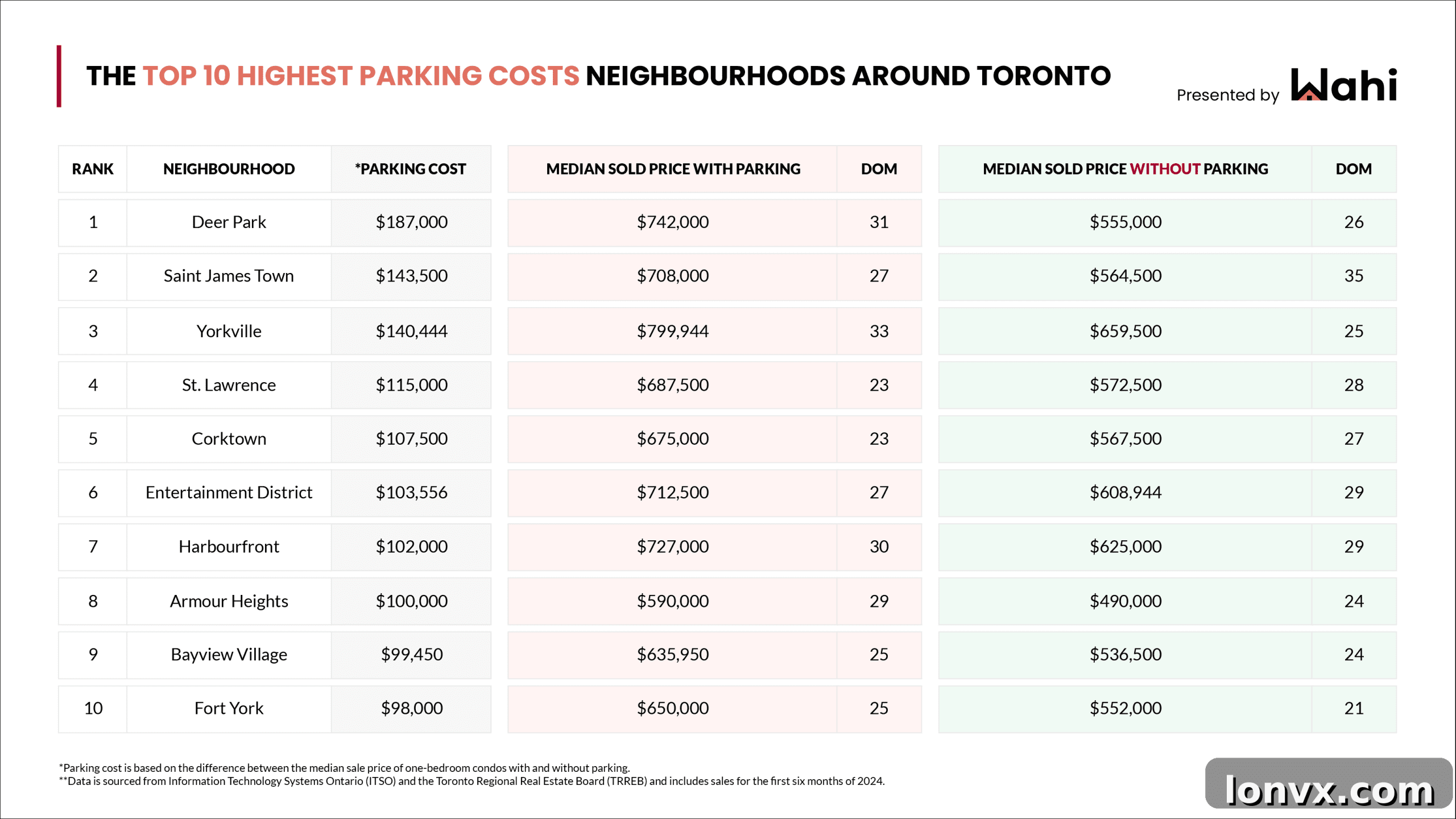
The infographic above visually represents these crucial findings, illustrating the varying degrees of parking value across Toronto’s diverse neighbourhoods. It underscores that while parking is valuable city-wide, its premium escalates dramatically in high-demand, high-income areas where space is at a premium and lifestyle dictates convenience. These areas often attract buyers who prioritize ease of access and are willing to pay a premium to avoid the challenges of street parking or relying solely on public transport.
Navigating Toronto’s Real Estate with Parking Insights
The comprehensive analysis by Wahi unequivocally highlights the substantial and often underestimated impact that a dedicated parking space can have on condominium prices throughout Toronto. This impact is particularly pronounced in areas characterized by high demand, limited urban space, and a certain demographic profile. For individuals actively engaged in the Toronto real estate market, whether as prospective buyers, sellers, or professional agents, a deep understanding of these intricate market dynamics is not merely beneficial but essential for effective navigation.
For buyers, understanding the cost implications of parking allows for more strategic financial planning. Those who prioritize having a vehicle will need to factor in a significant premium, particularly if they are eyeing central or affluent neighbourhoods. Conversely, buyers who are comfortable relying on public transit, cycling, or ride-sharing services might find more affordable options by targeting units without parking, especially in well-connected transit hubs. This choice can lead to considerable savings, which could then be allocated towards other desirable property features or a larger down payment.
Sellers, on the other hand, can leverage these insights to optimize their marketing strategies. If a condominium unit includes a parking space, it should be prominently featured as a key selling point, as it demonstrably adds substantial value and accelerates sales. Highlighting the convenience and scarcity of parking can attract a broader pool of potential buyers who are willing to pay top dollar for this amenity. For units without parking, sellers might focus their marketing efforts on attracting buyers who prioritize walkability, transit access, or proximity to amenities that negate the need for a car, such as downtown professionals or students.
Furthermore, real estate agents can utilize Wahi’s data to provide superior guidance to their clients. By clearly illustrating the price differences and sales velocity associated with parking, agents can help buyers set realistic budgets and refine their search criteria. For sellers, agents can offer data-backed advice on pricing strategies and effective property staging, ensuring that the unique value proposition of each listing is clearly communicated to the market. This data-driven approach fosters greater transparency and empowers all parties to make more informed decisions.
Future Trends and Considerations
Looking ahead, the value of parking in Toronto’s condo market is likely to remain significant, if not increase. As the city continues to grow and densify, available space will become even scarcer. The rise of electric vehicles (EVs) also introduces a new dimension: units with EV charging infrastructure or the potential for it could see an additional premium, catering to a growing segment of environmentally conscious buyers. This evolving landscape suggests that parking will continue to be a crucial element of real estate investment and lifestyle choices in Toronto.
In conclusion, a parking space in Toronto is not a mere accessory; it is a powerful driver of property value and a key differentiator in a competitive market. Whether you are contemplating a purchase, preparing a sale, or advising clients, a thorough appreciation of parking’s financial and practical implications is indispensable for success in the Toronto real estate arena.