
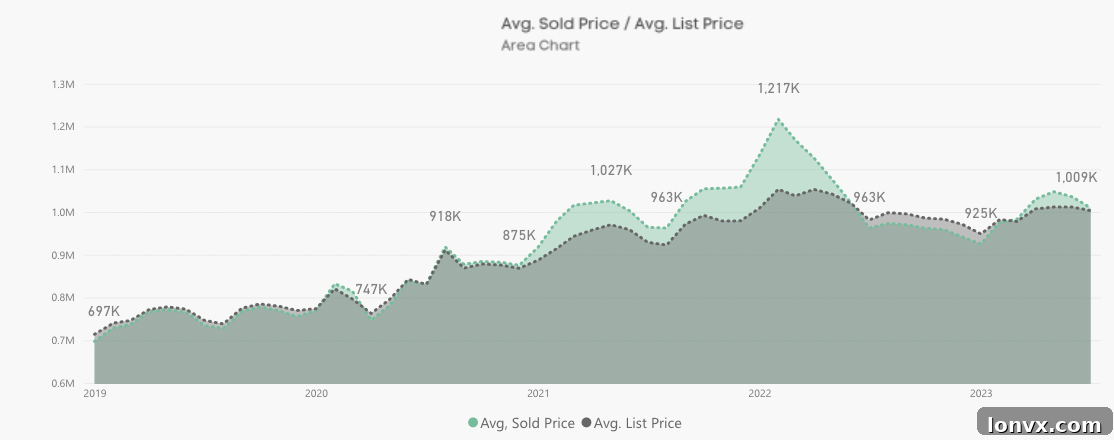
The dynamic landscape of the Toronto Regional Real Estate Board (TRREB) continues to be a focal point for homeowners, prospective buyers, and investors alike. As revealed in its recent Market Watch report for July, the Toronto real estate market has shown discernible signs of rebalancing, a sentiment largely echoed by industry observers. This newfound equilibrium suggests a market where neither buyers nor sellers hold an overwhelming advantage, fostering an environment of negotiation and adaptation. This delicate balance is particularly evident in the interplay between average sale prices and average list prices, indicating a mutual adjustment of expectations between transacting parties. Understanding this shift is crucial for anyone navigating the complexities of Canada’s largest housing market.
Source: Daniel Foch, Chartography.ca, TRREB Market Watch
While TRREB’s data points to a year-over-year increase of 4.2 percent in home prices from July 2022, this comparison warrants a deeper, more nuanced interpretation. July 2022 represented an exceptional anomaly, marking the nadir of one of the most tumultuous periods in recent Canadian housing history, characterized by an unprecedented, rapid decline in prices. To frame current market performance against such an outlier could inadvertently distort the true picture. Nevertheless, the accompanying increase in sales volume by 7.8 percent does offer an encouraging signal. This uptick suggests that the reduction in extreme market volatility has instilled a renewed sense of security and confidence among buyers, encouraging them to re-enter the market after a period of significant uncertainty.
Deciphering the New Trend: Beyond Short-Term Fluctuations
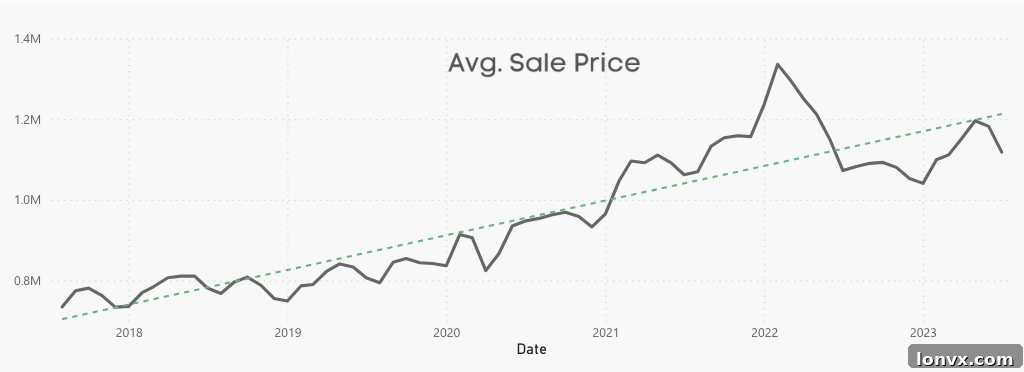
The year 2022 stands out as an exceptionally volatile period for the Toronto real estate market, making it an unreliable benchmark for year-over-year comparisons across virtually any metric. Instead of focusing on such immediate, and often misleading, snapshots, a more insightful approach involves examining the market through the lens of long-term trendlines and historical averages. This methodology provides a much clearer understanding of the market’s trajectory, aligning current performance with established patterns derived from years of data, rather than being swayed by a single, anomalous period.
When we apply this long-term perspective, it becomes clear that the growth in house prices has now dipped below the established trendline of its most recent bull market. This bull run, which saw modest beginnings following the significant price corrections of 2017, gained substantial momentum during the extraordinary conditions of the pandemic era. Characterized by record-low interest rates, increased demand for space, and a prevailing sense of market exuberance, that period saw rapid and sustained price appreciation. However, the gains observed during this year’s spring market, which initially offered a glimmer of recovery, have largely been eroded, signaling a potential shift in the market’s underlying dynamics. This reversal suggests that the factors that once fueled rapid price growth are now either diminishing or being counteracted by new economic realities, particularly higher borrowing costs and broader economic uncertainties.
Source: Daniel Foch, Chartography.ca, TRREB Market Watch
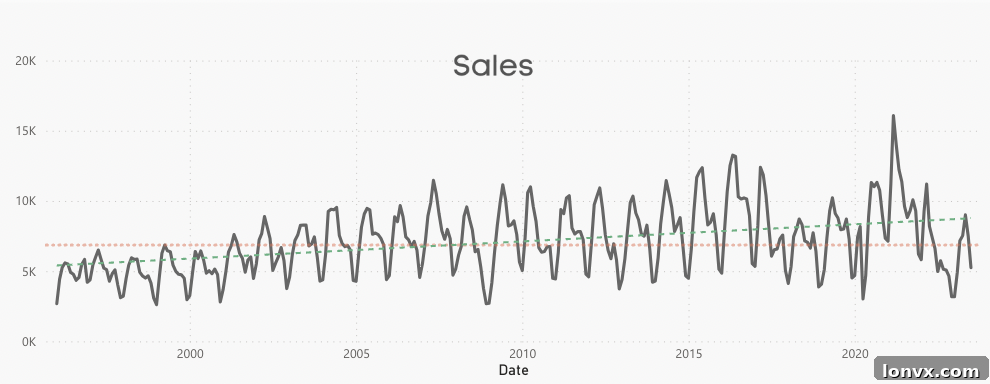
Similarly, an examination of sales activity reveals a similar pattern of deceleration. Sales volumes have now fallen just below the long-term average, and perhaps more significantly, they are considerably below their historical growth trendline. This decline in transaction activity can be attributed to a confluence of factors, including escalating interest rates that diminish affordability, a more cautious buyer sentiment influenced by economic uncertainty, and a general recalibration of market expectations. The reduced sales volume indicates a cooling period, where potential buyers are either priced out, choosing to wait on the sidelines, or facing increased difficulty securing financing. This trend suggests that while prices may have stabilized somewhat, the overall pace and velocity of the Toronto real estate market have undoubtedly slowed from the frenetic levels of recent years, pushing it back towards, or even below, its historical norm.
Source: Daniel Foch, Chartography.ca, TRREB Market Watch
The Persistent Challenge of Supply and Demand in Toronto
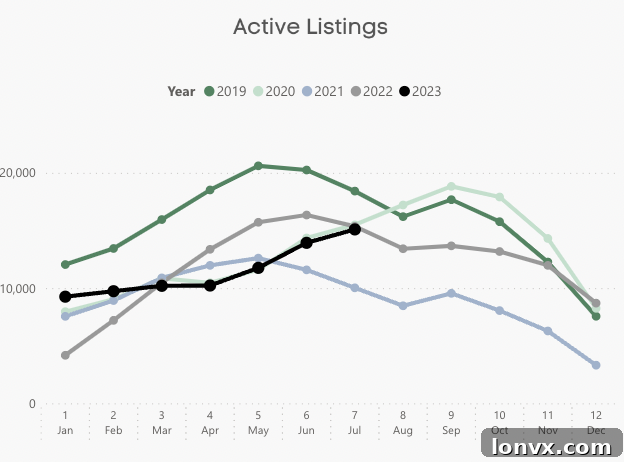
For a significant portion of the past two years, the dialogue surrounding the Toronto and broader Canadian housing markets has been overwhelmingly dominated by the critical issue of insufficient supply. This chronic shortage of available homes for sale has been a primary driver of price escalation, creating an environment of excess demand even when market conditions were otherwise suppressed by the Bank of Canada’s aggressive return to interest rate hikes. The fundamental economic principle dictates that when demand consistently outstrips supply, prices inevitably climb. This dynamic is exacerbated by Canada’s robust population growth, which continues to set new records. When this surge in population is juxtaposed against a stagnant or slow-growing housing inventory, the reasons why we have yet to witness any substantial, sustained decreases in house prices since the initial drop-off experienced last year become strikingly clear. The influx of new residents places immense pressure on an already constrained housing stock, perpetually fueling demand.
However, recent data suggests a subtle, yet potentially significant, shift in this long-standing narrative. For the past two months, new listings on TRREB have begun to align more closely with typical historical figures. This development could signal a variety of factors: it might indicate that some homeowners, facing rising carrying costs or seeking to capitalize on still-elevated prices, are more willing to list their properties. Alternatively, it could be a simple return to more customary market behavior after an atypical period of extreme scarcity. While this doesn’t necessarily imply a flood of new inventory, it does represent a movement away from the severe undersupply that has characterized the market for so long. This subtle increase in listings, if it continues, could offer a modicum of relief to prospective buyers and contribute further to the market’s rebalancing act, especially if buyer demand remains tempered by prevailing economic headwinds.
Source: Daniel Foch, Chartography.ca, TRREB Market Watch
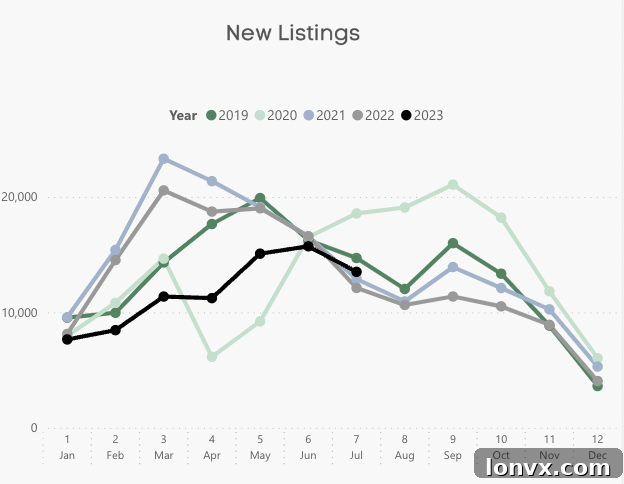
Source: Daniel Foch, Chartography.ca, TRREB Market Watch
Navigating the Path Forward: What Lies Ahead for Toronto Real Estate
The recent declines in home prices observed across the Toronto real estate market this summer appear, at first glance, to be consistent with typical seasonal patterns. Just as the robust price growth witnessed earlier in the year could largely be attributed to the traditional surge in spring market activity, a summer slowdown is not entirely unexpected. Historically, real estate markets often experience a slight dip in activity and prices during the warmer months as buyers and sellers focus on vacations and other summer pursuits. However, the critical question remains: is this current downtrend merely a seasonal phenomenon, or does it signal a more fundamental return to the bear market conditions that initially took hold in 2022? The upcoming September data will be instrumental in answering this pivotal question, acting as a crucial barometer for the market’s underlying health and direction. While an early prediction might lean towards a return to a more challenging environment, it remains prudent to await further concrete evidence.
A significant factor influencing current market sentiment is the palpable disheartening effect of the Bank of Canada’s decision to unpause its series of rate hikes. This move has sent ripples of concern throughout the financial community and among homeowners, amplifying existing anxieties about affordability and debt servicing. Consequently, there are growing indications that financial stress is mounting on a segment of sellers, particularly those with variable-rate mortgages, recent large mortgages, or investment properties facing higher carrying costs. This mounting pressure could compel more homeowners to list their properties, thereby increasing the overall supply in the market. Simultaneously, a pervasive sense of economic uncertainty – encompassing concerns about inflation, potential recession, and job security – is causing many prospective buyers to adopt a wait-and-see approach, leading them to delay or reconsider their homebuying plans. This combination of increased potential supply from stressed sellers and diminished demand from cautious buyers creates a fertile ground for a shift. Should these trends solidify and the market unequivocally turn in favor of buyers, further price declines would not only be possible but indeed highly probable, marking a significant recalibration for the Toronto real estate landscape.