
A recent, comprehensive report has cast a stark light on the increasingly precarious state of the real estate construction sector across the Greater Toronto Area (GTA) and the Greater Golden Horseshoe (GGH). The analysis reveals a dramatic decline in new home starts, a trend that is not only exacerbating the existing housing supply crisis but also leading to significant job losses within the construction industry, painting a grim picture for Ontario’s economic future. This downturn signals a critical juncture for policymakers and industry stakeholders alike, demanding immediate and decisive action.
The pivotal assessment, spearheaded by the renowned Missing Middle Initiative at the University of Ottawa in collaboration with the Real Estate Construction Council of Ontario (RESCON), meticulously details the severe contraction. Drawing upon robust data from reputable sources such as the Canada Mortgage and Housing Corporation (CMHC) and Altus Group, the report unequivocally demonstrates that housing starts during the initial nine months of 2025 have plummeted substantially when compared to the corresponding periods in the preceding three years. This worrying trajectory is directly correlated with a continuous escalation in industry-wide job losses, highlighting a profound crisis that extends far beyond mere statistics.
Housing Starts in Steep Decline: A Deep Dive into the Numbers
To gain a holistic understanding of the housing market’s health, researchers meticulously investigated the construction landscape across 34 distinct municipalities, encompassing nine separate metropolitan areas within the GTA and GGH. Their investigation scrutinized various facets of housing sales, construction activity, and the resultant impact on industry employment, providing an unparalleled snapshot of the challenges at hand.
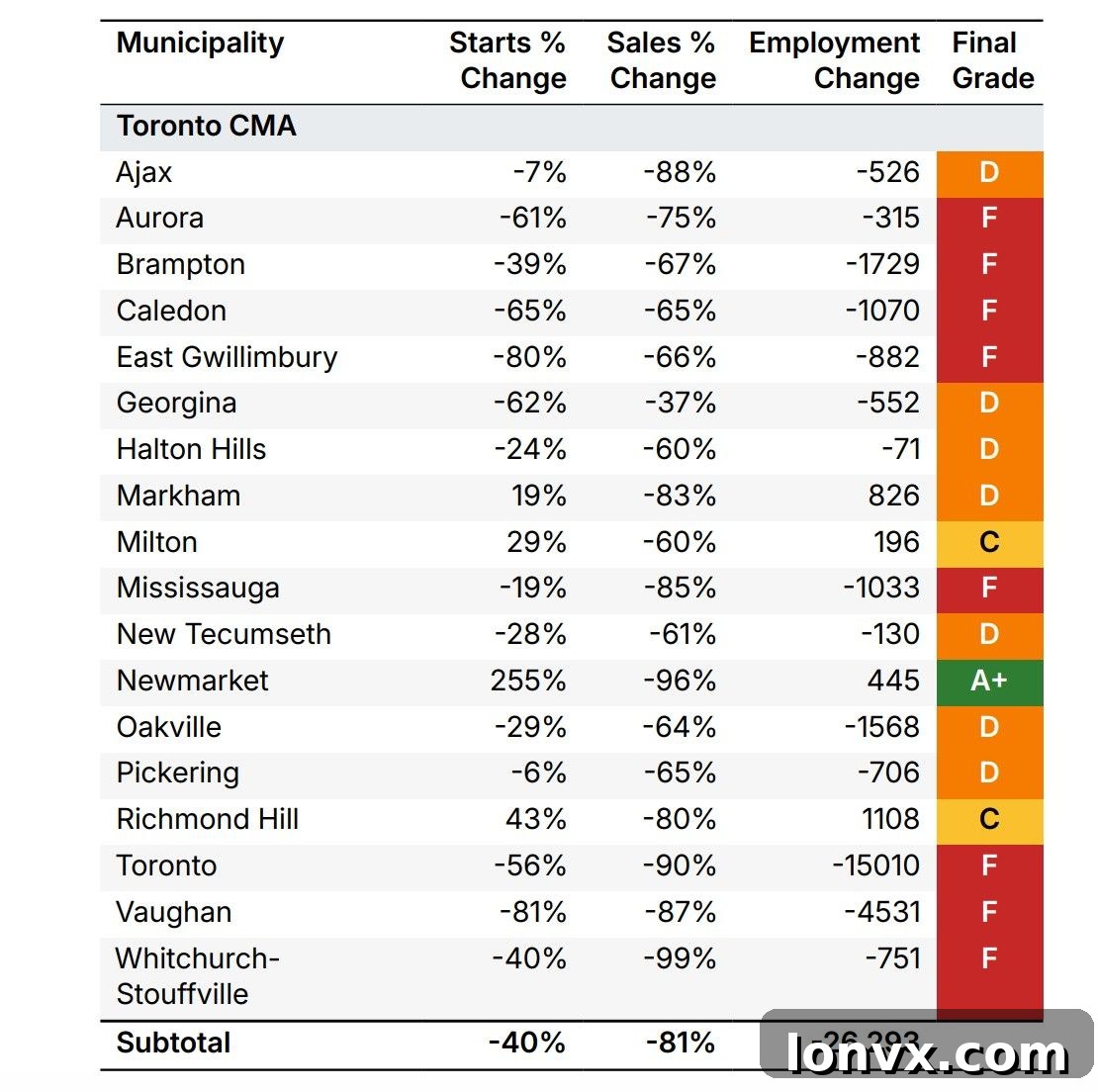
The findings are alarming: overall housing starts across these municipalities registered a staggering 34 per cent decrease during the first three quarters of 2025, relative to the average activity observed between January and September from 2021 to 2024. This significant drop underscores a systemic issue that is impeding the delivery of much-needed housing units to a rapidly growing population.
Even more pronounced is the collapse in the condominium apartment sector, which saw its starts fall by an astonishing 51 per cent in 2025 compared to the same historical periods. This decline is particularly troubling given that condo developments are crucial for increasing urban density and providing more affordable entry points into homeownership, especially for first-time buyers and young families. The contraction in this segment points to a severe bottleneck in the housing pipeline, promising further supply constraints and potentially higher prices in the coming years.
In contrast to these discouraging trends, one segment of the market has demonstrated remarkable resilience: purpose-built rental starts. This category experienced a robust 42 per cent increase over the identical periods, bucking the overall downturn. This surge in rental construction, often driven by institutional investors seeking long-term stability and consistent returns, offers a glimmer of hope for renters struggling with affordability. However, it also highlights a growing disparity between the for-sale and rental markets, suggesting that while rental options might expand, the dream of homeownership remains increasingly elusive for many.
The Ripple Effect: How Declining New Homes Lead to Massive Job Losses
The dramatic decline in housing starts is not merely a statistical anomaly; it carries profound economic consequences, most notably in the form of widespread job losses. The report estimates that, when compared to the average of the previous four years for this point in time, the reduction in new home construction has eliminated over 26,000 jobs across the Toronto Census Metropolitan Area (CMA). This figure represents a significant blow to the region’s workforce and its broader economy.
These job losses span the entire spectrum of the construction industry, affecting not only on-site laborers and skilled tradespeople but also architects, engineers, project managers, suppliers of building materials, real estate agents, and legal professionals involved in property transactions. The evaporation of these roles creates a devastating ripple effect, impacting countless families and communities. When construction projects are delayed or cancelled, demand for raw materials, manufacturing, and related services also diminishes, leading to further job losses in adjacent sectors. This multiplier effect means that the economic pain extends far beyond the immediate construction site, permeating local economies and dampening overall consumer confidence and spending. Furthermore, a sustained period of job losses can lead to a skills drain, as experienced workers may leave the industry, creating future challenges when construction activity eventually resumes.
The release of this critical report could not be more timely. Both the federal and Ontario governments have publicly committed to ambitious targets aimed at significantly increasing housing starts to address the ongoing affordability crisis. However, as experts have increasingly pointed out, these targets appear increasingly out of reach and, perhaps more critically, lack the clear, actionable strategies necessary for their realization. The current trajectory suggests a growing chasm between political rhetoric and the stark realities on the ground, calling into question the effectiveness of existing housing policies and underscoring the urgent need for a strategic re-evaluation. Without concrete measures to reverse the current decline, these vital housing goals risk becoming mere aspirations, further exacerbating an already dire situation.
Industry Leaders Warn of Impending Crisis: ‘Staring into the Abyss’
Richard Lyall, President of RESCON, articulated the palpable sense of alarm within the industry, stating that the report’s findings merely confirm what construction companies and builders have been experiencing firsthand for an extended period. “We are staring into the abyss. The new home market has tanked, and it is a particularly dark time for those who dedicate their lives to residential construction,” Lyall declared, highlighting the “significant” and widespread job losses that have swept across the sector. He emphasized that numerous projects are being shelved indefinitely, a phenomenon that will undoubtedly trigger a severe trickle-down effect throughout Ontario’s broader economy. “We must act quickly and decisively to stem the bleeding before the situation becomes irreversible,” he urged, stressing the critical need for immediate intervention.
A significant contributor to the current crisis, according to RESCON, is the exorbitant tax burden placed on new home construction. The organization’s press release details that a staggering 36 per cent of the total cost of a new home is attributed to various taxes, fees, and levies. These include, but are not limited to, development charges, municipal fees, land transfer taxes, and provincial sales taxes, all of which inflate the final price beyond the reach of many potential homeowners. This heavy financial imposition not only stifles construction activity by eroding builder margins and increasing risk but also directly undermines affordability for consumers, creating a formidable barrier to entry into the housing market.
In response to this critical challenge, RESCON has put forth a bold proposal: a call for both the federal and provincial governments to eliminate sales taxes on all new homes. This comprehensive measure would go beyond the steps already taken to provide tax relief for first-time buyers, aiming instead to stimulate the entire new housing market. The rationale behind this proposal is that reducing the upfront cost of new homes would not only make them more accessible to a wider range of buyers but also incentivize builders to undertake more projects, thereby increasing supply and alleviating price pressures. This systemic change, RESCON argues, is essential to inject much-needed vitality into a struggling sector and address the root causes of the affordability crisis.
Lyall further underscored the gravity of the report, noting, “This report is an eye-opener, as it clearly indicates we are trending in the wrong direction, and the situation could deteriorate even further if left unaddressed.” He reiterated the fundamental principle that “builders need to be able to construct homes that people can realistically afford.” This requires a policy environment that supports, rather than hinders, construction. “Decisive steps must be taken immediately to get the industry back on track. Our provincial and national economy, as well as the well-being of our citizens, critically depends on it,” Lyall concluded, emphasizing the urgent need for collaborative action to avert a deeper crisis and ensure a sustainable future for housing in Ontario. The time for proactive and impactful policy reform is now, before the abyss becomes too deep to escape.