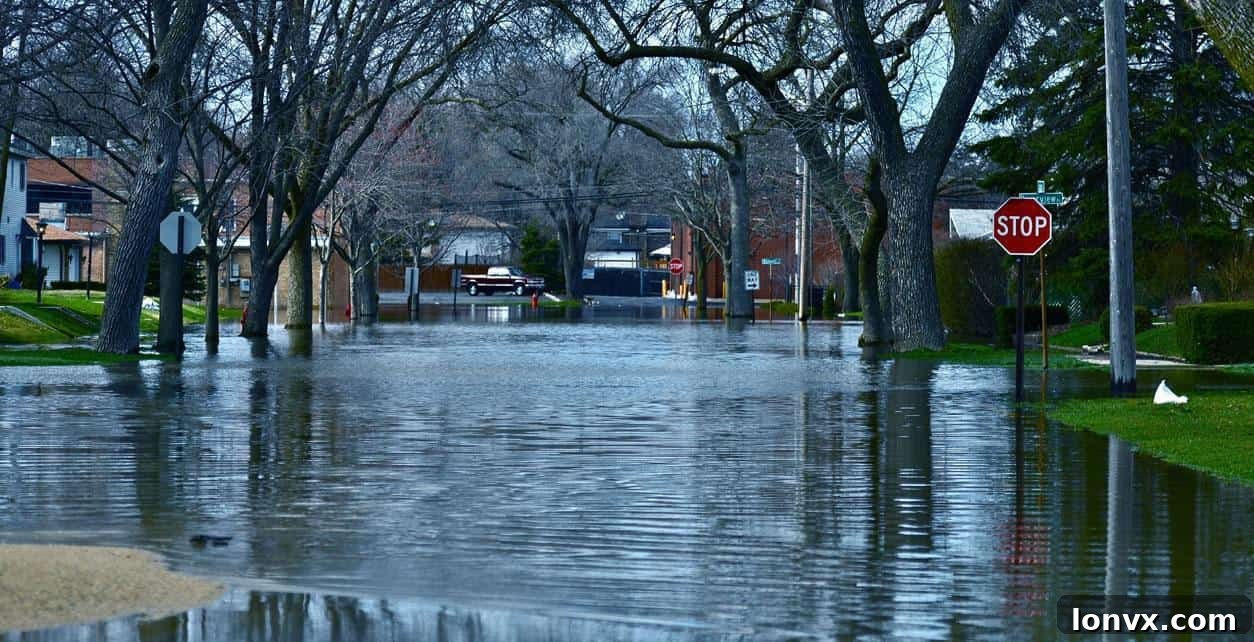
The escalating impacts of climate change are increasingly reshaping not just our environment, but also the fundamental aspects of our daily lives, including where and how we live. A recent pivotal study sheds stark light on one of these profound shifts, revealing how catastrophic flooding actively suppresses housing prices, diminishes the supply of homes for sale, and dramatically extends the time properties spend on the market. This detailed analysis underscores the urgent need for a paradigm shift in how Canada addresses its burgeoning flood risk.
The comprehensive report, aptly titled Treading Water: Impact of Catastrophic Flooding on Canada’s Housing Market, presents compelling evidence of these trends. Over an eight-year investigative period, the study found that major flood events across five key Canadian cities resulted in an alarming average reduction of 8.2 per cent in the final sale price of affected homes. Beyond just price depreciation, the ripple effects were widespread: a significant 44.3 per cent reduction in the number of houses listed for sale, indicating a hesitant or damaged market, and a substantial 19.8 per cent increase in the average number of days it took for a house to sell, pointing to a severe slowdown in market activity and buyer confidence.
Conducted by the esteemed Intact Centre on Climate Adaptation at the University of Waterloo, the research meticulously examined housing market dynamics following major flood occurrences between 2009 and 2020. The study focused on diverse geographic locations, including Grand Forks, British Columbia; Burlington, Ontario; Toronto, Ontario; Ottawa, Ontario; and Gatineau, Quebec. This broad scope allowed researchers to capture a representative understanding of flood impacts across various urban and rural Canadian settings, ensuring the findings possess significant national relevance.
The methodology employed was rigorously designed to isolate the true impact of flooding. Researchers measured changes in housing market metrics over a critical six-month period both preceding and following each flood event. To accurately attribute these changes to flooding, rather than other market fluctuations, the study compared the data from flood-affected areas with that of nearby, non-flooded control communities over identical time frames. This comparative analysis strengthens the credibility of the report’s conclusions, demonstrating a direct causal link between flood events and adverse housing market outcomes.
“The most costly impact of climate change affecting Canadians is residential basement flooding that is often made worse through poor land-use planning and management,” states the report. This statement highlights a critical interplay between natural phenomena and human decision-making, emphasizing that while climate change intensifies flood risks, inadequate planning exacerbates the damage. It signals that solutions must encompass both environmental adaptation and smarter urban development.
The report further elaborates on the scale of the challenge: “With about nine per cent (3.3 million) and 11 per cent (3.9 million) of the Canadian population residing in one-in-100 and one-in-200-year floodplains, respectively, these percentages are expected to increase as floodplains expand in response to more extreme precipitation driven by climate change . . . and to the loss of natural infrastructure (forests, grasslands and wetlands that act as ‘sponges’).” These statistics paint a sobering picture of current vulnerability, which is only projected to worsen. The expansion of floodplains is not just an abstract concept; it means more homes and communities previously considered safe will fall within high-risk zones. This expansion is directly linked to the increased frequency and intensity of extreme weather events, a hallmark of climate change, alongside the alarming degradation of natural landscapes that historically offered protection. Forests, grasslands, and wetlands play an indispensable role as natural sponges, absorbing vast quantities of water and slowing down runoff, thereby mitigating flood impacts. Their destruction leaves communities more exposed.
Moreover, the study points out that “outside the boundary of floodplains, residential flooding is impacting an increasing number of homes and communities due to high-intensity precipitation events – referred to colloquially as ‘water bombs’ – that render historically safe communities vulnerable to flooding.” This phenomenon, often termed “urban flooding” or “flash flooding,” occurs when localized, intense rainfall overwhelms existing drainage systems, leading to widespread inundation even in areas not traditionally considered flood-prone. This challenges conventional flood mapping and risk assessment, requiring a broader, more dynamic approach to flood resilience.
Chris Chopik
Chris Chopik, a distinguished Realtor with Sotheby’s International Realty Canada in Toronto and a valuable contributor to the study, provided crucial real-world context to the academic findings. He explained that the research meticulously examined not only areas directly impacted by flooding but also adjacent communities, recognizing that the ripple effects of such events extend beyond immediate inundation zones. This holistic approach ensures a more complete understanding of market dynamics in the aftermath of a flood.
Chopik acknowledged the resilience of the market, stating, “These markets, they recover. They’re not stuck there.” However, he quickly tempered this with the study’s concrete data: “We’re measuring what happened and on average across five Canadian flood-affected cities, from catastrophic loss the average is an 8.2 per cent drop (in prices).” This distinction is critical; while markets may eventually stabilize, the immediate and significant financial consequences for homeowners and the local economy are undeniable and measurable. The recovery often comes at a substantial cost to those directly affected, both financially and emotionally.
Emphasizing the undeniable reality of these findings, Chopik asserted, “The key message is that this is actually happening. It’s not hyperbole. It’s not like, ‘oh, Chris is making some wild claims that flood is affecting real estate values’. This is an academic university that did the math and what they discovered is that it takes longer to sell, there are fewer properties available and the price comes down after a flood event, after a catastrophic loss event.” This statement directly challenges any skepticism, grounding the discussion in verifiable academic research. The triple whammy of longer selling times, reduced inventory, and lower prices collectively paints a grim picture for sellers in flood-affected regions, transforming what would typically be a straightforward transaction into a protracted and potentially loss-making ordeal.
Looking ahead, Chopik articulated a proactive stance: “And in some markets, where this is going to be a persistent, on-going problem, that marketplace will have to reconcile its choice of path.” This suggests that passive acceptance of flood risk is no longer viable. Instead, communities prone to recurring floods must critically re-evaluate their approaches to urban planning, infrastructure development, and building standards. Such reconciliation could involve significant investments in upgrading existing building codes and enhancing building practices to render houses in these vulnerable neighbourhoods more flood-resilient. This might include elevating foundations, installing flood vents, using water-resistant materials, and ensuring quicker recovery mechanisms after an event. These measures are not just about protecting property; they are about safeguarding community stability and economic vitality in the face of an evolving climate threat.
A long-standing advocate for greater transparency and data accessibility, Chopik reiterated a crucial need: “I’ve been advocating for years that the government create a flood map that allows real estate practitioners to teach our clients about the risk and to learn ourselves. You should be able to put an address into a field on the internet and get a result which says this site is at risk of a one-in-100-year flood or at risk of one-in-10-year flood (or that it) has been flooded, is going to flood.” The absence of publicly accessible, granular flood risk maps in Canada poses a significant barrier to informed decision-making for buyers, sellers, lenders, and insurers alike. Such maps would empower individuals to understand the specific risks associated with a property, facilitating better planning, appropriate insurance coverage, and ultimately, more resilient communities. Without them, buyers may inadvertently purchase homes in high-risk areas, leading to unforeseen financial burdens and emotional distress.
The study also extended its analysis to the financial sector, examining the impact of community-level flooding on mortgage arrears and deferrals in two Canadian cities over six months before and after flood events. Encouragingly, results showed no immediate change in homeowners’ ability to consistently meet their mortgage payments. This suggests that in the immediate aftermath, support systems or personal financial resilience might cushion the blow. However, a more subtle, yet equally significant, finding emerged: a quantifiable reduction in the appraised value of a house due to flooding. This reduction, while not directly impacting payment ability, would invariably influence limits on lending by mortgage providers. Lenders assess property value to determine loan-to-value ratios and collateral risk. A lower appraisal could restrict access to capital for repairs, impede refinancing options, or even make it harder for potential buyers to secure mortgages in affected areas, creating a chilling effect on local real estate markets and perpetuating the cycle of depressed property values.
In response to these critical findings, the report outlines a series of actionable recommendations designed to provide Canadians with clear guidance on how to effectively limit flood risk and build more resilient communities. These recommendations span various levels of government, industry, and individual action, underscoring the necessity of a multi-faceted and collaborative approach.
Home Flood Protection Guidance
To empower individual homeowners, the report strongly recommends that municipalities, banks, insurers, and real estate associations collaboratively distribute comprehensive guidance on practical means to lower the risk of basement flooding. This guidance should be clear, accessible, and actionable, covering measures such as proper lot grading, ensuring downspouts drain away from foundations, installing sump pumps with battery backups, backwater valves to prevent sewer backup, and elevating critical appliances. Proactive homeowner action, informed by reliable guidance, is a crucial first line of defense against residential flooding.
Climate Adaptation Home Rating Program (CAHRP)
The federal government is urged to establish and link a Climate Adaptation Home Rating Program (CAHRP) to existing EnerGuide home energy audits. Just as EnerGuide rates homes for energy efficiency, CAHRP would assess and rate properties based on their resilience to climate impacts, including flood risk. Integrating this with EnerGuide would streamline the assessment process, incentivize homeowners to adopt adaptation measures, and provide valuable information to buyers, sellers, and insurers about a home’s overall climate resilience, fostering a market that values sustainability and protection.
Flood Risk Maps
A fundamental recommendation is for the federal government to update existing flood risk maps and, crucially, ensure they are publicly accessible. Accurate, up-to-date flood maps are indispensable tools for urban planners, emergency services, insurers, real estate professionals, and the general public. They provide essential data for land-use planning, inform building codes, guide infrastructure investments, and empower individuals to make informed decisions about where to live, purchase insurance, and implement protective measures. Transparency in flood risk mapping is a cornerstone of effective flood management.
Residential Flood Risk Scores
Building on the need for better data, the report advocates for the federal government to develop a home flood-risk scoring system based on postal codes, similar to systems already successfully implemented in the U.S. Such a system would offer a standardized, easily digestible metric of flood risk for every property. This scoring could be integrated into real estate listings, mortgage applications, and insurance assessments, allowing for data-driven risk pricing and promoting greater awareness among all stakeholders about localized flood vulnerabilities.
Natural Infrastructure
Recognizing the immense value of ecological solutions, the report calls upon all levels of government to commit to retaining and restoring natural infrastructure, including forests, grasslands, and wetlands. These natural systems serve as critical protective buffers, absorbing excess water, filtering pollutants, and mitigating erosion. Investing in their preservation and restoration is a cost-effective, long-term strategy to limit both current and future flood risk, fostering not only flood resilience but also broader ecosystem health and biodiversity.
Community Flood Risk Mitigation
Finally, the study stresses that communities themselves must act now to identify and proactively protect areas at high risk of flooding. This involves comprehensive risk assessments, developing and implementing flood mitigation strategies, such as green infrastructure (e.g., permeable pavements, rain gardens), improving storm sewer capacities, establishing early warning systems, and implementing appropriate land-use zoning. Proactive community-level mitigation saves lives, protects property, and significantly reduces the economic and social costs of future flood events.
Reflecting on the overarching message, study co-author Blair Feltmate encapsulates the imperative: “Canada must learn to manage flood risk, rather than chase it. Recognizing that residential flooding is the most costly and pervasive impact of extreme weather, municipal planners should double-down on ensuring that adaptation factors into community design.” This statement serves as a powerful call to action, urging a fundamental shift from reactive emergency response to proactive risk management and adaptation. The economic and social well-being of Canadian communities hinges on the collective ability to integrate climate adaptation directly into the fabric of urban and regional planning, building a more resilient future for generations to come.