
Ontario Housing Market Shifts: Widespread Underbidding Emerges Outside the GTA
The dynamic landscape of Ontario’s real estate market is undergoing a notable transformation, presenting both challenges and opportunities for buyers and sellers alike. A recent comprehensive report from Wahi, a leading digital real estate platform, reveals a significant trend: underbidding on homes is now prevalent across a majority of Ontario’s largest cities located outside the Greater Toronto Area (GTA). This shift marks a departure from the frenzied bidding wars that characterized previous years, indicating a more balanced, and in some areas, a buyer-friendly market.
Last month, a striking eight out of Ontario’s ten largest cities, excluding the densely populated GTA, reported instances of median sale prices falling below median list prices. This widespread phenomenon points to a market recalibration, where buyers are gaining more leverage in negotiations. The report highlights Barrie, Guelph, and Hamilton as frontrunners in this trend, with median sale prices in these cities bid down by a notable three percent when compared to their initial median list prices. This data underscores a shift in buyer sentiment and purchasing power, influenced by evolving economic conditions.
Unpacking the Underbidding Trend in Major Ontario Cities
The cities of Barrie, Guelph, and Hamilton, traditionally robust markets that have seen significant growth in recent years, are now experiencing this pronounced underbidding. A three percent reduction from the median list price to the median sale price represents a tangible benefit for prospective buyers, translating into substantial savings on a significant investment like a home. This trend is likely fueled by several factors, including increased inventory, a more cautious buyer pool, and the palpable impact of higher interest rates on affordability. Buyers in these areas are demonstrating a newfound willingness to negotiate, and sellers are adapting to a market that no longer guarantees multiple, aggressive offers.
For potential homeowners, this environment offers a unique window of opportunity. The ability to purchase below asking price allows for greater financial breathing room, potentially offsetting some of the increased costs associated with higher mortgage rates. It also signifies a move towards a more rational market, where pricing is more aligned with perceived value and current economic realities rather than speculative demand.
Pockets of Overbidding: The Exception to the Rule
While underbidding dominates much of Ontario, two cities within the Regional Municipality of Waterloo, Kitchener and Cambridge, stand out as exceptions, continuing to experience overbidding conditions. This divergence highlights the unique economic and demographic factors at play within specific regional markets. The Waterloo Region, known as a burgeoning tech hub, continues to attract significant investment and population growth, which likely sustains robust housing demand. The strong local job market, coupled with ongoing development, may insulate these cities from the broader underbidding trend seen elsewhere.
Wahi’s digital real estate platform employs a precise methodology to identify these market dynamics, meticulously comparing the differences between median list and sold prices across all home types. This granular analysis provides invaluable insights, allowing both buyers and sellers to navigate the complexities of their local markets with greater confidence. Understanding these localized variations is crucial, as a blanket assumption about the entire Ontario market could lead to missed opportunities or unrealistic expectations.
A Closer Look at Neighbourhood Dynamics and Market Reversals
The underbidding trend extends deep into the fabric of local communities, with Wahi’s report indicating that last month, a staggering 209 neighbourhoods—representing 74 percent of all analyzed areas—were being underbid. While this figure is substantial, the report also notes that it marked the smallest month-over-month increase in underbid neighbourhoods for the year, at just three percent. This might suggest a potential stabilization of the underbidding trend, or perhaps a saturation point where the majority of susceptible markets have already transitioned. Regardless, the sheer volume of underbid neighbourhoods underscores a fundamental shift in market power towards buyers.
Further compounding this shift is the significant reversal observed in GTA neighbourhoods. Historically characterized by intense overbidding, the GTA is now mirroring the broader provincial trend. In June, 35 percent of GTA neighbourhoods were selling below asking price, a figure that dramatically increased by 14 percent between July and August. This rapid change within the GTA, a market segment long considered immune to such downturns, signals a widespread correction. The once-unthinkable notion of negotiating prices down in Toronto and its surrounding areas is now becoming a tangible reality for many buyers, marking a pivotal moment in Canada’s most competitive housing market.
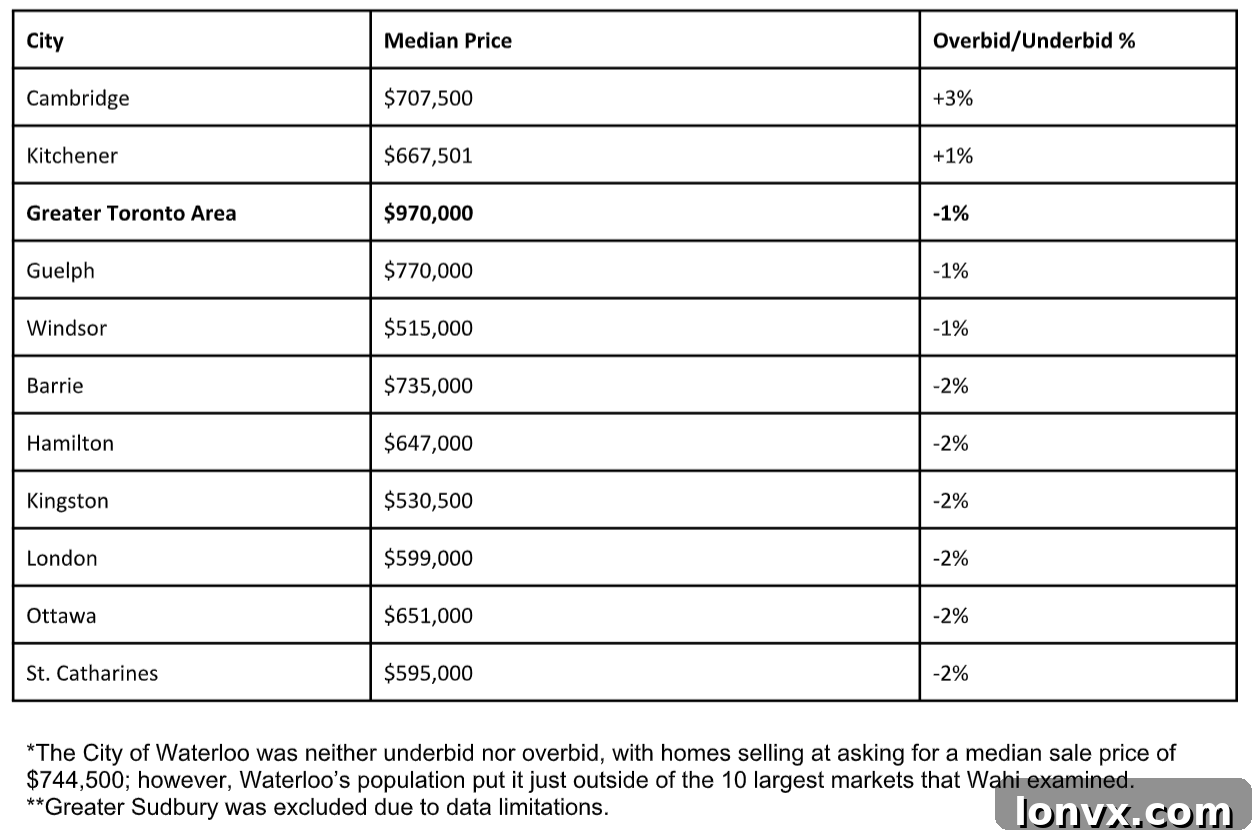
Source: Wahi
Expert Perspectives: Seizing Opportunities in a Shifting Market
Benjy Katchen, CEO of Wahi, offers crucial insights into this evolving market. “The effects of higher interest rates are being felt in real estate markets across southern Ontario,” he states, acknowledging the primary driver behind the current trends. Higher interest rates directly impact mortgage affordability, increasing monthly payments and tightening qualification criteria. This forces many potential buyers to either reconsider their budgets or put their purchasing plans on hold, thereby reducing overall demand and softening prices.
However, Katchen also points to the silver lining for a specific segment of buyers: “That said, for homebuyers who are able to afford the higher monthly mortgage payments in the near term, now could be a great time to potentially purchase a home due to having a greater selection of properties for sale and potentially being able to cut a sharper deal than just a few months ago.” This advice is particularly pertinent for well-capitalized buyers, those with substantial down payments, higher incomes, or fewer financial constraints. These individuals are now encountering a market with more inventory and less competition, allowing for strategic purchases and more favorable negotiations. The extended time on market for many properties gives buyers the luxury of choice and the power to negotiate on terms and price, a stark contrast to the rush of previous years.
Katchen further advises prospective buyers to “Make sure you really understand the data and bidding dynamics in your desired area.” This emphasizes the importance of granular market research and partnering with knowledgeable real estate professionals who can provide localized insights. Given the regional variations, what holds true for Barrie might not apply to Kitchener, making precise market understanding invaluable. Furthermore, he recommends: “You might also want to consider looking outside the GTA. Not only are the vast majority of the biggest southern Ontario cities outside the GTA in underbidding territory, a number of them are also considerably more affordable.”
This counsel highlights the significant value proposition offered by cities beyond the GTA. These areas not only present more opportunities for underbidding, indicating a buyer’s market, but also come with lower average price points. For many, the prospect of owning a detached home in a vibrant community just an hour or two outside Toronto, often at a fraction of the GTA price, becomes a much more attainable dream. These regions offer a blend of affordability, community amenities, and often, a better quality of life for those willing to consider a slightly longer commute or a different lifestyle.
Navigating the New Real Estate Paradigm: A Look Ahead
The prevailing underbidding trend across much of Ontario signifies a significant recalibration of the provincial housing market. This shift, primarily driven by sustained higher interest rates and a cooling of speculative demand, is transforming what was once a red-hot seller’s market into a more balanced, and in many instances, a buyer-favorable environment. While some regions, like Kitchener and Cambridge, maintain their resilience through unique economic strengths, the broader picture points to increased negotiating power for purchasers.
For strategic buyers, this period represents a unique opportunity to enter the market or upgrade their homes under more favorable conditions. The abundance of choice, coupled with the potential to secure properties below asking price, offers a significant advantage. However, understanding the nuances of individual markets and staying informed about local bidding dynamics remains paramount. As the market continues to adapt to ongoing economic pressures, both buyers and sellers must remain agile and well-informed to navigate the evolving landscape successfully. The days of guaranteed multiple offers may be behind us for a while, ushering in an era where careful consideration and strategic planning are key to real estate success in Ontario.
Enjoying this article?
Get the latest REM articles in your inbox 3x week so you stay up to date on the latest in the Canadian real estate industry