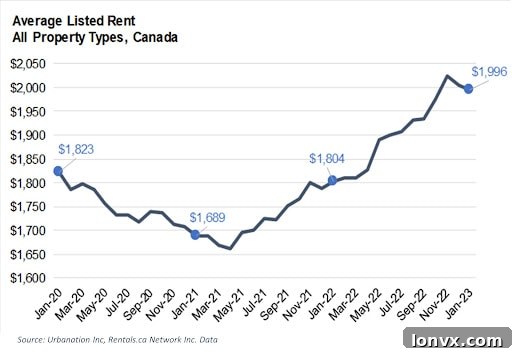
The Canadian rental market continued its upward trajectory in January, with the average listed rent for all property types across the country soaring by an impressive 10.7 per cent year-over-year. This marks the ninth consecutive month of double-digit increases, a clear indicator of sustained pressure on renters nationwide. The latest national rent report, a collaborative effort by Rentals.ca and Urbanation, paints a picture of a robust and increasingly competitive market, challenging affordability for many.
While the annual growth remains strong, the average listed rent did see a slight month-over-month dip in January, settling at $1,996. This represents a 0.5 per cent decrease from December, after consistently staying above the $2,000 mark for the preceding two months. Despite this minor monthly fluctuation, the longer-term trend highlights a significant escalation in rental costs. Compared to the pre-pandemic average rent of $1,823 recorded in January 2020, current rents in Canada have surged by 9.5 per cent, equating to an average annual increase of 3.2 per cent over the past three years. This persistent rise underscores the evolving dynamics within the Canadian housing sector, impacting individuals and families seeking stable accommodation.
Understanding the Dynamics: Low Supply and Rising Demand Fueling Canada’s Rental Crisis
The Canadian rental market’s journey into 2023 mirrored its exit from 2022, characterized by a potent cocktail of low housing supply and rapidly escalating demand. Shaun Hildebrand, president of Urbanation, succinctly summarized the situation: “The Canadian rental market started 2023 where it ended in 2022, posting sharp annual rent growth amid low supply and quickly rising demand.” This fundamental imbalance continues to be the primary driver behind the persistent rent hikes observed across the nation.
The demand side of this equation is bolstered by several factors. Canada’s ambitious immigration targets mean a steady influx of newcomers, many of whom initially enter the rental market. Furthermore, inter-provincial migration, particularly towards provinces offering greater economic opportunities or a perceived better quality of life, further intensifies competition in specific regions. Exacerbating this is the current interest rate environment, which has made homeownership increasingly unattainable for many Canadians, pushing more potential buyers into the rental pool. This confluence of factors places immense pressure on an already constrained housing inventory.
On the supply front, the pace of new housing construction, particularly rental units, has struggled to keep up with this burgeoning demand. Challenges such as high construction costs, labor shortages, lengthy approval processes, and zoning restrictions continue to impede the delivery of new housing units. This gap between the number of available rental properties and the sheer volume of prospective tenants creates a fiercely competitive environment, allowing landlords to command higher prices. While Toronto has traditionally been a focal point for rent discussions, Hildebrand highlighted a crucial shift: “Outside of Toronto, rent increases are becoming more acute in markets in B.C. and Alberta, which are experiencing relatively strong rates of population growth.” This signals a broader geographical spread of the rental crisis, moving beyond the traditional major urban centers and impacting a wider range of Canadian communities.
City Spotlight: Canada’s Most Expensive Rental Markets
Vancouver: Leading the Charge in Rental Costs
Consistently holding its position at the pinnacle of Canada’s most expensive rental markets, Vancouver once again topped the list of 35 cities for average monthly rent in January. The bustling West Coast metropolis continues to set benchmarks for rental costs, reflecting its desirability, strong job market, and limited housing supply within a geographically constrained area. For prospective tenants, finding affordable housing in Vancouver remains a significant challenge, with prices climbing steadily across all property types.
In January, the average monthly rent for a one-bedroom apartment in Vancouver reached a staggering $2,730. This figure represents a substantial year-over-year increase of 24.2 per cent, demonstrating the intense competition and soaring demand in the city. Similarly, two-bedroom units saw their average monthly rent hit $3,624, an impressive 20.9 per cent increase compared to January of the previous year. These significant annual jumps highlight the rapid appreciation of rental properties in one of Canada’s most sought-after urban centers.
Looking at month-over-month changes, Vancouver’s rental market showed continued upward momentum. The average rent for a one-bedroom home in January rose by 5.2 per cent from December, while two-bedroom units experienced a 1.7 per cent increase. These monthly gains, even on already high base prices, underscore the persistent upward pressure on Vancouver’s rental market, making it an increasingly difficult city for many to afford.
Toronto: A Close Second in High Rental Prices
Toronto, Canada’s largest city and economic powerhouse, firmly secured its spot as the second most expensive rental market among the 35 cities surveyed. The Greater Toronto Area (GTA) continues to be a hotbed of rental activity, driven by robust population growth, a thriving job market, and a persistent shortage of housing options. For many navigating the Toronto rental landscape, the quest for affordable accommodation is an ongoing battle, as rental prices continue to escalate year after year.
In January, the average monthly rent for a one-bedroom apartment in Toronto stood at $2,458, placing it second only to Vancouver. This represents a significant 20.8 per cent increase year-over-year, showcasing the intense demand within the city. For those seeking more space, two-bedroom units commanded an average monthly rent of $3,227, also ranking second nationally, and reflecting a 17.2 per cent rise from January of the previous year. These figures underscore the considerable financial commitment required to secure housing in Toronto’s competitive market.
The sustained double-digit growth in both one-bedroom and two-bedroom rental categories highlights the enduring appeal of Toronto as a destination for professionals, students, and new immigrants. However, it also brings into sharp focus the escalating housing affordability crisis that many residents, particularly those with moderate incomes, are grappling with. The consistent upward pressure on rents indicates that without a substantial increase in supply, Toronto’s rental market will likely remain one of the most challenging in the country.
Montreal: Steadily Rising, Yet More Accessible
While not experiencing the same meteoric rises as its Western and Central Canadian counterparts, Montreal’s rental market continued its steady ascent in January. The vibrant Quebecois metropolis, known for its unique cultural offerings and educational institutions, remains a comparatively more accessible option than Vancouver or Toronto, though affordability is becoming an increasing concern for residents. Montreal ranked 24th for average monthly rent for a one-bedroom home at $1,624 and 21st for a two-bedroom at $2,124 among the 35 cities evaluated.
Despite its lower ranking, Montreal’s rental prices are undeniably on an upward trend. Year-over-year, the average monthly rent for a one-bedroom apartment in January saw a 7.6 per cent increase, while two-bedroom units experienced a 7.7 per cent rise. These increases, while not in the double-digits seen elsewhere, are significant and reflect growing demand in the province’s largest city. Factors contributing to this growth include a healthy job market, a thriving student population, and a renewed interest from inter-provincial migrants.
The relatively slower but consistent growth in Montreal indicates a market that is still more balanced than those in BC and Ontario. However, if current trends persist, Montreal could face similar affordability challenges in the coming years. Policymakers and developers will need to monitor these trends closely to ensure that the city remains an attractive and livable option for a diverse range of residents, balancing demand with an appropriate supply of new rental housing.
Condo Rentals and Apartments: A Key Driver of Rent Growth Across Major Markets
The segment of condominium rentals and apartments has emerged as a particularly strong driver of rental price increases across Canada’s largest rental markets. These property types often represent a significant portion of urban rental inventory, and their performance offers a clear snapshot of broader market health and demand. In January, several major cities reported substantial annual growth in average rents for condo rentals and purpose-built apartments, reflecting intense competition among renters.
Among Canada’s six largest rental markets, Vancouver and Calgary led the pack with the highest increases. Vancouver experienced an impressive 22.9 per cent annual growth in average rent for condominium rentals and apartments, underscoring the city’s overall rental market pressures. Calgary was not far behind, with a robust 22.7 per cent annual increase, signaling a rapidly strengthening market in Alberta’s largest city. Toronto, consistently a high-demand market, saw its condo rental and apartment rents climb by 20.8 per cent annually in January, further cementing its status as one of Canada’s most challenging rental environments.
Other major markets also reported significant, albeit slightly more moderate, increases. Average annual rents for condo rentals and apartments in Ottawa rose by 11.5 per cent in January, indicating steady growth in the nation’s capital. Edmonton experienced a 9.3 per cent increase in average rents, reflecting a solid market that is becoming increasingly competitive. Montreal, while generally more affordable than its Western counterparts, still saw average rents for condo rentals and apartments rise by a healthy 7.9 per cent annually. These figures collectively highlight a nationwide trend of rising rental costs, particularly within the condo and apartment sectors, which are often the entry point for many new renters and a crucial part of the urban housing ecosystem.
The Rise of Medium-Sized Cities: Spillover Effects and New Rental Hotbeds
The ripple effect from Canada’s major urban centers is increasingly evident in the rental markets of medium-sized cities. These communities, often located in close proximity to economic hubs or offering a more perceived affordable lifestyle, are now experiencing some of the most dramatic rent increases. As affordability becomes a pressing concern in cities like Vancouver and Toronto, many renters are looking to surrounding medium-sized markets, inadvertently transferring demand and driving up prices.
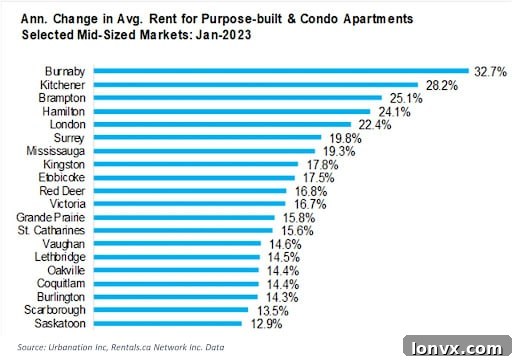
Among 20 medium-sized cities analyzed, Burnaby, British Columbia, recorded the highest average annual rent increase for condo rentals and apartments, surging by an astounding 32.7 per cent in January. This significant jump underscores the intense demand in the Greater Vancouver Area and the spillover effect from Vancouver’s prohibitive costs. Kitchener, Ontario, a rapidly growing tech hub, followed closely with average rents up 28.2 per cent year-over-year for condo rentals and apartments, reflecting its booming economy and expanding population. Brampton, another key city in the Greater Toronto Area (GTA), saw its average rents in January climb by 25.1 per cent, while Hamilton experienced a 23.1 per cent increase. London, Ontario, rounded out the top five with average annual rents increasing by 22.4 per cent for condo rentals and apartments.
The January report also highlighted new entrants and rapidly growing areas within the top 20 for annual rent increases for condominium rentals and apartments. These include Red Deer (16.8 per cent) and Grande Prairie (15.8 per cent) in Alberta, indicating the strengthening rental market in that province. In Ontario, Vaughan (14.6 per cent), Oakville (14.4 per cent), and Coquitlam (14.4 per cent) also demonstrated significant growth, further emphasizing the widespread nature of rental pressures in the GTA and parts of BC. These figures illustrate a clear trend: the rental crisis is no longer confined to just the largest cities but is actively reshaping the housing landscape of secondary markets.
When it comes to the most expensive medium-sized rental markets, a clear geographical concentration emerges. The top three most expensive cities for average rents in January for condo rentals and apartments were all in British Columbia: Burnaby ($2,947), Coquitlam ($2,680), and Richmond ($2,636). Following these, the next six most expensive medium-sized rental markets were exclusively located within the Greater Toronto Area: Vaughan ($2,581), Oakville ($2,549), Etobicoke ($2,541), Mississauga ($2,510), Brampton ($2,466), and Burlington ($2,418). Remarkably, all of the top 20 most expensive medium-sized rental markets were found in either British Columbia or Ontario, showcasing the dominant influence of these two provinces on Canada’s overall rental affordability challenges.
Provincial Overview: Alberta Leading Rent Growth, Yet Remaining Relatively Affordable
A provincial breakdown of rental trends reveals distinct patterns across Canada, with Alberta emerging as a surprising leader in annual rent growth for condo rentals and apartments in January. The province experienced a robust 14.6 per cent increase, closely followed by British Columbia at 14.4 per cent. This surge in Alberta signals a rapidly heating market, driven by factors such as inter-provincial migration and a strengthening economy, particularly in its major urban centers.
Ontario, home to some of the country’s most expensive cities, placed third with average annual rents up 13.5 per cent, continuing its trend of significant rental appreciation. Nova Scotia, a province that has seen considerable population growth in recent years, also reported strong increases, with average annual rents for condos and apartments rising by 12.3 per cent in January, indicating growing demand in the Maritimes.
Further west, Saskatchewan experienced a nine per cent increase in average annual rents in January. Quebec, with its unique market dynamics, saw average annual rents rise by 7.6 per cent, while Manitoba’s rents increased by seven per cent annually. These figures highlight a nationwide pattern of rising rental costs, though the pace and scale vary significantly from province to province.
Despite leading in annual growth, the report underscores a crucial point about Alberta’s rental market: it remains relatively affordable compared to its Western neighbor. The average rent for condos and apartments in Alberta was $1,435 in January. Breaking this down, one-bedroom units averaged $1,271, and two-bedroom units averaged $1,595. This affordability, coupled with strong economic prospects, makes Alberta an attractive destination for many looking to escape the higher costs of living in other provinces.
In stark contrast, average rents in British Columbia were 72 per cent higher than in Alberta, standing at $2,471. One-bedroom units in BC averaged $2,163, and two-bedroom units averaged $2,769, illustrating the immense cost disparity between the two provinces. Ontario’s apartment rents, while high, were on average five per cent cheaper than in B.C. at $2,341. One-bedroom units in Ontario averaged $2,130, and two-bedroom units averaged $2,573. This provincial comparison clearly demonstrates the varying degrees of rental market pressures and affordability challenges across Canada, with BC and Ontario standing out as the most expensive regions.
Saskatchewan: Canada’s Most Affordable Provincial Rental Market
In contrast to the high-cost markets dominating the headlines, Saskatchewan maintained its position as the least expensive province for renters in January. This Western province offers a significant reprieve for those seeking more affordable accommodation, making it an attractive option for individuals and families on a tighter budget. The average rent across all property types in Saskatchewan stood at $1,087, providing a stark contrast to the national average and the much higher figures seen in provinces like British Columbia and Ontario.
Breaking down the provincial averages, one-bedroom units in Saskatchewan commanded an average of $998 in January, making it one of the few places in Canada where average one-bedroom rents remain below the $1,000 mark. Two-bedroom units were also considerably more affordable, averaging $1,167. These figures highlight a market that, while experiencing growth, still offers substantial value compared to the rest of the country.
Even within this affordable market, rental prices are on the rise. One-bedroom average annual rents for condo rentals and apartments increased by 10.1 per cent in January to an average of $1,739. Two-bedroom average annual rents rose by 9.9 per cent to an average of $2,103 in January. Studios recorded an 8.7 per cent annual increase in average rents, reaching an average of $1,426. For larger families or those needing more space, three-bedroom average annual rents were up 5.7 per cent to an average of $2,364 for condo rentals and apartments in January. While these increases are notable, Saskatchewan’s overall price point positions it as a vital option for maintaining rental accessibility in Canada.
The January 2023 national rent report underscores a critical period for Canada’s housing market. Persistent double-digit rent growth, driven by a severe imbalance between supply and demand, continues to challenge affordability nationwide. While major urban centers like Vancouver and Toronto remain the most expensive, the rapid escalation in medium-sized cities and provinces like Alberta signals a widening scope of the rental crisis. Understanding these trends is paramount for policymakers, developers, and renters alike as Canada navigates this evolving landscape.
For a comprehensive understanding of these trends, including a detailed regional breakdown, read the full rental report here.