
The Canadian housing market has been a rollercoaster for prospective homeowners over the past few years. From the tail end of 2023 through the mid-point of the current year, a window of improved housing affordability emerged for many Canadians. This brief respite was primarily driven by a confluence of favorable economic factors: a notable dip in interest rates, a flattening trend in home prices across various regions, and a consistent increase in average household incomes. These combined elements provided a much-needed breathing room, allowing more individuals and families to entertain the dream of homeownership or to consider upgrading their current residences.
However, this period of enhanced accessibility now appears to be a fleeting memory, largely confined to the “rearview mirror” according to a comprehensive new report from RBC. Robert Hogue, the astute Assistant Chief Economist at RBC, highlights a significant shift in the market dynamics, suggesting that the recent affordability gains may not only be plateauing but could face considerable headwinds moving forward.
The RBC report, accessible here, articulates a cautious outlook: “Further advancement becomes more challenging once interest rates reach a stable plateau as it depends exclusively on home price movements and household income trends. Substantial price declines or robust increasing income would be necessary to drive more meaningful gains.” This statement underscores a critical insight: with interest rates likely to remain steady for the foreseeable future, the onus for improving affordability now rests almost entirely on two other crucial pillars – significant adjustments in home valuations or a sustained surge in household earnings. Without either of these powerful catalysts, the path to broader homeownership affordability will remain steep.
Looking ahead, Hogue’s analysis points to a period of relative stability in pricing across Canada over the next two years. While some regional variations are anticipated, the overarching trend is expected to be flat or exhibit only modest movements. Coupled with this, the projection for wage increases is moderate, meaning that income growth alone may not be sufficient to offset the prevailing housing costs without a more substantial recalibration of property values. This outlook paints a picture of a Canadian housing market settling into a more tempered rhythm after years of rapid fluctuations, albeit one where affordability remains a persistent challenge for many.
Understanding the Shifting Sands of Canadian Housing Affordability
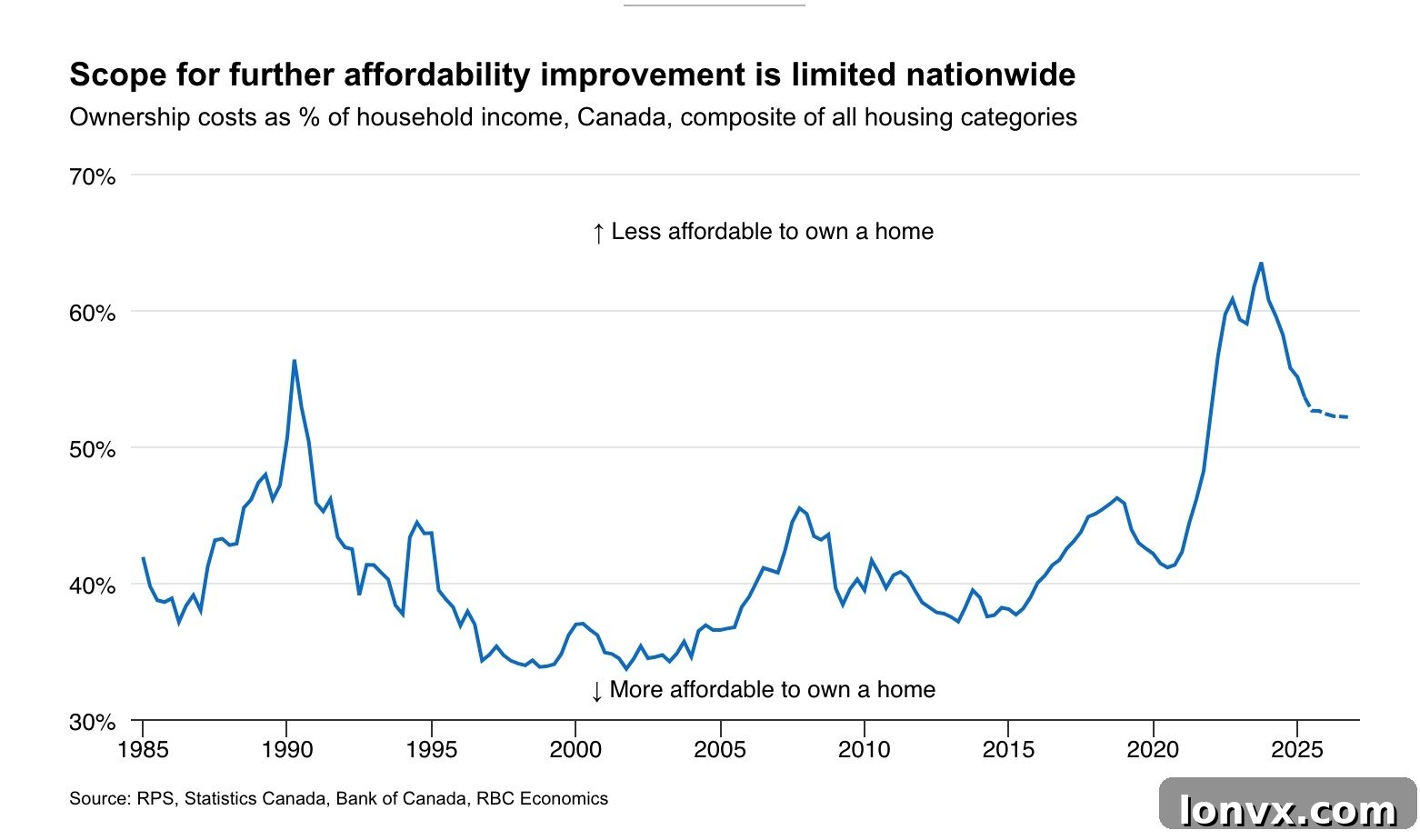
The journey towards homeownership in Canada is intrinsically linked to a delicate balance of economic factors. For a brief period, falling interest rates provided a crucial lever, lowering the cost of borrowing and making mortgage payments more manageable. Simultaneously, a stabilization in home prices, moving away from the aggressive growth seen in previous years, offered a window of opportunity. This was further bolstered by an uptick in household incomes, allowing potential buyers to save more for down payments and qualify for larger mortgages. These three elements converged to create the recent, albeit temporary, improvement in affordability that the RBC report now characterizes as historical.
The challenge now, as interest rates are expected to plateau, is that one of the most powerful tools for enhancing affordability has become less effective. Future gains will demand more dramatic shifts. For instance, a “substantial price decline” would necessitate a significant market correction, potentially driven by an increase in supply or a sustained drop in demand. Conversely, “robust increasing income” implies a period of strong economic growth and wage inflation that outpaces the cost of living and housing. Neither of these scenarios is a given, making the path forward for prospective homebuyers considerably more complex and uncertain. The prevailing sentiment from economic experts like Hogue is that the market is entering a phase where significant improvements in homeownership costs will be hard-won, requiring a sustained effort from both market forces and potentially, policy adjustments.
Purchasing Power Under Threat: A Looming Economic Headwind
Just as the housing market shows tentative signs of finding its footing in some regions, a new and formidable challenge is emerging: the deteriorating health of the Canadian labor market. The RBC report meticulously details how worsening labor market conditions are beginning to exert considerable pressure on household finances, thereby undermining a fundamental pillar of support for aspiring homebuyers. A slowdown in the pace of wage growth threatens to erode the purchasing power of Canadians at a time when they need it most to navigate the complexities of property acquisition.
Over the preceding 18 months, robust household incomes played an indispensable role in fostering the fleeting improvements in housing affordability. Hogue’s analysis reveals that rising earnings were responsible for over a third of the recent decline in RBC’s national aggregate affordability measure. This quantitative evidence clearly signaled a more favorable environment for buyers, effectively offsetting the persistent impact of stubbornly high home prices and elevated borrowing costs. The growth in disposable income provided a critical financial buffer, allowing many to absorb the costs associated with buying and owning a home.
However, that crucial buffer is now observed to be dissipating, according to Hogue’s latest assessment. The Canadian employment landscape has notably weakened, directly impacting the trajectory of income growth. A softening labor market typically translates into fewer job opportunities, slower salary increases, and increased job insecurity, all of which directly impede a household’s capacity to save for a down payment, qualify for a mortgage, and comfortably manage monthly housing expenses. This trend marks a concerning pivot, as one of the key pillars that supported affordability gains is now showing cracks, potentially reversing some of the progress made.
The economic implications of this weakening labor market extend beyond immediate purchasing power. It can influence consumer confidence, leading to delayed housing decisions and a more cautious approach to major financial commitments. For first-time buyers, in particular, a stagnant wage environment makes it exceedingly difficult to accumulate the necessary capital for a down payment, especially in markets where property values remain high. For existing homeowners, slower wage growth might limit their ability to absorb future rate hikes or unexpected financial shocks, adding another layer of fragility to the overall housing ecosystem.
Regional Snapshots: A Diverse Canadian Housing Landscape
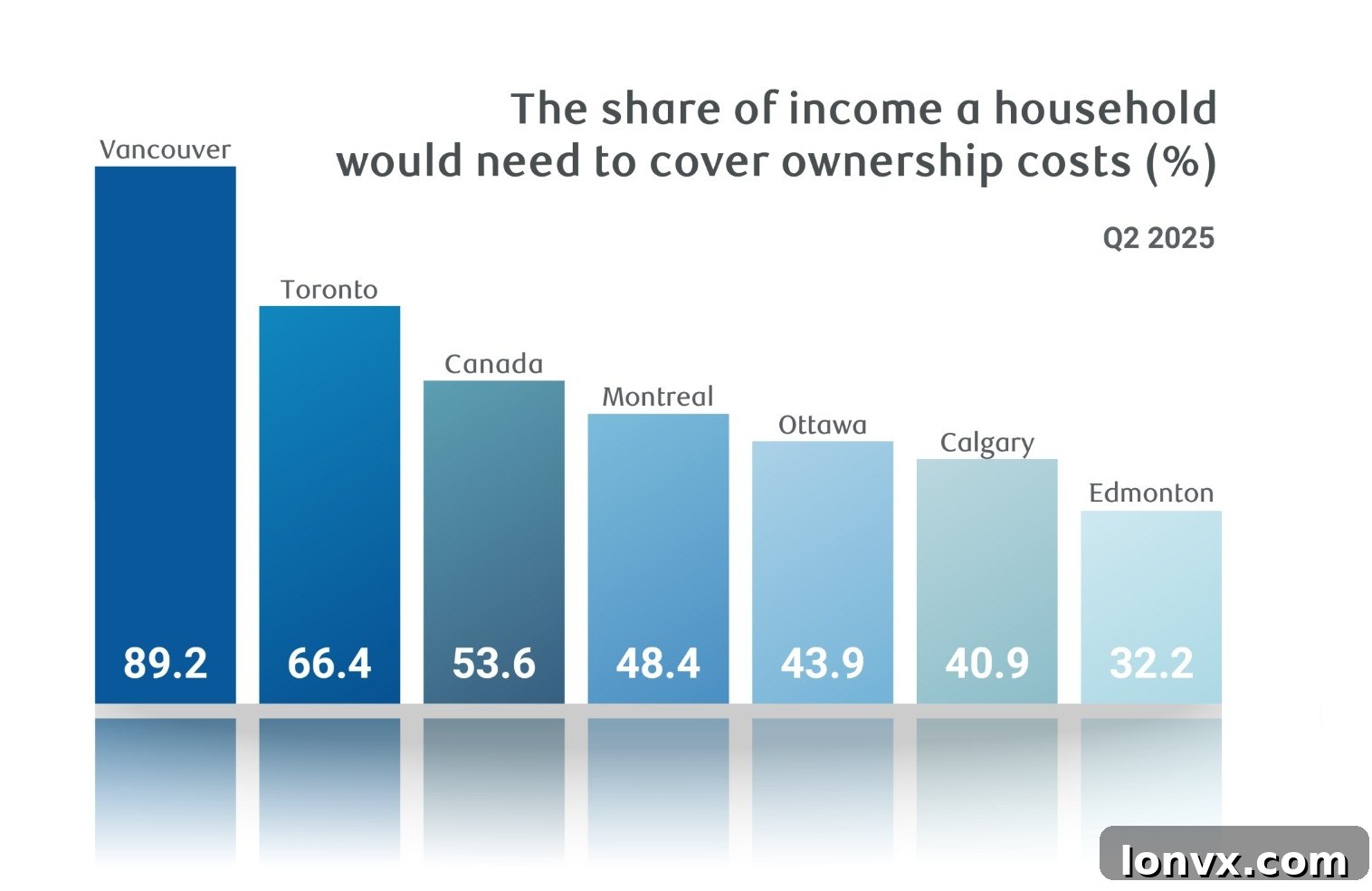
While national trends offer a broad overview, Canada’s vast and diverse geography means that housing market conditions vary significantly from province to province, and even city to city. The RBC report provides critical regional insights, highlighting areas of particular vulnerability and unexpected resilience.
Ontario: Navigating Economic Headwinds
Ontario markets, traditionally bellwethers of the national economy, appear particularly susceptible to the current economic climate. The province’s jobless rate has surged, now standing notably above its pre-pandemic levels and ranking among the highest in Canada. This elevated unemployment rate is a significant concern for the housing sector, as it directly impacts consumer confidence and the financial capacity of potential homebuyers. Fewer people employed, or employed in precarious positions, translates into reduced demand and increased market uncertainty.
Compounding these internal challenges, the ongoing complexities of international trade relations, specifically the “trade war,” continue to exert immense pressure on Ontario’s vital manufacturing base. This sector, a cornerstone of the provincial economy, faces disruptions that ripple across related industries and service sectors, further straining job markets and household incomes. The combination of a high jobless rate and external economic pressures creates a precarious environment for Ontario’s housing market, where any affordability gains are likely to be tenuous and hard-won. Buyers in this region face a double whammy of high housing costs and an uncertain employment future, making their purchasing decisions exceptionally challenging.
Vancouver: The Apex of Unaffordability
According to the RBC report, Vancouver continues to hold the unenviable distinction of having the worst affordability conditions in the entire country. Despite occasional “modest summer gains” in property transactions, the overall market remains suppressed, a stark indicator of the persistent and formidable affordability burdens faced by residents. High property values, coupled with significant borrowing costs, mean that even with minor seasonal upticks, the barrier to entry for many remains prohibitively high.
The outlook for Vancouver suggests further declines in property values are anticipated. This projection is primarily attributed to two critical factors: elevated inventory levels and supply-and-demand conditions that are increasingly favoring buyers. A surplus of available homes, combined with a relatively subdued buyer pool (due to affordability constraints), creates a competitive environment among sellers. This shift in market power gives buyers more leverage, leading to downward pressure on prices as sellers vie for attention. For those who have been priced out, this potential correction, while painful for existing homeowners, could eventually offer a glimmer of hope, though significant improvements in affordability will require sustained trends.
Calgary: A Model of Market Rebalancing
In stark contrast to Vancouver, Calgary’s housing market has experienced a substantial improvement in affordability. This positive trajectory is largely a result of robust construction activity, which has led to a significant increase in new housing supply. The city’s aggressive building pace has successfully brought a substantial volume of properties to the market, addressing previous supply shortages.
Furthermore, Calgary boasts “sky-high inventory levels,” meaning there is an abundance of homes available for purchase. This buyer-friendly environment offers prospective homeowners “lots of options,” ranging from single-family homes to condominiums, across various price points and neighborhoods. This healthy supply-demand dynamic has fostered greater competition among sellers, leading to more stable pricing and a less frenzied purchasing experience. For buyers, this translates into more choice, less pressure, and ultimately, better value for their investment, solidifying Calgary’s position as one of Canada’s more accessible major housing markets. The sustained growth and diversification of its economy also contribute to this stability, attracting new residents and ensuring a healthy demand, but one that is met by ample supply.
Toronto: The Lingering Affordability Puzzle
Toronto’s housing market continues to grapple with a complex interplay of poor affordability and weakening job prospects, creating a challenging landscape for both buyers and sellers. While the ownership cost pressures have noticeably eased over the past year, particularly within the condominium segment, the progress made is deemed insufficient to fully unlock the considerable “pent-up demand” that exists in the metropolitan area.
The easing of costs for condominiums can be attributed to a combination of factors, including a steady stream of new condo developments and potentially a slight recalibration of investor sentiment. However, even with these improvements, the overall cost of homeownership, particularly for detached and semi-detached properties, remains exceptionally high. The concept of “pent-up demand” refers to a large cohort of potential buyers who are willing and able to purchase but are waiting for more favorable market conditions – either significantly lower prices, lower interest rates, or stronger income growth. The report suggests that while some relief has occurred, it hasn’t been enough to bridge the gap for this critical segment of the market, indicating that Toronto’s housing affordability crisis, though perhaps less acute for condos, is far from resolved for the broader market. The ongoing weakness in job prospects further dampens spirits, as even if prices stabilize, the ability to secure and sustain a mortgage becomes more tenuous for many.
Navigating the Future: A Complex Outlook for Canadian Homeownership
The latest insights from RBC’s Robert Hogue paint a nuanced and somewhat cautious picture of Canada’s housing market. The fleeting period of improved affordability, fueled by falling rates and rising incomes, is largely behind us. The path forward is considerably more challenging, heavily reliant on significant adjustments in home prices or a sustained, robust growth in household earnings – neither of which is a guaranteed outcome in the near term.
The weakening labor market, characterized by slowing wage growth and rising unemployment in key provinces like Ontario, poses a significant threat to purchasing power across the country. This economic headwind is set to make homeownership even more difficult for many aspiring buyers, dampening overall market activity. The regional disparities are stark: while Calgary shines as an example of successful market rebalancing through robust supply, major urban centers like Vancouver and Toronto continue to battle entrenched affordability crises, albeit with some subtle shifts in specific segments like condominiums.
For policymakers, these trends underscore the ongoing need for strategic interventions that support sustainable housing supply, address labor market weaknesses, and explore mechanisms to enhance true, long-term affordability rather than relying on transient market corrections. For prospective homebuyers, the message is clear: vigilance and careful financial planning are paramount. The Canadian housing market is entering a phase defined by stability in prices but also persistent challenges in affordability, particularly when viewed through the lens of individual household budgets and uncertain income growth. The dream of homeownership remains vibrant for many, but realizing it will require navigating a complex and evolving economic landscape.